France CV Tips & Format Requirements
Applying for a job in France? This guide has the tips, examples, & format requirements needed to write the perfect French CV. Create your VisualCV today!
France CV Requirements
This section will outline the requirements of a French CV. France has its own set of CV expectations that are distinct from those of other countries.
Browse our gallery of resume examples here.
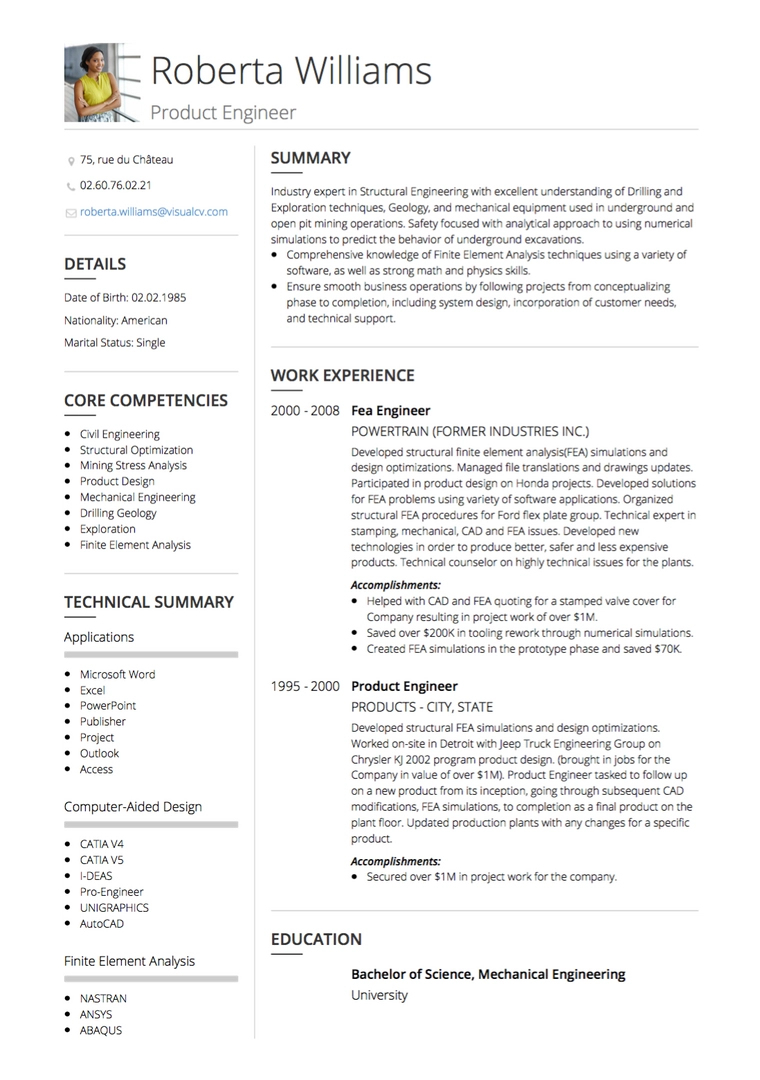
French CV Example

What to Include in a French CV
-
Personal Information (Informations personnelles) - Include your full name, contact details (phone number and email), and city of residence. Optionally, you may include your date of birth, nationality, and a professional photo, which is common but not mandatory. Marital status may also be added if relevant or customary in your industry.
-
Professional Summary (Profil Professionnel) - Add a short section summarizing your career objectives or key achievements. This section is sometimes titled À propos de moi (About Me) and gives recruiters a brief overview of your professional background, key skills, and career aspirations.
-
Work Experience (Expérience Professionnelle) - List your work experience in reverse chronological order. For each entry, include:
- Job Title (Intitulé du poste)
- Company Name (Nom de l’entreprise)
- Location (Ville, Pays)
- Dates of Employment (Dates d’emploi)
- Key Responsibilities and Achievements (Principales responsabilités et réalisations) - Use bullet points to describe each responsibility or achievement, focusing on quantifiable outcomes and using action verbs.
-
Education (Formation) - List your academic qualifications in reverse chronological order. For each entry, include:
- Degree Obtained (Diplôme obtenu)
- Institution Name (Nom de l’établissement)
- Location (Ville, Pays)
- Dates of Attendance (Dates de fréquentation)
- Specialization or Major (Spécialisation) - Mention the main focus or major of each degree.
-
Skills (Compétences) - Highlight key skills that are relevant to the position you are applying for. Organize them into categories such as Compétences Techniques (Technical Skills), Compétences Linguistiques (Language Skills), and Compétences Interpersonnelles (Interpersonal Skills).
-
Languages (Langues) - If not listed within the Skills section, create a separate Langues section to indicate your language proficiencies. Use detailed levels according to recognized standards like Débutant (Beginner), Intermédiaire (Intermediate), Avancé (Advanced), or Courant (Fluent/Bilingual).
-
Certifications and Licenses (Certifications et Licences) - Include any relevant certifications or licenses, particularly those that are relevant to the job. Specify the title, issuing organization, and the date of issuance or expiration if applicable.
-
Hobbies and Interests (Centres d’intérêt) - This section is optional but can help provide recruiters with an idea of your personality and cultural fit within a company. Choose hobbies that showcase positive attributes or relevant skills.
How to Write a French CV
-
Follow the Standard Structure - A French CV typically follows a specific structure, starting with personal information and ending with optional sections like hobbies or references. Ensure you maintain a clear and organized format to meet local expectations.
-
Use a Professional Layout - Keep your CV clean, concise, and easy to read. Use bullet points instead of long paragraphs, choose a professional font (like Arial or Calibri), and maintain a font size between 10 and 12 points. Limit your CV to one or two pages, depending on your experience level.
-
Include Personal Information (Informations personnelles) - Add your full name, phone number, professional email address, and city of residence. Optionally, include nationality, date of birth, and a professional photo if appropriate. Avoid including sensitive details like your full address or personal identification numbers.
-
Add a Professional Summary (Profil professionnel or À propos de moi) - Write a brief section summarizing your career goals, key skills, and main achievements. Tailor this section to the job you are applying for, highlighting relevant experience and skills.
-
Detail Your Work Experience (Expérience professionnelle) - List your work experience in reverse chronological order. For each entry, include:
- Job Title (Intitulé du poste)
- Company Name (Nom de l’entreprise)
- Location (Ville, Pays)
- Dates of Employment (Dates d’emploi)
- Key Responsibilities and Achievements (Principales responsabilités et réalisations) - Use bullet points for each key responsibility or achievement, focusing on quantifiable outcomes and starting with action verbs.
-
Highlight Your Education (Formation) - List your academic qualifications in reverse chronological order. Include:
- Degree Obtained (Diplôme obtenu)
- Institution Name (Nom de l’établissement)
- Location (Ville, Pays)
- Dates of Attendance (Dates de fréquentation)
- Major or Specialization (Spécialisation) - Mention the main focus of your degree if relevant to the job.
-
Emphasize Key Skills (Compétences) - Create a section for key skills relevant to the position. Organize them into categories like Compétences Techniques (Technical Skills), Compétences Linguistiques (Language Skills), and Compétences Interpersonnelles (Interpersonal Skills). Tailor your skills list to the job requirements.
-
List Languages (Langues) - If language proficiency isn’t listed in the Skills section, create a dedicated section for it. Mention your level of proficiency using recognized standards such as Débutant (Beginner), Intermédiaire (Intermediate), Avancé (Advanced), or Courant (Fluent/Bilingual).
-
Include Certifications and Licenses (Certifications et Licences) - Add any relevant certifications or licenses, particularly those that demonstrate your expertise in your field. Specify the title, issuing organization, and date of issuance or expiration if applicable.
-
Add Hobbies and Interests (Centres d’intérêt) - This section is optional but can help demonstrate your personality or interests that align with the company culture. List hobbies that reflect positive attributes or relevant skills.
France CV Tips and rules
- Length: A CV in France should not exceed two pages.
- Terminology: Even though the word ‘resume’ has its roots in the French language, what many Anglos call a resume the French call a CV. Don’t get these confused, as it is important to have the terminology correct - for your job applications in France, you will be writing a CV, not a resume.
France CV Format, Order and Layout:
Photo: In French CVs, a picture is expected. According to Samia Zeriahene, quoted in The Local, an appropriate and professional photo is key. “It’s good to show you have taken the time to take a special picture for your CV,” says Zeriahene.
Personal Information: Include your name, address, phone number, email address, date of birth (or age), and marital status (as well as the number of children you have).
Objective: A brief description of your strengths and goals is acceptable to include near the top of your resume.
Work experience: Your Work Experience section is the most important part of your resume. Display your previous positions in reverse-chronological order, including the name of the company, your job title, and the dates you held the position. According to cvrite, you should “include facts and figures to provide substance to the content” - use quantifiable information wherever possible to complement your achievements
Education: Showcase your most impressive academic achievements. Include dates, diplomas, and institution names.
Resume template: Browse through our gallery of French resume templates.


How to List Personal Information on a French CV
To list personal information on a French CV, include the following in your CV header:
- Full Name: Display prominently at the top, typically in bold or larger font.
- Contact Information: Include your phone number (with country code +33 for France), a professional email address, and city of residence.
- LinkedIn Profile (Optional): If you have an up-to-date and professional LinkedIn profile, include a link.
- Date of Birth: Often included but optional based on personal preference. Age is frequently referenced instead of birth date.
- Nationality: Recommended if it is relevant for visa or legal reasons.
- Marital Status: Not mandatory, but can be included if it is relevant to the position or company culture.
How to List Your Name on a French CV
Follow these guidelines when listing your name on a French CV: Placement: Place your full name prominently at the top of the page. Formatting: Use a larger font size or bold text to make your name stand out.
Photo on a French CV
Including a photo on a French CV is common but not obligatory. If you choose to add a photo, follow these guidelines:
- Placement: Place your photo in the top right or left corner of your CV.
- Size: Use a small, passport-sized photo (typically 3.5 x 4.5 cm).
- Attire: Dress professionally in business attire suitable for your industry. Avoid casual clothing.
- Background: Opt for a neutral background, avoiding any busy or distracting elements.
- Expression: A friendly, neutral expression is ideal. Extreme expressions are best avoided.
- Quality: Ensure that your photo is clear, well-lit, and of good resolution. A blurry or poorly lit image can impact the perception of your professionalism.
How to List Your Nationality on a French CV
If relevant, mention your nationality in the personal information section. Here are some examples:
- Nationalité: Française
- Nationalité: Algérienne
- Nationalité: Américaine
How to List Your Contact Information on a French CV
When listing your contact information on a French CV, make sure to provide a professional email address and a French phone number, starting with +33 for the country code. Be sure your email address is appropriate for a professional setting.
How to Mention Your Visa or Work Permit Status on a French CV
In France, it is crucial to indicate your work authorization status if you are a foreign national. Mention your visa or work permit type in the personal information section or within the header. For example:
- Visa Status: Permis de travail – Visa de Résidence
- Visa Status: Autorisation de travail
How to Write a Winning Work Experience on a French CV
When listing your work experience on a French CV, use reverse chronological order (starting with your most recent position). Opt for bullet points over paragraphs to clearly convey your achievements. Highlight your tasks and the impact you made, focusing on measurable results when possible. Begin each bullet point with an action verb to create a dynamic narrative.
How to List Your French or EU Work Experience on a CV
For listing your French or European Union (EU) work experience on a French CV, include the following elements:
- Job Title: Mention your job title clearly and concisely.
- Company Name: Include the full name of the company or organization.
- Location: Specify the city and country where the company is based (e.g., Paris, France).
- Dates of Employment: Indicate the start and end dates of your employment (in month and year format).
- Responsibilities and Achievements: Use bullet points to describe your responsibilities and key achievements. Focus on quantifiable achievements, if applicable, and start each bullet with a strong action verb. For instance:
- Increased customer satisfaction scores by 20% through enhanced service protocols.
- Led a team of 10 in executing successful marketing campaigns that resulted in a 15% revenue increase.
- Developed a new client onboarding system, reducing process time by 30%.
Tips for Highlighting Your Work Experience on a French CV
- Be Concise and Clear: Each bullet should convey a single, clear idea. Avoid overly long explanations.
- Quantify Achievements: Whenever possible, use numbers to showcase your success and the impact you made.
- Use Relevant Action Verbs: Consider using dynamic verbs like géré (managed), conçu (designed), augmenté (increased), réalisé (achieved), développé (developed), etc.
- Tailor for Relevance: Tailor your listed experience to be relevant to the job you are applying for in France.
How to List Education on a French CV
When detailing your education background on a French CV, include the following information:
- Degrees Obtained: List your degrees in reverse chronological order, starting with the highest level achieved. Clearly indicate the type of degree (e.g., Licence, Master, Diplôme d’Ingénieur) and the field of study.
- Institutions Attended: Provide the full name of the educational institution along with its location (city and country). This information is crucial for employers to assess the credibility and location of your qualifications.
- Graduation Dates: Mention the graduation date for each degree, indicating both the month and year.
- Majors/Fields of Study: Clearly state the major or field of study for each degree obtained. This helps recruiters understand your academic expertise and focus areas.
- Relevant Courses or Projects: Optionally, list any relevant courses or projects completed during your studies that showcase your skills and specialization in the field. This can include internships, research projects, or any coursework that aligns with the job you’re applying for.
Example Format to List Education on a French CV
Example 1:
Master en Administration des Affaires (MBA) Institution: Université XYZ, Paris, France Date de diplôme: Mai 2022 Spécialisation: Administration des Affaires
Example 2:
Licence en Sciences de l’Ingénieur Institution: Université ABC, Lyon, France Date de diplôme: Juin 2018 Spécialisation: Génie Mécanique Cours ou Projets Pertinents: Mentionner des cours tels que "Gestion Stratégique," "Analyse Financière," ou un projet de fin d’études comme "Projet de Conception Mécanique."
Key Skills to Emphasize on Your French CV
When creating a CV for the French job market, it is important to highlight these key skills:
- Language Proficiency: Proficiency in French and English is highly valued. Mention your fluency level (e.g., Courant, Bilingue, Débutant) and, if applicable, knowledge of additional languages like Spanish, German, or Italian.
- Cross-Cultural Communication: Ability to navigate and collaborate effectively in multicultural environments.
- Technical Skills: Include relevant technical skills specific to your field (e.g., software proficiency, industry-specific tools).
- Leadership and Management Skills: Demonstrate experience in leading teams or managing projects.
- Adaptability and Flexibility: Emphasize your ability to adjust to new challenges, environments, or responsibilities.
- Customer Orientation: Showcase your ability to provide excellent customer service, which is especially valued in customer-facing roles.
- Teamwork and Collaboration: Stress your ability to work well within a team and contribute effectively to group projects.
- Problem-Solving and Analytical Thinking: Mention your ability to analyze complex situations and find effective solutions.
- Time Management and Organization: Highlight your skills in prioritizing tasks and managing deadlines efficiently.
- Networking Skills: Indicate your ability to build professional relationships and expand your network, particularly in industries where this is key.
How to List Languages on a French CV
There are two ways to mention language proficiency on a French CV:
- In a dedicated Languages section.
- As part of the Skills section.
It’s generally recommended to create a Languages section for clarity and emphasis, but if space is limited, including it within the skills section is acceptable.
Examples of Listing Language Proficiency on a French CV
Language Proficiency with Certification Example
Test de Connaissance du Français (TCF) Niveau: C1 Détails des compétences:
- Compréhension orale: 28/30
- Compréhension écrite: 25/30
- Expression orale: 22/30
- Expression écrite: 24/30
Listing Language Skills with Examination Authority Example
English Language Proficiency Test (IELTS) Niveau général: 8.0 Détails des compétences:
- Écoute: 8.0
- Lecture: 8.0
- Expression orale: 8.5
- Expression écrite: 7.5
Listing Language Skills with Center Certification Example
Anglais: Niveau avancé (certifié par le Centre XYZ)
How to Mention French Language Proficiency on a French CV
Native Speaker:
- Français (Langue Maternelle) Native proficiency in French, with fluency in both formal and colloquial communication.
Fluent Proficiency:
- Français (Courant) Fluent in both written and spoken French, capable of engaging in professional discussions and managing formal communications.
Advanced Proficiency:
- Français (Avancé) Able to conduct business meetings, presentations, and written reports in French. Comfortable with professional and informal registers.
Intermediate Proficiency:
- Français (Intermédiaire) Proficient in daily conversations and basic written communication, with continuous language improvement through practice and immersion.
Beginner Proficiency:
- Français (Débutant) Currently learning French with a goal of achieving higher fluency. Possesses a basic understanding of grammar and vocabulary.
How to List Certifications and Licenses on Your French CV
- Section Heading: Create a dedicated section titled Certifications et Licences or Qualifications Professionnelles to clearly present your credentials.
- List Certifications: Start by listing each certification or license you hold. Include the full title, the issuing organization, and relevant dates (e.g., date of issuance or expiration).
- Relevance: Prioritize certifications and licenses that are most relevant to the job you are applying for. Highlight those that demonstrate specific expertise or compliance with the industry requirements.
- Formatting: Maintain a consistent format for listing certifications and licenses, using bullet points or a clear tabular format. Ensure that the information is easy to read and properly organized.
French CV Certification Example
Certificat de Maîtrise en Gestion de Projet (PMP)
- Organisation émettrice: Institut de Gestion de Projet (PMI)
- Date d’émission: Janvier 2021
- Date d’expiration: Janvier 2026
Example of How to List License on a French CV
Expert-Comptable Diplômé (CPA)
- Organisation émettrice: Institut Américain des Experts-Comptables Diplômés (AICPA)
- Date d’émission: Juin 2018
How to List References on a French CV
When listing references on a French CV, follow these guidelines:
- Section Heading: Create a separate section titled Références Professionnelles to indicate that the following details pertain to your professional references.
- Details for Each Reference: Provide the full name, job title, company name, email address, and phone number for each reference. Ensure that all information is accurate and up-to-date.
- Professional Relationship: Briefly describe your professional relationship with each reference, such as ancien supérieur hiérarchique (former supervisor) or collègue (colleague).
- Permission and Willingness: Always seek permission from your potential references before listing them on your CV, and confirm their willingness to provide a positive recommendation.
Example of References on a French CV
Références Professionnelles
Jean Dupont
- Titre: Directeur Principal
- Société: Société ABC
- Email: jean.dupont@example.com
- Téléphone: +33 6 12 34 56 78
- Relation Professionnelle: Ancien Supérieur Hiérarchique
Marie Lefevre
- Titre: Directrice Marketing
- Société: Entreprise XYZ
- Email: marie.lefevre@example.com
- Téléphone: +33 7 98 76 54 32
- Relation Professionnelle: Collègue
French CV vs American Resume
-
Length and Detail
- French CV: French CVs are typically more detailed and can extend beyond one page, especially for experienced professionals. They often include sections like "Personal Information," "Professional Experience," "Education," "Skills," and even "Languages" or "Hobbies."
- American Resume: In contrast, American resumes are concise, usually limited to one page (for most candidates) or two pages for those with significant experience. They focus on summarizing the most relevant professional experience, skills, and education, omitting excessive personal details.
-
Personal Information
- French CV: It is common to include more personal information on a French CV, such as date of birth, nationality, and sometimes marital status. A photo is also frequently added, though not mandatory.
- American Resume: Personal information is kept to a minimum, typically including only the candidate’s name, phone number, email, and city/state of residence. Photos are not included due to anti-discrimination regulations.
-
Photo Inclusion
- French CV: Photos are standard and often included, reflecting local hiring practices where the candidate’s visual presentation might be taken into account.
- American Resume: Including a photo on an American resume is strongly discouraged, as it can lead to potential bias or discrimination claims.
-
Professional Objective vs. Profile
- French CV: French CVs may include a brief summary or a career objective, similar to an "À propos de moi" (About Me) section.
- American Resume: American resumes usually start with a career summary or a "Professional Profile" that briefly highlights key skills and career goals.
-
Educational Details
- French CV: Education sections in French CVs often include detailed information about academic qualifications, including specific courses, diplomas, and the French grading system.
- American Resume: American resumes typically list the degree, major, institution, and graduation date. Specific course details are usually not included unless directly relevant to the job.
-
Language Skills
- French CV: Listing language proficiency is common, with detailed levels indicated using European standards (e.g., A1 to C2).
- American Resume: Language skills are mentioned only if relevant to the job, typically without detailed categorization.
French CV vs UK CV
-
Length and Format
- French CV: A French CV can be longer and more detailed, often including personal information like age, nationality, and a photo.
- UK CV: UK CVs are usually two pages long and focus primarily on work experience, skills, and qualifications. Including a photo is not common practice.
-
Personal Information
- French CV: The inclusion of personal details such as date of birth and marital status is more accepted in France.
- UK CV: Personal details are kept brief, with only basic contact information provided.
-
Educational Details
- French CV: The education section in French CVs often includes detailed information about diplomas and certifications, with an emphasis on institutions and academic achievements.
- UK CV: In the UK, the focus is on degrees, institutions, and key achievements, and there is less emphasis on including specific course details unless directly relevant.
French CV vs German CV
-
Length and Structure
- French CV: The structure of a French CV is often detailed, including additional sections like "Languages" and "Hobbies."
- German CV: A German CV (Lebenslauf) is highly structured, often presented in a tabular format with clear headings for each section.
-
Photo Inclusion
- French CV: Photos are frequently included in French CVs but not mandatory.
- German CV: A photo is almost always included, with a professional appearance being a key consideration.
-
Personal Information
- French CV: Personal information is more detailed, often including marital status and nationality.
- German CV: Personal details like marital status, age, and nationality are also included, reflecting similar conventions to French CVs.
How long should a French CV be?
A French CV should ideally be one to two pages long, depending on your level of experience. For early career professionals or recent graduates, a single page is usually sufficient. More experienced professionals may extend their CV to two pages to include additional details on their work history, skills, and achievements. However, it’s essential to keep the CV concise and focused on the most relevant information for the job you are applying for, avoiding unnecessary details or overly long descriptions.
Should I include a photo on my French CV?
Including a photo on a French CV is common practice, but it is not obligatory. If you choose to include one, make sure it is a professional, high-quality photo that aligns with the role and industry. A clear headshot with a neutral background is recommended, avoiding casual or overly formal attire that doesn’t fit the job’s expectations. If you prefer not to add a photo, this will not necessarily be seen as a disadvantage, particularly for international or modern roles.
Should I write my French CV in English or French?
If you are applying to a job in France or to a French-speaking company, your CV should be written in French. However, if the job posting is in English, or if the role requires a high level of English proficiency, it may be acceptable or even preferable to submit an English CV. Always review the job posting carefully for language requirements, and tailor your CV to match those expectations. When in doubt, reach out to the recruiter or employer for clarification.
What font and style should I use in a French CV?
A French CV should use a professional and easy-to-read font, such as Arial, Calibri, or Times New Roman, with a font size between 10 and 12 points. Consistency is key; avoid using multiple fonts or font sizes that could make your CV look cluttered or unorganized. Bold or larger font sizes can be used for section headings, and bullet points are recommended for listing achievements and skills. The overall style should be clean, organized, and minimalist, with appropriate use of white space to enhance readability.
Should I include my marital status on a French CV?
Including marital status on a French CV is optional and is becoming less common in modern CVs. Traditionally, some applicants included details like marital status, number of children, or nationality, but this is not a strict requirement today. Unless the information is specifically requested or relevant to the position, it is not necessary to include this detail. Focus on the professional elements of your CV, such as your experience, skills, and education.
How important is listing hobbies on a French CV?
Listing hobbies (centres d’intérêt) on a French CV is optional but can be a nice addition if it helps showcase your personality, interests, or cultural fit for the company. French recruiters often appreciate seeing interests that demonstrate positive qualities such as teamwork, creativity, leadership, or dedication. Choose hobbies that relate to the role or can contribute to presenting you as a well-rounded individual. However, avoid listing hobbies that are too generic or irrelevant to the job.
Can I use color on my French CV?
Using color on a French CV is acceptable, but it should be done sparingly and tastefully. Subtle shades can be used to differentiate headings or highlight key information, but it’s essential to maintain a professional appearance. Avoid bright or distracting colors, and make sure the CV remains easy to read both in print and on a screen. Neutral colors like dark blue, gray, or soft accents are often the safest choice for maintaining a clean and polished look.
Should I include my LinkedIn profile on a French CV?
Including a LinkedIn profile on a French CV is increasingly common, especially for professionals in corporate, marketing, or tech roles. If you choose to include it, make sure your LinkedIn profile is up-to-date and consistent with the information on your CV. Place the LinkedIn link in the personal information section or under your professional summary. This can provide recruiters with a more in-depth view of your professional achievements and network. However, if your profile is not current or lacks detail, it’s better to leave it out.
How should I describe my language proficiency on a French CV?
When listing language skills on a French CV, it’s best to use recognized language levels to describe your proficiency, such as Débutant (Beginner), Intermédiaire (Intermediate), Avancé (Advanced), or Courant (Fluent/Bilingual). For even more precision, you can refer to the CEFR (Common European Framework of Reference for Languages) levels (A1 to C2). If you have taken standardized language tests like IELTS or TCF, you can include your scores to add credibility to your listed proficiency.
Should I provide references on a French CV?
It is not common practice to include references directly on a French CV. Instead, you should mention that references are available upon request, using the phrase Références disponibles sur demande. French recruiters usually do not contact references until the final stages of the recruitment process. Make sure you have a list of references prepared in advance, with the necessary details and permission from your referees to provide their contact information if requested.
How far back should I list my work experience on a French CV?
In a French CV, it’s advisable to include only the most relevant work experience from the past 10 to 15 years, depending on your seniority. For more experienced professionals, it’s important to focus on recent and significant roles that demonstrate your expertise and achievements. If you have held many positions, select those that are most relevant to the job you are applying for. For younger professionals, listing internships, volunteer work, or part-time jobs related to the field can be beneficial.
Is it necessary to include soft skills on a French CV?
Yes, including soft skills (compétences interpersonnelles) is important on a French CV, especially when applying for roles that require teamwork, communication, or leadership. Soft skills such as Gestion du temps (Time Management), Résolution de problèmes (Problem Solving), and Travail en équipe (Teamwork) can be listed in a dedicated skills section. Whenever possible, back up these skills with specific examples in your work experience to demonstrate their practical application.
Should I translate my CV into French when applying for jobs in France?
If the job posting is in French or the company is based in France, it is advisable to submit your CV in French. French employers typically expect applications in their native language, and translating your CV shows cultural awareness and professionalism. Be sure to use accurate translations and localized terms, and if necessary, consult a native French speaker to proofread your CV. If the role requires proficiency in English, you can also prepare an English version of your CV, but prioritize the French one for initial submissions.
Conclusion:
When writing your CV for positions in France, it is important to customize the content to best suit French work culture. The expectations are different from American resumes - for example, age and a picture are expected. If possible, having a French local look over your resume is a great way to get some feedback on your France CV.
Copyright ©2024 Workstory Inc.