What Do Hiring Managers Look for in a Graduate Student Resume?
- A strong academic background in your field of study.
- Relevant coursework, projects, or internships showcasing applied skills.
- Experience in research, analysis, or problem-solving.
- Strong communication and teamwork skills for collaborative environments.
- Proficiency in tools, software, or methodologies relevant to your area of expertise.
- Extracurricular activities or leadership roles that demonstrate initiative and commitment.
How to Write a Graduate Student Resume?
To write a professional Graduate Student resume, follow these steps:
- Select the right Graduate Student resume template.
- Write a professional summary highlighting your academic achievements, key skills, and career aspirations.
- Include a section detailing your education, internships, research experience, and relevant projects.
- Follow the STAR method to describe your experiences, focusing on measurable outcomes and contributions.
- Highlight technical or analytical skills, as well as soft skills like teamwork and communication, in a dedicated skills section.
- Include certifications, publications, or training programs relevant to your field of study.
Struggling to make your Graduate Student resume stand out? Let our AI resume tool do the hard work—analyze job requirements, optimize your content, and create a resume that gets noticed.
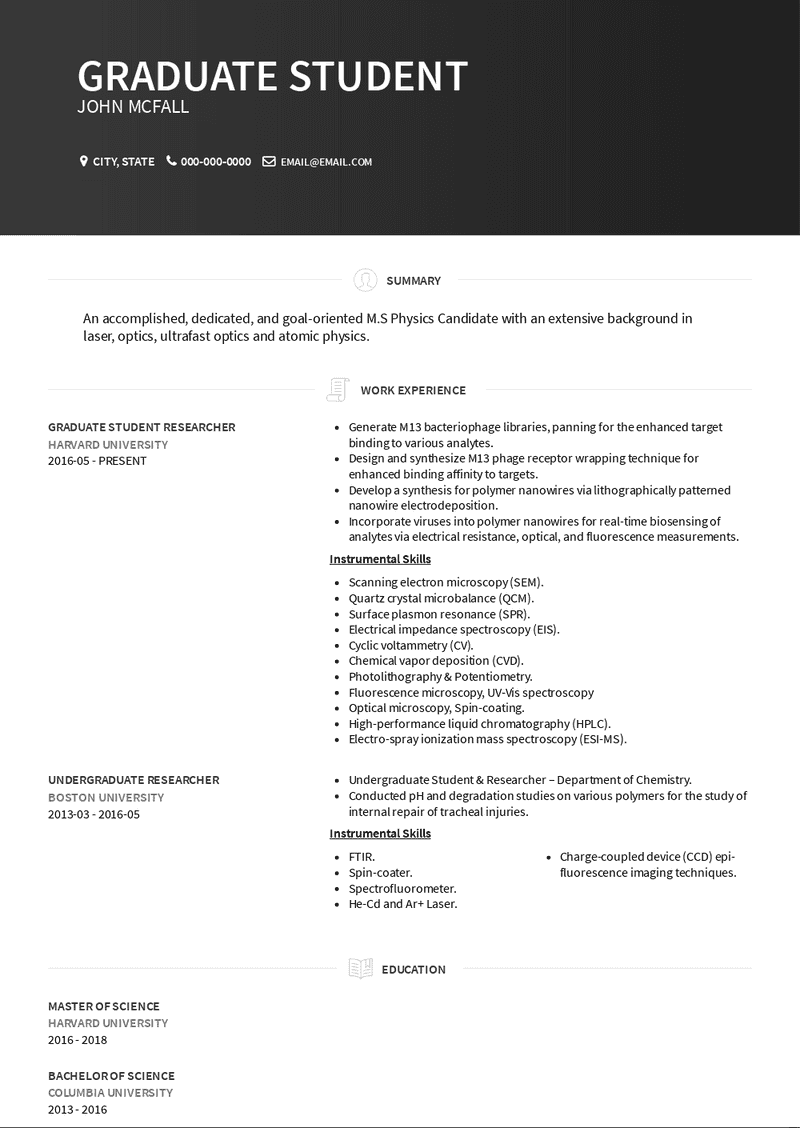
Write the perfect Graduate Student resume header by:
- Adding your full name prominently at the top.
- Including a professional photo if it aligns with industry norms in your region.
- Adding your current graduate program title or most relevant role.
- Providing contact information: city, phone number, professional email address, and a LinkedIn or personal portfolio link.
John Doe 123 Academic Lane Email: studentguru@email.com, Instagram: @gradlife123
John Doe, Boston, MA, Phone: +1-555-555-5555, Email: john.doe@email.com, LinkedIn: linkedin.com/in/johndoe
How to Write a Professional Graduate Student Resume Summary?
Use this template to craft a compelling Graduate Student resume summary:
"Graduate Student in [field] with [academic background or research experience]. Skilled in [key skills, e.g., data analysis, project management]. Seeking opportunities to apply [specific expertise] in [career aspirations or industry]."
Examples:
- "Graduate Student in Environmental Science with research experience in renewable energy. Skilled in data analysis and GIS mapping, seeking a role in sustainability consulting."
- "Dynamic MBA Graduate Student specializing in marketing analytics. Proficient in data visualization tools and campaign strategy development, eager to contribute to digital marketing projects."
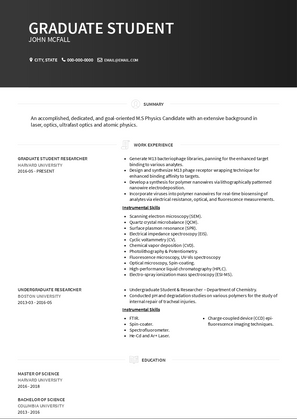
Graduate Student Resume Example
Research Assistant
- Conducted research on renewable energy systems, contributing to a published paper in a peer-reviewed journal.
- Analyzed data using MATLAB and Excel, improving project efficiency by 20%.
- Presented findings at a national conference, earning recognition for clarity and innovation.
Graduate Student Resume Example
Teaching Assistant
- Assisted in grading and mentoring for undergraduate economics courses.
- Conducted weekly study sessions, improving student grades by an average of 15%.
- Supported faculty in developing course materials and assessments.
Graduate Student Resume Example
Intern, Data Analyst
- Analyzed large datasets to identify trends and inform strategic decisions.
- Created dashboards in Tableau, simplifying data visualization for stakeholders.
- Collaborated with cross-functional teams, contributing to a project that increased efficiency by 10%.
Graduate Student Resume Example
Project Lead, Capstone Project
- Led a team of four in designing a sustainable water filtration system.
- Conducted market research and cost analysis, presenting the solution to industry professionals.
- Achieved the highest project grade in the cohort for innovation and feasibility.
Graduate Student Resume Example
Graduate Researcher
- Investigated neural network models for image classification, resulting in a published conference paper.
- Used Python and TensorFlow to develop algorithms with 90% accuracy.
- Participated in collaborative brainstorming sessions to refine methodologies.
Graduate Student Resume Example
Intern, Marketing Specialist
- Designed and executed a social media campaign that increased engagement by 25%.
- Conducted competitor analysis to identify gaps in the company’s digital presence.
- Assisted in content creation, producing blog posts and promotional materials.
Graduate Student Resume Example
Volunteer, Community Outreach
- Organized workshops on financial literacy for underprivileged communities.
- Managed logistics for events, ensuring smooth operations and positive feedback.
- Collaborated with non-profit organizations to expand program reach.
Graduate Student Resume Example
Lab Assistant
- Assisted in setting up and conducting experiments in a molecular biology lab.
- Maintained lab equipment and ensured adherence to safety protocols.
- Documented findings accurately, contributing to ongoing research projects.
Graduate Student Resume Example
Freelance Writer
- Created content on technical and academic topics for online platforms.
- Conducted thorough research to ensure content accuracy and relevance.
- Built a portfolio of 20+ articles, enhancing communication and writing skills.
Graduate Student Resume Example
Event Coordinator, University Club
- Planned and executed events for the graduate student body, increasing participation by 30%.
- Managed budgets and vendor negotiations, reducing event costs by 15%.
- Promoted events through digital and offline channels, achieving high attendance rates.
Additional Sections for a Graduate Student Resume
- Certifications (e.g., Python, Data Analysis, Project Management)
- Publications or Research Papers
- Languages (if applicable)
- Professional Memberships
- Extracurricular Activities
Top Graduate Student Resume Skills for 2025
- Research and Data Analysis
- Project Management and Team Leadership
- Communication and Public Speaking
- Technical Tools (e.g., MATLAB, Tableau, Python)
- Critical Thinking and Problem-Solving
- Report Writing and Documentation
- Collaboration and Teamwork
- Digital Marketing and Social Media
- Event Planning and Coordination
- Adaptability and Time Management
How Long Should My Graduate Student Resume Be?
Graduate Student resumes typically range from one to two pages. Focus on academic achievements, internships, and relevant projects to create a concise and impactful document.
For assistance, consider using our resume builder or explore Graduate Student resume examples to get started.
Specific Metrics/KPIs to Include in a Graduate Student Resume
Highlighting key performance indicators (KPIs) and metrics in your graduate student resume can demonstrate your achievements, skills, and potential to contribute significantly to a research team or academic institution.

- Research Grants and Funding: Mention the amount of funding you've secured for projects and the duration of each grant.
- Publications: Include details about the number of articles, conference proceedings, and book chapters published during your graduate studies.
- Patents: List any patents resulting from your research or coursework.
- Awards and Recognition: Showcase any awards, scholarships, or honors received for academic excellence, research achievements, or community service.
- Presentations: Specify the number of conferences, seminars, and workshops where you've presented research findings.
Certifications for a Graduate Student Resume
Obtaining relevant certifications can enhance your skills and make your resume more competitive in today's academic job market.

- GRE/GMAT: If required by the institution or program, include scores from the Graduate Record Examination (GRE) or Graduate Management Admission Test (GMAT).
- Language Proficiency Tests: Highlight proficiency in languages other than English, with test scores from TOEFL, IELTS, or other recognized language exams.
- Research Methodologies Certifications: Consider obtaining certifications in research methodologies, statistics, and data analysis to demonstrate your expertise.
- Ethics Training: Include any ethics training related to your field of study, such as IRB (Institutional Review Board) training or CITI (Collaborative Institutional Training Initiative).
As a graduate student, you'll likely work with various tools and platforms in your research and academic pursuits. Incorporating these into your resume can showcase your technical skills and adaptability.

- Statistical Software: Mention proficiency in software like R, SPSS, SAS, or Python for data analysis.
- Version Control Systems: Highlight experience with Git or SVN for managing code and collaborating on projects.
- Project Management Tools: Include any project management tools such as Trello, Asana, or Jira that you've used to organize your research tasks and workflows.
- Collaboration Platforms: Emphasize experience with collaboration platforms like Google Drive, Dropbox, or OneDrive for sharing files and working together remotely.
Methodologies and Frameworks for a Graduate Student Resume
Demonstrating your understanding of research methodologies and frameworks can help set you apart from other graduate student applicants.

- Quantitative Research: Highlight your skills in designing and executing quantitative studies, including surveys, experiments, and statistical analysis.
- Qualitative Research: Showcase your ability to conduct qualitative research through methods such as interviews, focus groups, ethnography, and content analysis.
- Mixed Methods Research: Emphasize your experience with mixed-methods research, where you've combined both quantitative and qualitative approaches to answer research questions.
- Theoretical Frameworks: Explain the theoretical frameworks that have guided your research in your field of study, such as grounded theory, social constructivism, or action research.
Selecting an appropriate resume format is crucial to showcasing your skills and experiences effectively for a graduate student career.

- Functional Resume: A functional format emphasizes skills and qualifications, making it ideal if you have transferable skills from prior jobs or experiences that can be applied to your graduate studies.
- Chronological Resume: This format focuses on work experience and is best suited for students with a clear progression of academic positions or research roles.
- Combination Resume: A combination resume combines elements of both functional and chronological formats, making it adaptable to various career paths within academia.
Choose the format that showcases your strengths and experiences most effectively while adhering to the specific requirements of the position you're applying for.