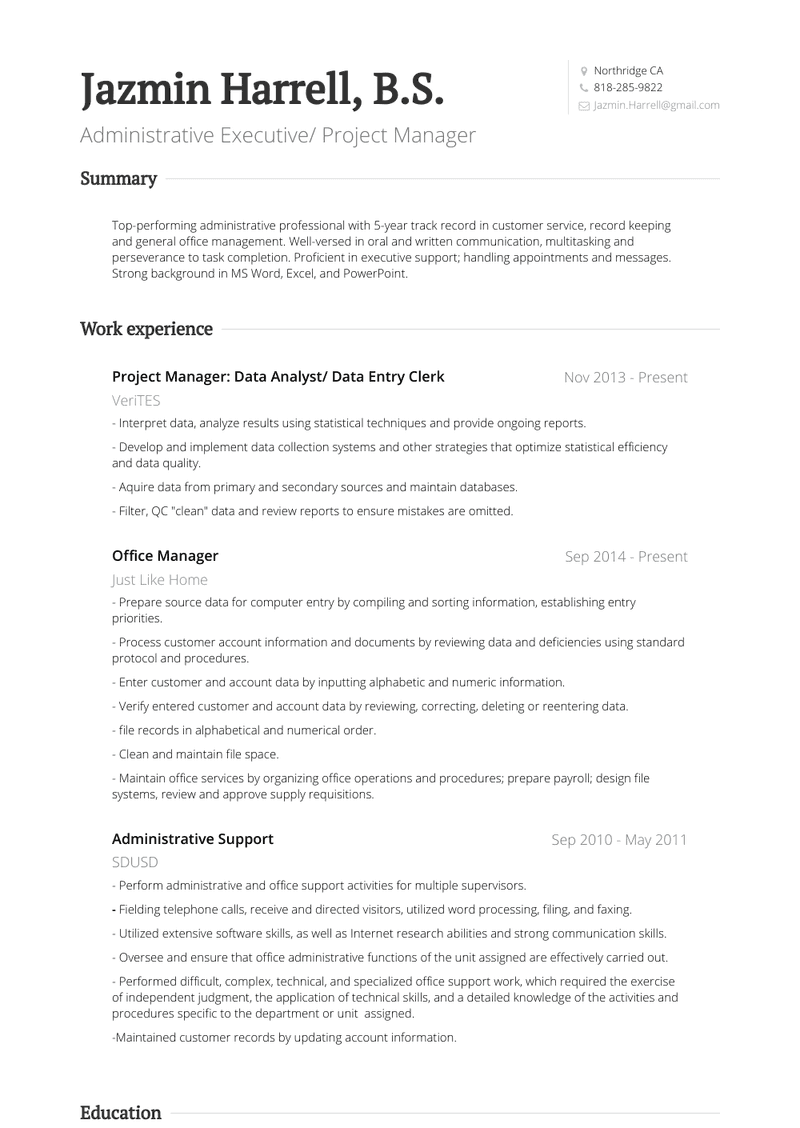
What Do Hiring Managers Look for in a Data Entry Clerk Resume?
- Proven accuracy and efficiency in handling large volumes of data.
- Strong organizational skills to manage and prioritize tasks effectively.
- Expertise in using data entry software, spreadsheets, and databases.
- Experience in maintaining data integrity and confidentiality.
- Ability to meet deadlines while ensuring a high level of precision.
- Excellent typing speed and attention to detail.
How to Write a Data Entry Clerk Resume?
To write a professional Data Entry Clerk resume, follow these steps:
- Select the right Data Entry Clerk resume template.
- Write a professional summary highlighting your data entry speed, accuracy, and technical skills.
- Include a section detailing your experience in data processing, record maintenance, and quality assurance.
- Follow the STAR method to describe your work experience, focusing on measurable outcomes and contributions.
- Highlight certifications, such as Microsoft Office Specialist or relevant software training.
- Include education, technical skills, and any awards or recognitions relevant to the role.
Struggling to make your data entry clerk resume stand out? Let our AI resume tool do the hard work—analyze job requirements, optimize your content, and create a resume that gets noticed.
Write the perfect Data Entry Clerk resume header by:
- Adding your full name prominently at the top.
- Including a professional title like "Data Entry Clerk" or specifying your expertise (e.g., "Data Entry Clerk - Medical Records").
- Providing contact information: city, phone number, professional email address, and LinkedIn profile link.
Jane Doe Data Entry Clerk Email: janedoe@email.com
Jane Doe, New York, NY, Phone: +1-555-555-5555, Email: jane.doe@email.com, LinkedIn: linkedin.com/in/janedoe
How to Write a Professional Data Entry Clerk Resume Summary?
Use this template to craft a compelling Data Entry Clerk resume summary:
"Detail-oriented and efficient Data Entry Clerk with [number of years] years of experience in [specific industries or areas]. Skilled in [key skills like data accuracy, speed, and tools]. Proven success in [key achievement, e.g., maintaining 99% accuracy in data processing]."
Examples:
- "Highly organized Data Entry Clerk with 5+ years of experience in managing and processing large datasets. Maintained a 99% accuracy rate while meeting tight deadlines."
- "Efficient and detail-focused Data Entry Clerk specializing in data verification and database management. Consistently achieved above-average typing speeds with zero errors."
How to Write a Data Entry Clerk Resume Experience Section?
Here’s how you can write a job-winning Data Entry Clerk resume experience section:
- Write your Data Entry Clerk work experience in reverse chronological order.
- Use bullets instead of paragraphs to explain your Data Entry Clerk work experience.
- While describing your work experience, focus on highlighting what you did and the impact you made (use numbers to describe your success as a Data Entry Clerk).
- Use action verbs in your bullet points.
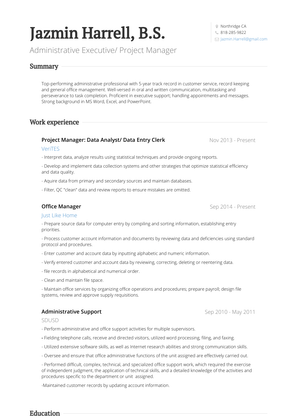
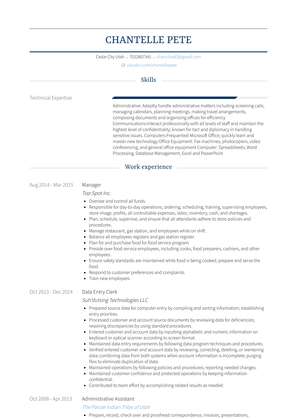
Data Entry Clerk Resume Example
Data Entry Clerk, ABC Corporation
- Processed and verified over 10,000 records monthly with a 99% accuracy rate.
- Developed efficient data entry protocols, reducing data processing time by 20%.
- Ensured confidentiality and integrity of sensitive information, adhering to company policies.
- Maintained and updated a comprehensive database, improving access and retrieval speed.
- Provided regular reports and summaries for senior management, enhancing decision-making.
Data Entry Clerk Resume Example
Data Entry Clerk, XYZ Logistics
- Entered and updated shipment data for 5,000+ orders weekly with exceptional accuracy.
- Created and maintained automated templates, reducing manual data entry errors by 15%.
- Verified invoice details, ensuring correct billing and record-keeping.
- Collaborated with cross-functional teams to resolve discrepancies in records.
- Trained new employees in database management systems, improving team efficiency.
Data Entry Clerk Resume Example
Data Entry Clerk, Retail Solutions Inc.
- Handled daily data entry tasks, including inventory updates and sales tracking.
- Streamlined data entry processes, reducing entry time by 25%.
- Verified and corrected errors in a customer database containing over 100,000 records.
- Supported the migration of legacy data to new systems, ensuring seamless transitions.
- Maintained compliance with data protection standards during all tasks.
Data Entry Clerk Resume Example
Data Entry Clerk, HealthTech Services
- Entered and maintained patient records for a healthcare database, ensuring 100% compliance with HIPAA regulations.
- Conducted audits of digital and paper records, identifying and rectifying discrepancies.
- Implemented new data validation techniques, enhancing data accuracy by 10%.
- Assisted with the development of a standardized data entry training program.
- Supported the analysis of patient data, contributing to improved healthcare delivery.
Data Entry Clerk Resume Example
Data Entry Clerk, Global Finance Corp
- Entered and reconciled financial data for monthly and quarterly reports.
- Monitored and maintained database accuracy, minimizing reporting errors.
- Automated repetitive data entry tasks, increasing efficiency by 30%.
- Worked closely with auditors to ensure accurate financial documentation.
- Delivered detailed data reports to support strategic planning and budgeting.
Additional Sections for a Data Entry Clerk Resume
- Certifications (e.g., Microsoft Office Specialist, Typing Speed Certification)
- Technical Skills (e.g., MS Excel, Google Sheets, QuickBooks)
- Languages (e.g., Spanish, French, Mandarin)
- Awards and Recognitions (e.g., Employee of the Month, Excellence in Data Management)
- Professional Memberships (e.g., International Association of Administrative Professionals)
Top Data Entry Clerk Resume Skills for 2025
- Data Entry and Verification
- Typing Speed and Accuracy
- Database Management
- Spreadsheet Proficiency
- Confidentiality and Data Protection
- Time Management and Prioritization
- Problem-Solving and Troubleshooting
- Report Generation and Analysis
- Software Proficiency (e.g., CRM tools)
- Record Maintenance and Quality Assurance
How Long Should My Data Entry Clerk Resume Be?
Data Entry Clerk resumes typically range from one to two pages. Focus on measurable achievements, technical skills, and data management expertise to create a concise and impactful document.
For assistance, consider using our resume builder or explore Data Entry Clerk resume examples to get started.
Specific Metrics/KPIs for a Data Entry Clerk Resume
In a data entry clerk resume, it's crucial to demonstrate your efficiency and accuracy in handling large volumes of data. Highlighting specific Key Performance Indicators (KPIs) helps potential employers understand your competence in this role. Here are some key metrics/KPIs you might want to include:
- Data entry speed (characters or keys per hour)
- Error rate (percentage of errors in data entry tasks)
- Average turnaround time for completing a task
- Experience with handling complex or specialized formats (e.g., XML, JSON, CSV)
Certifications for a Data Entry Clerk Resume
While not always required, certifications can help you stand out from other candidates and demonstrate your commitment to professional development. For data entry clerks, certifications in areas such as data processing, spreadsheets, or computer literacy may be particularly valuable. Here are some examples of relevant certifications:
- Microsoft Office Specialist (MOS) certification for proficiency in Microsoft Excel, Word, and PowerPoint
- Certified Data Processing Specialist (CDPS) by the American Society for Quality (ASQ)
- Certified Administrative Professional (CAP) by the International Association of Administrative Professionals (IAAP)
Tools and Platforms for a Data Entry Clerk Resume
A data entry clerk often works with various software tools, databases, and platforms to manage and process data efficiently. Highlighting your familiarity with these tools can make you an attractive candidate for employers seeking candidates with adaptable skills. Here are some tools and platforms commonly used in the data entry clerk role:
- Microsoft Office Suite (Excel, Word, PowerPoint)
- Google Workspace (Google Sheets, Google Docs)
- Database management systems (MySQL, SQL Server)
- Data processing software (Filemaker Pro, Airtable)
- Optical Character Recognition (OCR) tools (Adobe Acrobat, Abbyy FineReader)
Methodologies and Frameworks for a Data Entry Clerk Resume
In addition to technical skills, employing the right methodologies and frameworks can help you excel as a data entry clerk. Emphasizing your understanding of these concepts shows that you are a conscientious and detail-oriented professional who takes pride in their work. Here are some methodologies and frameworks worth mentioning:
- Data validation techniques to ensure accuracy and consistency (e.g., range checks, cross-checking with other data sources)
- Data normalization methods to maintain uniformity across databases and systems
- Using version control systems like Git or SVN for managing and tracking changes in data files
- Lean Six Sigma principles for process improvement and error reduction
Choose the Right Resume Format for Your Data Entry Clerk Career
Selecting the appropriate resume format can help you showcase your skills, qualifications, and experiences effectively to potential employers. For a data entry clerk resume, consider using formats that emphasize your quantifiable achievements, technical skills, and certifications. Here are some popular formats for a data entry clerk resume:
- Chronological format: This format lists your work experience in reverse chronological order, allowing you to highlight recent achievements and progression in your career.
- Functional format: This format focuses on your skills and qualifications rather than your work history, making it an excellent choice if you have little to no professional experience in data entry or are transitioning into this field from a different industry.
- Combination format: This hybrid format combines elements of both the chronological and functional formats by presenting your work experience in reverse chronological order while also highlighting relevant skills and qualifications.