Want a 3 Civil Engineering Intern Resume Examples and Templates resume that actually gets results? Skip the guesswork—build yours in minutes with our powerful resume builder and start landing interviews faster.
How to Write a Civil Engineering Intern Resume?
To write a professional Civil Engineering Intern resume, follow these steps:
- Select the right Civil Engineering Intern resume template.
- Write a professional summary at the top explaining your Civil Engineering Intern’s experience and achievements.
- Follow the STAR method while writing your Civil Engineering Intern resume’s work experience. Show what you were responsible for and what you achieved as a Civil Engineering Intern.
- List your top Civil Engineering Intern skills in a separate skills section.
Advance your engineering career with a professionally crafted resume. Our engineering resume writing service showcases your technical expertise, project achievements, and problem-solving skills to help you secure top engineering roles.
Struggling to make your 3 Civil Engineering Intern Resume Examples and Templates resume stand out? Let our AI resume tool do the hard work—analyze job requirements, optimize your content, and create a resume that gets noticed.
Write the perfect Civil Engineering Intern resume header by:
- Adding your full name at the top of the header.
- Add a photo to your resume if you are applying for jobs outside of the US. For applying to jobs within the US, avoid adding photo to your resume header.
- Add your current Civil Engineering Intern to the header to show relevance.
- Add your current city, your phone number and a professional email address.
- Finally, add a link to your portfolio to the Civil Engineering Intern resume header. If there’s no portfolio link to add, consider adding a link to your LinkedIn profile instead.
Karina 7598 Old Manor St. Saugus, MA 01906 Marital Status: Married, email: cooldude2022@gmail.com
Karina Camacho, Saugus, MA, Phone number: +1-555-555-5555, Link: linkedin/in/johndoe
Make sure to add a professional looking email address while writing your resume header. Let’s assume your name is John Doe - here is a formula you can use to create email addresses:
- firstnamelastname@email.com - johndoe@email.com
- firstname.lastname@email.com - john.doe@email.com
- lastname.firstname@email.com - doe.john@email.com
- f.lastname@email.com - j.doe@email.com
- l.firstname@email.com - d.john@email.com
- firstnamelastname12@email.com - johndoe12@email.com
For a Civil Engineering Intern email, we recommend you either go with a custom domain name (john@johndoe.com) or select a very reputed email provider (Gmail or Outlook).
How to Write a Professional Civil Engineering Intern Resume Summary?
Use this template to write the best Civil Engineering Intern resume summary:
Civil Engineering Intern with [number of years] experience of [top 2-3 skills]. Achieved [top achievement]. Expert at [X], [Y] and [Z].
How to Write a Civil Engineering Intern Resume Experience Section?
Here’s how you can write a job winning Civil Engineering Intern resume experience section:
- Write your Civil Engineering Intern work experience in a reverse chronological order.
- Use bullets instead of paragraphs to explain your Civil Engineering Intern work experience.
- While describing your work experience focus on highlighting what you did and the impact you made (you can use numbers to describe your success as a Civil Engineering Intern).
- Use action verbs in your bullet points.
Civil Engineering Intern Resume Example
Civil Engineering Intern
- Analyzed survey reports, map, blueprints and other topographical and geological data to effectively plan infrastructure and construction project.
- Displayed strong communication and interpersonal skills while visiting clients, job sites and consultant offices to support project and business development needs.
Civil Engineering Intern Resume Example
Civil Engineering Intern
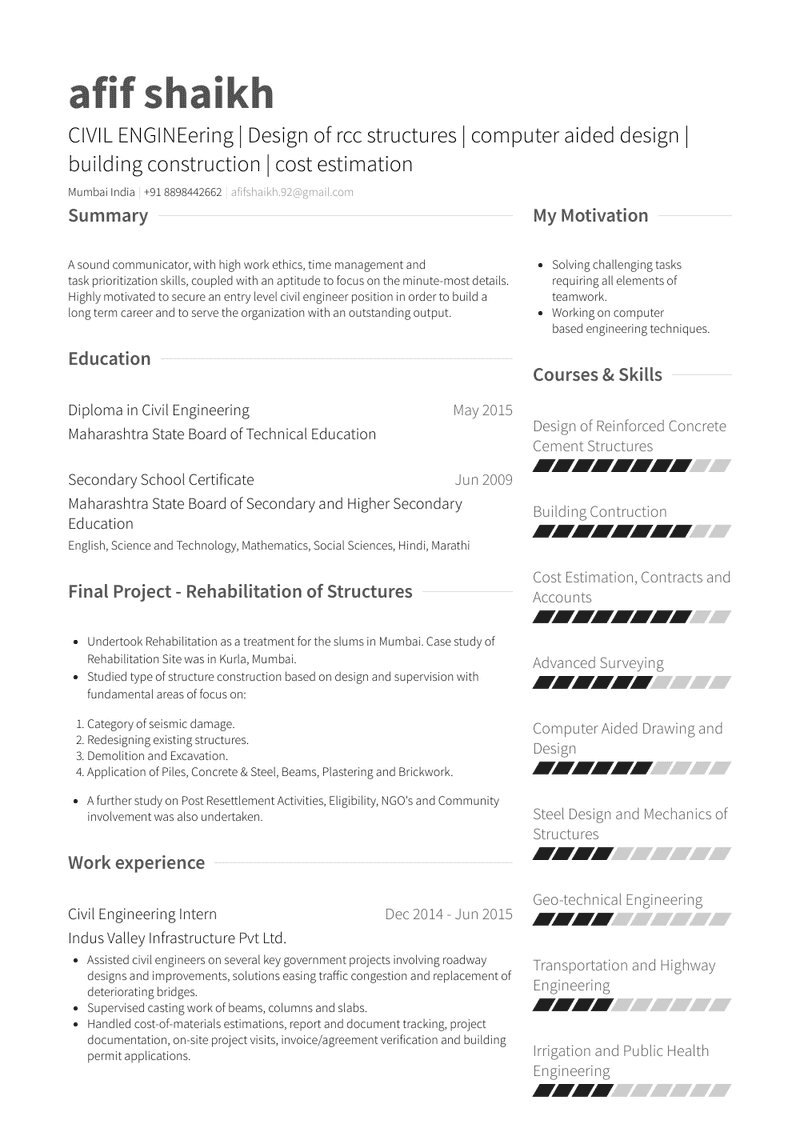
- Supervised casting work of beams, columns, and slabs.
- Handled cost-of-materials estimations, report and document tracking, project documentation, on-site project visits, invoice/agreement verification, and building permit applications.
- Assisted Civil Engineers on several key government projects involving roadway designs and improvements, solutions easing traffic congestion and replacement of deteriorating bridges.
Civil Engineering Intern Resume Example
Civil Engineering Intern
- Assisted senior engineers in cost analysis for project work
- Read and analyzed shop drawings with senior Draftsmen and Design Engineers
- Assisted senior Quantity Surveyors during the valuation of work done by subcontractors and verifying the invoices received based on the work done
- Assisted in variation analysis, recommendations, and case studies
- Reviewed and reported performance against budgets and forecast targets
- Coordinated with special subcontractors for any design data required
Civil Engineering Intern. Resume Example
Civil Engineering Intern.
- Basic Survey Training.
- Compaction Using Mechanical Device.
- Reinforced Steel Fixing.
- Concrete Placing Including Vibrating Of Concrete.
- Foundation Setting Out.
Civil Engineering Intern Resume Example
Civil Engineering Intern
- Supported site engineers in a public plaza construction project by preparing documents for reports and writing memos for contractors.
- Assisted with CAD drafting for on-site civil projects.
- Closely worked with contractors and surveyors to perform topographic surveys and identify environmental constraints to ensure safe design and construction protocols.
Top Civil Engineering Intern Resume Skills for 2022
- AutoCAD
- Microsoft Office
- Transportation and Highway Engineering
- Building Construction
- Advanced Surveying
- Computer Aided Drawing and Design
- Design of Reinforced Concrete Cement Structures
- Steel Design and Mechanics of Structures
- Cost Estimation, Contracts, and Accounts
- SAP 2000
How Long Should my Civil Engineering Intern Resume be?
Your Civil Engineering Intern resume length should be less than one or two pages maximum. Unless you have more than 25 years of experience, any resume that’s more than two pages would appear to be too long and risk getting rejected.
On an average, for Civil Engineering Intern, we see most resumes have a length of 2. And, that’s why we advise you to keep the resume length appropriate to not get rejected.
Specific Metrics/KPIs to Include in a Civil Engineering Intern Resume
Highlighting your quantifiable achievements is crucial when applying for a civil engineering internship. Here's what you should focus on:
- Project Timelines and Completion Rates: Demonstrate your ability to meet deadlines and deliver results efficiently by providing examples of completed projects within the stated timeline.
- Cost Estimation and Management: Showcase your skills in estimating project costs accurately and managing budgets effectively, ensuring that projects are completed on time and under budget.
- Quality Assurance and Regulatory Compliance: Emphasize your understanding of design standards, building codes, and safety regulations by highlighting any instances where you ensured compliance during your projects.
Certifications for a Civil Engineering Intern Resume
To make your resume stand out, include any relevant certifications that demonstrate your proficiency in civil engineering. Some common ones are:
- Fundamentals of Engineering (FE) Exam: This exam is the first step toward becoming a Professional Engineer and demonstrates your fundamental knowledge of engineering principles.
- OSHA 10-Hour Construction Safety Training: This certification shows that you understand basic safety guidelines in construction, which is crucial in civil engineering projects.
- AutoCAD Certification: Having AutoCAD skills can give you an edge, as it's a widely used software in the field of civil engineering.
Showcasing your familiarity with various tools and platforms is essential in a competitive job market. Here are some to consider:
- AutoCAD, Revit, or MicroStation for design and drafting tasks
- Microsoft Excel for data analysis and financial modeling
- GIS software like ArcGIS for spatial analysis and mapping
- Construction management tools such as Procore or PlanGrid
Methodologies and Frameworks for a Civil Engineering Intern Resume
Demonstrating your understanding of various methodologies and frameworks can set you apart from other applicants. These include:
- LEED (Leadership in Energy and Environmental Design) certification, demonstrating your commitment to sustainable design practices
- Agile project management, emphasizing flexibility, collaboration, and adaptability during projects
- BIM (Building Information Modeling) methodology for creating and managing digital models of buildings and infrastructure
Selecting a suitable resume format is essential to present your skills and experiences effectively. Here are some options:
- Functional resume: Focuses on skills and abilities, ideal if you're transitioning into civil engineering from another field or have limited work experience.
- Combination resume: A blend of functional and reverse-chronological formats, allowing you to showcase both your skills and work history effectively.
- Reverse-chronological resume: Highlights your work history, showing employers a clear progression of roles and responsibilities. This format is ideal if you have significant civil engineering experience.
What should I include in my objective statement on a civil engineering intern resume with no experience?
Your objective statement should emphasize your educational background in civil engineering, your enthusiasm for gaining hands-on experience, and your commitment to contributing to engineering projects. For example: "Motivated and detail-oriented civil engineering student seeking an internship opportunity at [Company Name] to apply my knowledge in structural analysis, CAD design, and project management. Eager to gain practical experience and contribute to innovative infrastructure projects."
How can I highlight relevant skills on a civil engineering intern resume if I have no direct experience?
If you lack direct experience, focus on your technical skills, such as proficiency in AutoCAD, Revit, or other engineering software. Highlight relevant coursework in areas like structural analysis, materials science, or geotechnical engineering. Emphasize your ability to apply engineering principles, solve problems, and work effectively in a team environment.
Should I include volunteer work on my civil engineering intern resume?
Yes, including volunteer work is valuable, especially if it involved construction, community projects, or any tasks that align with engineering principles. Volunteer experiences that demonstrate your ability to work on projects, manage responsibilities, or apply technical skills can strengthen your resume and show your commitment to the field of civil engineering.
How can I demonstrate my understanding of civil engineering concepts on my resume?
To demonstrate your understanding of civil engineering concepts, mention any relevant coursework, projects, or certifications. Highlight your experience with engineering software, such as AutoCAD or Civil 3D, and any hands-on projects where you applied engineering principles. If you have participated in engineering competitions, labs, or design projects, be sure to include those as well.
What should I include in the education section of my civil engineering intern resume?
Include your current academic status, such as your pursuit of a Bachelor’s degree in Civil Engineering or a related field. List any relevant courses you have completed, such as Structural Analysis, Fluid Mechanics, or Transportation Engineering. Mention any academic achievements, such as a high GPA or involvement in engineering clubs or organizations.
Can I include non-engineering work experience on my civil engineering intern resume?
Absolutely. Non-engineering work experience can be valuable, especially if it demonstrates skills such as teamwork, problem-solving, or project management. For example, roles in customer service, leadership positions, or any job that required you to work on a team or manage projects can provide relevant experience for a civil engineering internship.
Use a clean and professional format with sections for your objective, skills, education, and experience. Start with a strong objective statement that outlines your enthusiasm for the role. Then, list your technical skills and any experience, including coursework, projects, or volunteer work, that demonstrate your ability to handle the responsibilities of a civil engineering intern. Highlight any relevant certifications or training that support your qualifications.
How important is a cover letter when applying for a civil engineering intern position with no experience?
A cover letter is very important as it allows you to explain your passion for civil engineering and why you’re a great fit for the internship, even without direct experience. Use the cover letter to highlight your academic achievements, relevant projects, and any experiences that demonstrate your readiness to contribute to engineering projects. Tailoring your cover letter to the specific company and role can help make a strong impression.
How can I make my civil engineering intern resume stand out with no experience?
To make your resume stand out, focus on your technical skills, academic achievements, and any relevant coursework or projects. Highlight your proficiency with engineering software, understanding of civil engineering concepts, and ability to work effectively on a team. Tailoring your resume to the specific needs of the employer and the projects they are working on can also help you differentiate yourself from other candidates.