Sales Resume Builder
Create a professional, ATS-friendly sales resume with customizable templates.
Sign-up FREE. No Credit Card Required.

Create a professional, ATS-friendly sales resume with customizable templates.
Sign-up FREE. No Credit Card Required.
More than 100k+ sales professionals use VisualCV to create winning resumes with design, ATS optimization, and AI guidance that highlights the pipeline results, client wins, and skills hiring managers seek.

Explore sales resume examples to clarify your approach or find fresh inspiration. These job-winning resumes show how to present quotas, territory growth, account results, and client skills clearly.
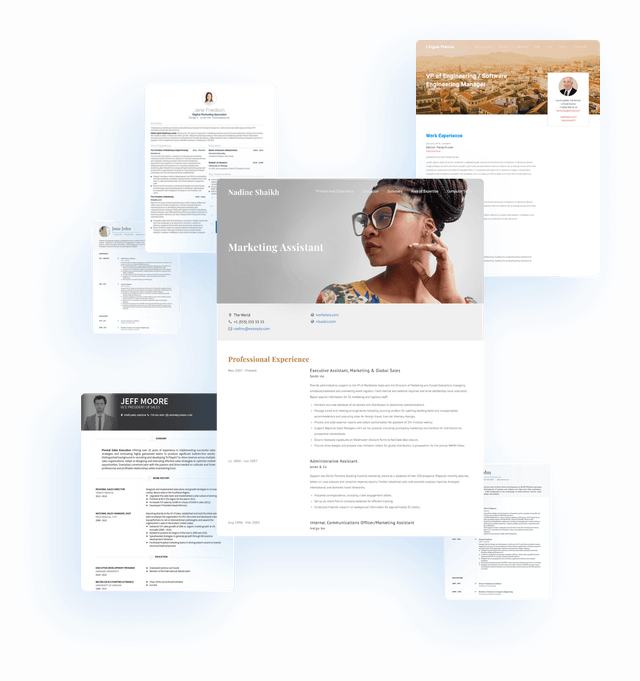
For a decade, we have researched and written sales-specific resume, cover letter, and job search advice that is hard to find elsewhere. Use our free resources to strengthen your search for a sales role.


Choose from polished resume designs that balance modern style with a professional look. Every VisualCV template has been tested and refined over a decade to support clear, compelling sales resumes.

Tailor your resume for every sales job with ease in VisualCV. Customizing a standout template for the role, territory, and buyer is an underrated way to show why your experience fits the opening.

ATS-optimized, customized resumes help your sales experience reach the right readers. After VisualCV helps you create a focused application, you can spend more time preparing for interviews.

VisualCV helps sales professionals turn scattered experience into a tailored resume for every application.
Use a reverse-chronological format for a sales resume: list your most recent role first, then work backward, because it quickly shows recency and progression, along with territory or account scope and revenue responsibility. Use a clean, conventional layout with clearly labeled roles and dates. Give the most visual space to recent roles and make these details easy to scan:
Before:
"Sales Skills: Prospecting and closing."
After:
"Account Executive | B2B SaaS | 2023 to Present\nOwn new-business opportunities from discovery through negotiation for mid-market accounts across the Northeast territory."
One page is normally sufficient for early-career sales candidates. It also suits retail and SDR or BDR applicants with limited relevant history. Use a second page only for relevant evidence of:
Before extending the document, cut:
A functional format, which minimizes dates, is best reserved for career changers or applicants with limited directly related sales history. It can obscure:
Keep a chronological employment record and use the opening profile to connect transferable customer-facing work to commercial responsibility. Avoid graphics or text boxes. Also avoid unconventional date layouts that make a sales resume harder to scan or parse.
Use familiar, scannable headings that show where you fit in the revenue process and let readers quickly find your target role, sales scope, results, tools, and qualifications.
Include your name, phone number, professional email, location, and LinkedIn URL. At the top of the resume, distinguish these elements:
Example:
“B2B account executive with experience managing full-cycle SaaS opportunities for mid-market operations teams, from discovery and demonstrations through negotiation and close.”
For each role, list the employer, job title, location, and dates. State the selling environment and the part of the cycle you owned, such as inbound or outbound prospecting, qualification, demos, closing, renewals, expansion, or channel support. Include the context a sales reader needs to judge scope:
For leadership roles, identify responsibility for coaching, hiring, forecasting, territory design, or team performance.
Place selected accomplishments beneath the role where they occurred. Use measures that fit the job, such as qualified meetings and sourced pipeline for prospecting roles, quota attainment and closed business for closing roles, or retention and expansion for account roles. The accomplishments section can cover how to choose and present those measures; when figures are restricted, briefly show scope through progression, larger accounts, territory growth, or strategic assignments.
List systems and knowledge that recur in your target roles. Include customer relationship management software, such as Salesforce, only when you used it, and reserve workflow detail for the tools section. Add relevant product, vertical, regulated-market, or language knowledge when it supported your sales work.
List your institution, credential, and graduation year when they support your experience level or target role. Include current, relevant training, awards, memberships, licences, or product credentials. Keep these qualifications separate from performance evidence; the credentials section can provide the appropriate detail when they are material to the role.
Build your sales resume around the sales motion you are pursuing, then select truthful evidence that shows your place in the revenue process. Start with the job posting: identify the buyer segment, territory, sales cycle, and new-business, renewal, or channel focus, then use those details to guide the version you create.
Choose the target sales motion. Define the role and environment before drafting. An SDR, account executive, account manager, and territory manager need different proof of ownership, from prospecting and qualification to closing, renewals, or expansion.
Inventory your truthful evidence. Review each role and note what you owned, including customer segment, territory, account type, sales-cycle stage, and commercial result. Include progression such as a larger book of business, strategic-account assignment, expanded territory, or coaching responsibility when it reflects your scope.
Select and order the most relevant bullets. Put the evidence closest to the target motion first in each role. Lead with outcomes and ownership rather than routine tasks, and give enough context for a reader to understand the work.
Before: "Managed client relationships and met sales goals."
After: "Managed a portfolio of mid-market accounts, led renewal and expansion conversations, and finished above annual quota."
Map accurate posting language to your experience. Use the employer's terms only where they match work you performed. If a posting calls for pipeline management, connect it to your actual work in qualification, stage progression, forecast calls, or opportunity hygiene rather than inserting the phrase without proof.
Validate and prepare the final version. Verify the target title, sales-motion alignment, dates, quota period and attribution, and territory or account claims against your records. Check that your resume is consistent with LinkedIn and supporting application material, then save a clearly named version and export it. Keep separate versions for distinct sales motions or role families rather than forcing one resume to fit every opening.
Describe sales experience by showing where you worked in the revenue process and the commercial context behind your results. A hiring reader should be able to tell whether you sourced prospects, ran discovery and demos, negotiated and closed business, renewed accounts, expanded customers, or led a team. Clarify whether you worked an inbound queue, a named-account territory, a retail floor, or a complex enterprise cycle, because “sales representative” alone does not establish the selling environment.
Start each experience entry with the sales motion, customer segment, territory or book of business, deal environment, and ownership level. A book of business is the accounts or revenue responsibility assigned to you. State whether results were individual, shared with a pod, meaning a small team working a common account group or territory, or achieved through a team you managed. This context prevents pipeline, revenue, or retention claims from overstating or understating your contribution.
Meaningful responsibilities are the parts of the sales motion you personally moved forward, not a generic list of calls and emails. Match the work you describe to the role you want.
Before:
“Responsible for managing client relationships and meeting sales goals.”
After:
“Owned renewal and expansion conversations for a portfolio of mid-market accounts, coordinating account plans with customer success and escalating commercial risks before renewal dates.”
The second version shows the account type, relationship stage, ownership, and operating work behind retention.
Use the accomplishments section to select verifiable proof, then give each result a benchmark or context. A quota result needs its period and ownership model. A pipeline claim needs the customer segment or sales motion. New-logo work means winning newly acquired customers, while existing-account work centers on renewals or expansion.
Do not invent figures that are unavailable. Support those entries through responsibilities, deal complexity, progression, process ownership, or a larger territory or strategic-account assignment. If results are confidential, anonymize them or use approved percentages or scope without naming customers, disclosing contract terms, or publishing restricted pipeline data.
Example:
“Managed the full sales cycle for enterprise prospects in a regulated market, from discovery through proposal and negotiation; maintained Salesforce forecasts and partnered with legal and implementation teams on complex evaluations.”
Sales accomplishments show how your work advanced prospects, customers, revenue, or account value, rather than only listing routine duties. Evidence identifies the sales motion and scope, then gives a result you can support.
Use action + scope + result. State what you did, identify the commercial context, and show the outcome. Name a territory or customer segment, then add account type or sales-cycle ownership when it clarifies your claim.
A sales funnel sets the boundary for attribution:
Do not attach revenue generated to work where you only sourced the meeting or supported an account executive. State your contribution precisely.
Before:
"Conducted discovery calls, product demos, and follow-up with prospects."
After:
"Owned discovery, demos, proposals, and negotiation for mid-market B2B prospects; exceeded annual new-business quota by 18%."
The second version establishes closing ownership and gives the result a benchmark.
Example:
"Built outbound pipeline across a Northeast healthcare territory by researching target accounts, sequencing prospects, and qualifying buyers; created 42 sales-accepted opportunities in one quarter."
Use measures from the stage you owned:
Use figures from records you can verify, such as a CRM, compensation plan, forecast report, or approved dashboard. Context makes the number useful: "Closed $600K" is unclear, while "Closed $600K in new annual contract value against a $500K individual quota" identifies both outcome and benchmark, if you may share it.
Activity volume belongs only when it connects to quality or an outcome. "Made 80 calls per day" says little alone. "Maintained a prospecting cadence that produced 15 qualified meetings per month" links effort to a sales result.
If you lack usable quota, revenue, pipeline, rank, or conversion figures, use one truthful evidence type:
If figures or customer details are confidential, do not guess or expose restricted data. Use a percentage, approved range, relative rank, territory scope, anonymized customer type, strategic-account assignment, or increased responsibility. Accuracy carries more weight than an impressive number without a clear source or ownership.
A targeted sales resume makes your position in the revenue process unmistakable. Treat these as intersecting dimensions of a role, not interchangeable job titles:
Move first: Prospecting, account research, outreach, qualification, qualified meetings, and pipeline sourced.
De-emphasize: Closed-won revenue when an account executive owned the close.
Name: Inbound or outbound motion, named accounts or territory, and target segment.
Example: “Prospected mid-market IT leaders, qualified discovery opportunities against agreed criteria, and created pipeline for account executives through Salesforce.”
Move first: Discovery, demos, proposals, negotiation, forecasting, and closed-won business you owned.
De-emphasize: Activity volume that does not show deal-cycle responsibility or outcomes.
Name: Whether you received qualified opportunities or sourced and closed your own book. For enterprise roles, name buying committees, procurement, longer cycles, or strategic accounts. For SMB roles, name pace, conversion, volume, or quota consistency.
Example: “Owned discovery through negotiation for commercial accounts, coordinating demos and proposals with buyer stakeholders.”
Move first: Book of business, renewal ownership, account plans, adoption conversations, and expansion work.
De-emphasize: Hunter-focused prospecting language when the role centered on existing customers.
Name: Whether you led renewals directly or supported a separate renewals team, plus the account segment you served.
Before: “Maintained client relationships and handled renewals.”
After: “Managed a portfolio of existing accounts, led renewal conversations, and identified expansion opportunities with customer stakeholders.”
Move first: Territory planning, coverage, travel, local account development, partner work, and joint opportunities.
De-emphasize: Inside-sales activity that does not reflect field execution or partner influence.
Name: Region, territory type, geographic coverage, or channel responsibility. Specify whether you recruited partners, enabled them, supported deals, or influenced partner-sourced revenue.
Example: “Planned account coverage across a regional territory and supported distributors on joint opportunities with local buyers.”
Move first: In-person selling, demonstrations, needs-based recommendations, transaction completion, and repeat-customer service.
De-emphasize: Enterprise account language that overstates a high-volume retail sales motion.
Name: Product category, customer interaction model, appointment or store-traffic context, and individual versus store-level ownership.
Example: “Guided customers through product comparisons and financing handoffs, supported repeat business, and contributed to store sales goals during peak weekend traffic.”
Move first: Buyer context, technical discovery, virtual demos, proof-of-concept work, and collaboration with solutions consultants.
De-emphasize: Product-name inventories or unsupported claims of technical expertise.
Name: Vertical, buyer function, product environment, and verified regulated-market knowledge or training when relevant.
Example: “Ran discovery with operations leaders and partnered with a solutions consultant to tailor virtual demos to workflow requirements.”
Move first: Hiring, coaching, pipeline reviews, forecast cadence, territory design, deal support, performance management, and team attainment.
De-emphasize: Personal production unless it establishes the scope of a player-coach role.
Name: Team size, role mix, region, and the operating rhythm you managed.
Example: “Led weekly pipeline and forecast reviews for a regional team of account executives, coached discovery and deal strategy, and partnered with recruiting on new-hire onboarding.”
Keep the chronology intact, but change the order of evidence rather than the facts. Put the sales motion the target role needs to assess near the start of each relevant experience entry.
The strongest sales resumes use terms that define the sales motion you performed, then support them with evidence of how you performed the work. Read the target posting to identify the revenue-process stage you owned, from prospecting and qualification through closing, renewals, expansion, or partner support. Use the employer's accurate language throughout relevant resume sections, not as a copied keyword list.
These terms can be useful keywords when they accurately describe your work:
Add market context when it changes the meaning of your experience. B2B SaaS selling to mid-market buyers differs from retail selling, enterprise new-logo acquisition, and management of existing accounts. Use terms such as SMB, enterprise, healthcare, financial services, and named accounts only when they describe your customers or territory. A hunter role focuses on winning new business, while a farmer role focuses on growing and retaining existing accounts.
A skills section can state concise terms, but your experience should show the work behind them. “Relationship building” says little alone. Explain whether you led discovery, worked with technical stakeholders, moved opportunities through stages, resolved renewal risk, or developed account plans.
Weak: "Salesforce; pipeline management; negotiation; relationship building."
Better: "Maintained CRM stage hygiene; ran discovery with business and technical stakeholders; and coordinated proposals and contract discussions for assigned opportunities."
The better version still needs to be true, but it gives pipeline management, CRM use, discovery, and negotiation business context. Use the tools section to decide which software belongs on the resume. Include MEDDICC, SPIN Selling, Challenger, Sandler, or another named methodology only when you were trained in or used it, and support it with relevant discovery, qualification, or deal-progression evidence.
Recruiters and screening systems can recognize familiar role language, but a long keyword string does not explain your contribution. Build a short skills list from terms repeated in the posting, then place relevant terms beside real responsibilities. Do not position meeting-setting as the center of your experience if you owned complex closes, and do not imply full-cycle ownership when another seller ran demos, proposals, and negotiations.
Match the terminology to the sales environment. Inbound and outbound work call for different evidence; so do field and inside sales, transactional and complex sales, or channel and direct selling. Your resume should show the sales motion you actually owned, rather than treating every customer-facing responsibility as equivalent sales experience.
List a tool in Skills when it is a screening requirement or a useful familiarity signal; use it in Experience when it materially explains how you sourced or advanced business, forecasted revenue, or retained and expanded an account. Context is stronger than a software-name inventory because it shows your role in the sales motion.
Use categories that match the role you want, separating systems from the workflows they support.
Keep the Skills section short, naming systems relevant to the target role. Give a tool space in Experience when the workflow helps explain your contribution to prospecting, qualification, deal progression, forecasting, renewals, or expansion.
Before:
“Salesforce, Outreach, Excel, Zoom.”
After:
“Managed outbound sequences in Outreach, maintained opportunity stages in Salesforce, and prepared weekly pipeline reports in Excel for an SMB territory.”
The second version names the systems while clarifying ownership, sales motion, and output.
List a sales credential in a clearly labeled Certifications, Licenses, and Training section, using the exact name, issuing organization, and current status. Put it below your summary when a license or credential is central to the role, such as regulated-product sales. Otherwise, place it after experience and education so your record of prospecting, discovery, pipeline management, closing, renewals, or account growth remains the focus.
Separate credentials from internal product onboarding and sales-methodology training. A credential can support your fit for a specific market, but it does not replace evidence that you can work a territory, manage a book of business, or run a deal cycle. Include only training you completed and can verify. If a credential is in progress, name it accurately and add the expected completion date only when you have one.
Example:
Do not write “certified” after your name, use an abbreviation, or imply authorization to sell a product unless you currently hold that status. Licensing and registration rules can vary by product, employer, and jurisdiction, especially in financial, insurance, healthcare, government, and other regulated sales environments. If a credential has lapsed or does not transfer to the role’s location, state its status plainly or leave it off.
You can write a credible sales resume without a sales title by using customer-facing, commercial, and performance-based work to show how you communicate, uncover needs, persuade, and follow through. Do not present service work as closing experience or claim quota attainment you did not have. Name the setting, your actual responsibility, and the evidence available, such as repeat business, appointment volume, event sign-ups, upsells, fundraising, or customer feedback.
Look for evidence from roles and activities where you had to influence a decision or move someone to a next step:
For an entry-level sales development representative role, emphasize prospect research, outreach discipline, qualification, and meeting coordination only if you performed those tasks. For retail or inside sales roles, customer conversations, product knowledge, point-of-sale accuracy, and add-on recommendations may be more relevant. Include a concise education section when coursework, a sales competition, or a relevant project supplies evidence that your work history cannot.
Before: "Provided customer service and helped customers find products."
After: "Guided customers through product comparisons, resolved purchase concerns, and documented recurring questions for the store team; recognized for reliable service during high-traffic shifts."
Use the same level of precision for informal experience. If you organized a student fundraiser, state the audience, outreach method, and outcome you can support. If records do not show a number, describe the process and responsibility instead of guessing. A resume can show readiness for the sales process without implying you owned a pipeline, carried a quota, or closed business.
Choose a results-forward, classic chronological, or leadership layout based on the sales motion and level of responsibility you need to present. The right format gives priority to the evidence most relevant to your target role, whether that is pipeline creation, full-cycle closing, account retention, or team performance.
Best for SDRs, BDRs, account executives, and territory representatives with clear performance records. Use a prominent summary and experience layout when you can support claims with quota attainment, qualified pipeline, closed revenue, deal size, or ranking context.
Example: "Enterprise Account Executive | Full-cycle new-logo sales | 118% of annual quota"
Best for retail sales, inside sales, customer-facing roles, or a steady progression from sales associate to representative or account executive. It keeps job dates, employers, territory or customer segment, and promotions easy to scan without forcing every role into a metrics-heavy design.
Best for sales managers, regional leaders, and heads of sales whose scope extends beyond personal production. Give space to team size, coaching, hiring, forecast cadence, territory design, strategic accounts, and the outcomes your team delivered, while separating those results from your individual book of business.
For this narrower follow-up, name the part of the sales cycle you owned, such as outbound prospecting, discovery, demos, proposals, negotiation, closing, renewals, or expansion. Add context about the buyer segment, territory, sales motion, deal complexity, and whether you carried individual or shared responsibility.
For this narrower follow-up, use metrics that match your role's commercial ownership. SDRs can emphasize qualified meetings, opportunities created, and sourced pipeline; account executives can show quota attainment, closed revenue, win rate, and deal size; account managers can highlight renewals, retention, and expansion.
Use truthful relative or scope-based evidence when exact figures are confidential. You can state that you exceeded quota, ranked among a defined group, managed a territory or book of business, earned larger-account responsibility, or improved a process, without naming customers, contract values, or restricted pipeline data.
For this narrower follow-up, list enough relevant skills to support the target role, usually a focused selection rather than every platform or soft skill you have used. Prioritize sales-motion terms and capabilities you can discuss credibly, such as discovery, pipeline management, forecasting, negotiation, account planning, or channel development.
Keep a sales resume to one page when your relevant experience can be presented clearly there, especially early in your career. Two pages can be appropriate for experienced account executives, sales leaders, or candidates with substantial territory, strategic-account, or industry experience; remove older or unrelated detail first.
Include quota attainment when you can state it accurately and it reflects your individual performance. Pair the percentage with useful context, such as the period, role, territory, customer segment, or sales motion, and distinguish personal attainment from team results, company growth, or activity metrics.
For this narrower follow-up, use evidence from customer-facing work that demonstrates commercial judgment and follow-through. Retail performance, fundraising, recruiting, hospitality, customer service, campus leadership, and volunteer work can support claims about prospecting, relationship building, objection handling, conversion, upselling, or meeting goals.
For this narrower follow-up, lead with evidence of revenue ownership: quota attainment, closed-won business, pipeline generated or managed, average deal size, win rate, and sales-cycle responsibility. Add segment and deal context, such as SMB, mid-market, enterprise, new logo, expansion, or a complex multi-stakeholder sale.
A resume builder can support ATS-compatible formatting when it uses clear headings, conventional sections, readable fonts, and a straightforward export, but it cannot guarantee parsing or selection. Your sales resume still needs accurate job-description language, standard titles, and formatting that avoids graphics, tables, or text that may not parse reliably.
For this narrower follow-up, list Salesforce only if you have used it and connect it to the work you performed, such as lead routing, opportunity management, pipeline hygiene, forecasting, reporting, or account planning. Name other CRM or sales tools separately when relevant, and avoid claiming advanced administration skills unless you held that responsibility.