Mechanical Engineer Resume Builder
Create an ATS-friendly resume fast, then download a polished PDF or Word file.
Sign-up FREE. No Credit Card Required.

Create an ATS-friendly resume fast, then download a polished PDF or Word file.
Sign-up FREE. No Credit Card Required.
Used by 100k+ mechanical engineers, VisualCV combines tested design, ATS optimization, and AI guidance to create a standout resume that highlights the skills and project results hiring managers seek.

Use our mechanical engineer resume examples to clarify formatting, sharpen your project language, or find inspiration. These job-winning resumes show the details and scope hiring managers expect to see.
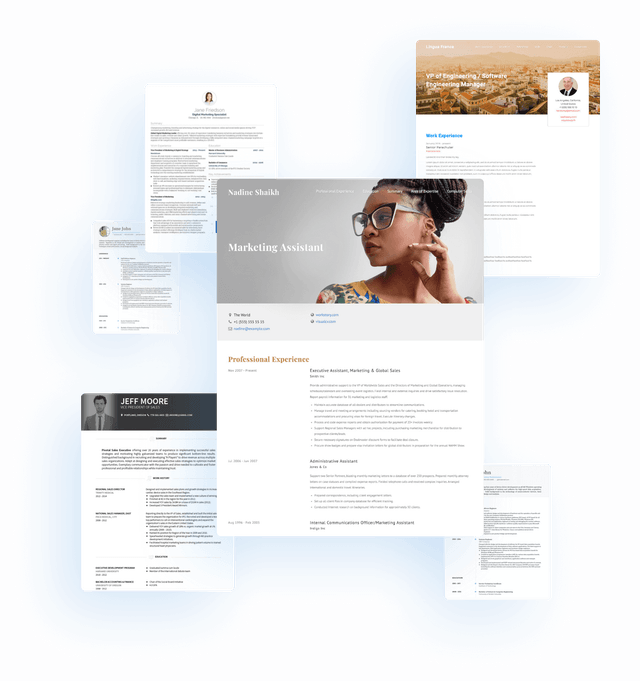
Explore free mechanical engineering resume, cover letter, and job search advice built from a decade of research and writing. Find specific guidance that is hard to get elsewhere for engineering roles.


Choose a polished resume design with tools that balance modern style and professionalism. Every VisualCV template has been tested and refined over a decade to support mechanical engineering resumes.

Customize your resume for each mechanical engineering job in minutes. VisualCV makes it easy to tailor standout templates to the role, a simple step that many applicants overlook in their search.

Use an ATS-optimized, customized resume to make every application more effective. With VisualCV, your focus can shift from formatting and keywords to preparing for your interviews.

VisualCV helps mechanical engineers beat the blank-page problem and build focused, application-ready resumes with ease.
You should use a reverse-chronological resume with a compact technical profile and relevant skills near the top. It lets hiring managers follow your work across the engineering lifecycle:
Conventional headings and an unbroken work history also help applicant tracking systems parse your experience. Use one page when it captures your strongest relevant engineering evidence; use two when your seniority and relevant scope require it.
Give visual priority to the specialty you want to be hired for, then to the evidence behind it. A mechanical design candidate should lead with assembly ownership and drawing release rather than a generic software list. For other specialties, lead with the relevant systems, lifecycle stage, and technical outputs.
Before:
"Mechanical Engineer | SolidWorks | ANSYS | MATLAB"
After:
"Mechanical Design Engineer | Electromechanical assemblies, drawing release, prototype verification"
The second version shows the engineering work that connects the tools.
A functional resume can make sense when you are changing fields or have limited directly related employment. It often weakens an engineering application because it separates claims about technical work from the dates, hardware, and deliverables that establish credibility. Use a hybrid format only when it preserves clear chronology and gives substantial space to relevant project work. When space is limited, cut first:
Use a CV for research-heavy or academic openings only when requested; a resume is clearer for most industry roles. Follow an employer-specified submission format when it differs.
A mechanical engineer resume should let a reader identify your engineering focus, physical-system context, and lifecycle contribution in the first scan.
Contact details and technical positioning: Include your name, location, email, phone number, and an authorized LinkedIn or portfolio link. Add a brief profile naming your specialty and relevant scope, such as product design or thermal systems. A useful summary states your specialty, physical-system scope, and relevant lifecycle evidence. Omit a generic objective. A targeted objective can help an early-career or specialty-transition candidate explain direction.
Professional experience: For each role, identify the component, assembly, equipment, or system you supported, then state your contribution. Show whether you developed concepts, released drawings, investigated failures, or supported production. Name concrete cross-functional interfaces, such as suppliers or quality, rather than claiming generic teamwork.
Selected engineering projects: Include capstone work, internships, research, student design teams, or major professional projects that demonstrate relevant work. The resume gives concise evidence of the authorized project, subsystem, method, and outcome. A portfolio provides permitted work samples. Omit the portfolio link if work is confidential, export-controlled, employer-restricted, or not curated. For restricted work, describe the product category and engineering problem without customer names, dimensions, specifications, or results.
Technical skills: Group tools and methods by the work they support, such as CAD and drawings or test and data acquisition. List SolidWorks, finite element analysis, MATLAB, or PLM only when you can explain how you used the tool in a design decision, analysis, test, or release.
Education: List your degree, school, and graduation or expected date. Early-career candidates can add relevant coursework, labs, competitions, or research when experience does not yet show the target specialty.
Credentials and professional work: Add Professional Engineer licensure, Engineer in Training status, relevant certifications, patents, publications, or memberships when earned and applicable. State credential names and statuses exactly.
Before: "Mechanical engineer with CAD experience and strong problem-solving skills."
After: "Mechanical design engineer with experience developing sheet-metal and machined assemblies from concept through drawing release, prototype evaluation, and manufacturing support."
The second version gives the reader technical context, a development stage, and recognizable deliverables. If you contributed to one subsystem, fixture, test campaign, or drawing package on a larger program, name that scope rather than claiming ownership of the full program.
Build a mechanical engineer resume by matching verified engineering evidence to the opening, then checking that the finished file is readable by both systems and people. Start with the role's technical scope and select only work you can support.
Analyze the posting and build a crosswalk. Identify the physical system, lifecycle stage, engineering method, and deliverable the role requires. For each important requirement, assign a destination: a headline or skills group, a project or experience bullet, or an earned credential. Deliberately omit claims you cannot support.
Build a fact sheet for relevant work. For each role, project, internship, or capstone, record what you owned, the system context, and the result or deliverable. Capture your actual stage of involvement, such as concept development through release or production support, so team contributions remain accurate.
Write evidence from the fact sheet. Connect a method to the decision, design output, test activity, or manufacturing result it supported rather than naming software alone.
Before: “Used SolidWorks to design parts and support prototypes.”
After: “Developed 3D models for a prototype fixture, issued tolerance-controlled drawings, and incorporated technician feedback during build iteration.”
Select supported measures. Add a measure only when you can explain its context and your contribution, such as drawing packages released, test cycles completed, or time reduced to resolve a production issue. When details are restricted, state the system type and engineering scope without exposing protected data.
Perform the final ATS, export, and submission check. Use conventional headings, text-readable contact details, and readable dates. Follow a standard section order and keep units and abbreviations consistent. Export the file, then verify that headings, bullets, and chronology remain intact. Parsing can help retrieval, but it does not replace clear evidence a hiring manager can read.
Describe each experience bullet so a hiring manager can see the physical scope, your engineering judgment, and the supported result. Use a consistent evidence chain:
Give each role enough physical and operational context to make the work legible without exposing proprietary details. Useful context includes:
Then state what you personally performed. A software name alone is weak evidence. Explain whether you used it to:
On multidisciplinary programs, name the interface you handled, such as manufacturing feedback, supplier coordination, quality review, or technician support. This preserves the distinction between your subsystem ownership and a program-level result.
Before:
"Created CAD models and helped with prototype testing."
After:
"Developed 3D part and assembly models for a prototype electromechanical subsystem, prepared fabrication drawings, and used fixture-based testing to identify an interference condition before design release."
Lead with the one or two bullets that most closely match the target role's work. Combine repetitive CAD, drawing, and prototype tasks into one evidence-rich bullet when they supported the same design decision or release. For older roles, reduce detail to the most relevant subsystem, contribution, and outcome rather than listing every revision or routine task.
Quantify an outcome only when your records support it and disclosure is safe, such as the number of drawings released or setup time reduced. When no defensible number exists, use a specific qualitative outcome, such as resolving a failure mode, closing a nonconformance, or enabling a design review. State the result you supported without assigning yourself credit for a team-owned outcome.
Example:
"Investigated recurring assembly variation with manufacturing and quality teams, updated the drawing tolerance scheme and inspection approach, and supported implementation of the corrective action."
Use truthful ranges or neutral descriptions when details are confidential, including "high-volume production line," "customer-specific equipment," or "safety-critical assembly." Do not disclose restricted dimensions, customer names, controlled technical data, or internal test limits. Check units, material and process terminology, drawing language, and analysis claims so each bullet accurately shows what you owned and what changed because of the work.
The strongest accomplishments distinguish a responsibility from evidence that your work was effective. A responsibility says what you were assigned, such as creating CAD models or supporting prototypes. Evidence shows the action you took, the mechanical scope, and a supported outcome.
Build each bullet around a specific contribution. Name the hardware, analysis, test work, drawing package, fixture, or process so the claim is credible, then add a numerical or qualitative result you can defend.
Before:
“Responsible for designing parts in SolidWorks and supporting prototypes.”
After:
“Designed machined and sheet-metal components for a prototype assembly in SolidWorks, incorporating build feedback into revised drawings before the next test iteration.”
The revised bullet identifies the work product and what changed because of your work without inventing a percentage.
Use numbers to show scale or change, not to decorate a bullet. State only measures you can trace to project records, test data, quality data, or release history.
Qualitative outcomes also count when they are specific: a drawing set released for build, an interference resolved before test, a design review completed, or an inspection finding addressed. If a result belongs to a group, credit it accurately: “Contributed to a cross-functional redesign that reduced assembly rework” is more credible than claiming sole ownership. When details are restricted, retain a truthful category and permitted result, such as “Updated drawings for a supplier-produced housing to address inspection findings before release.”
Example:
“Performed structural FEA on mounting-bracket concepts using defined load cases and constraints; compared stress and displacement results to guide geometry selection before prototype release.”
For FEA or CFD, do not say a model “proved” a design. Identify the analysis, relevant assumptions or boundary conditions, and the decision the results informed. For validation work, distinguish among writing a test plan, building instrumentation or a fixture, executing tests, analyzing data, and approving a verification report. Those are different responsibilities and should not be combined into a claim you cannot support.
Build each version around the engineering workflow the role owns, then move matching projects and evidence ahead of less relevant experience. Keep job titles and facts unchanged, but change the headline, summary, project selection, and first bullets under each role. If you are moving from adjacent mechanical work, foreground transferable lifecycle work and bridge projects without relabeling it as direct target-specialty ownership; use the specialty-transition section for a fuller approach.
Move requirements, concepts, assemblies, drawings, prototypes, design reviews, and release work forward. Name the physical context and your ownership boundary, then emphasize tolerance decisions, manufacturability, and the drawing package.
Before: "Created CAD models and drawings for new products."
After: "Owned 3D models, assembly interfaces, and released 2D drawings for a sheet-metal enclosure subsystem; resolved tolerance and fastener-access issues during prototype review."
Lead with the production process rather than the part. Emphasize fixtures, work instructions, root-cause investigation, supplier coordination, quality collaboration, and the production result of an engineering change.
Example: "Developed a locating fixture and updated assembly work instructions after investigating fit-up variation; supported pilot-build feedback through production release."
State the process, the issue, and what you changed instead of claiming you "improved manufacturing."
Put the system analyzed, load case, assumptions, and design decision together. Emphasize analysis you performed in a working context, and include test correlation only when you performed it.
Example: "Performed structural finite element analysis of a bracket assembly under specified load cases, reviewed stress concentrations with the design team, and recommended geometry changes for prototype evaluation."
Do not imply that a model alone validated a design.
Reorder experience around verification planning and evidence. Emphasize the requirement or operating condition, test fixture, instrumentation, data collection, failure observations, and corrective-action decision.
Example: "Designed a repeatable bench-test fixture, coordinated instrumentation and data collection, and documented failure observations to support a corrective-action decision."
When details are restricted, describe the test category and decision supported without publishing controlled values or specifications.
Center building-system evidence over product-design work. Bring load calculations, equipment selection, mechanical drawings, coordination, site observations, and construction-question responses forward; mention codes only when accurate for the role and location.
Example: "Prepared equipment selections and coordinated mechanical drawings for a commercial renovation, resolving routing conflicts with architectural and electrical disciplines."
Keep a product project only when it supports the target scope rather than displacing building-system evidence.
Treat regulated-work evidence as an industry overlay, not a separate functional specialty. Apply only the target environment's relevant requirements, traceability, configuration control, verification, change-review, or quality-record terminology alongside your design, analysis, test, or manufacturing evidence.
Example: "Supported engineering change review for a safety-sensitive assembly by updating controlled drawings, tracking revisions, and coordinating verification inputs across design, quality, and manufacturing."
Use terminology only for processes you actually performed, and describe restricted work precisely but generally.
Reduce routine CAD detail and expand technical decision scope. Emphasize subsystem ownership, trade studies, risk reduction, design-review leadership, supplier direction, mentoring, and decisions affecting test or production.
Example: "Led design reviews for a thermal-management subsystem, aligned interfaces with electrical and manufacturing teams, and guided design changes through prototype and release decisions."
Distinguish technical leadership from formal people management by stating whether you directed engineering decisions, reviewed work, coordinated interfaces, or held responsibility for staffing and performance.
Use target-role terminology that matches engineering work you can demonstrate in a project or experience bullet. Your skills section helps an applicant tracking system and hiring manager identify your specialty, while bullets establish what you actually contributed.
An explicit skill should appear only when a project or experience bullet demonstrates it. Use an exact posting term, such as GD&T or design verification, when it accurately describes your work. If the term is adjacent to your experience, demonstrate the underlying capability instead of claiming the keyword. For example, list test planning and instrumentation if you supported a test program but did not own formal design verification.
Separate skills by what they represent:
Keep the role-specific scope clear:
Match direct language from the posting only when you can explain the component, method, decision, and deliverable. A posting may explicitly request tolerance stack-up, PLM, or PFMEA. If your contribution was adjacent, use the precise evidence: a drawing update informed by supplier feedback, a test fixture you built, or a failure investigation you documented.
Generic labels such as cross-functional collaboration or problem solving add little alone. Name the interface and engineering decision, such as manufacturing feedback on a machined part or electrical-team coordination at an enclosure interface.
Weak:
"SolidWorks; GD&T; FEA; teamwork; problem solving."
Better:
"Created released part and assembly drawings in SolidWorks, applying GD&T and manufacturability feedback from machining suppliers; supported design review of a structural bracket with FEA results and test observations."
The better version establishes design context, work products, and the limits of your involvement. Do not claim ownership of an entire program when you owned a subsystem, drawing package, fixture, test setup, or analysis task.
Use a narrow list of methods, competencies, systems, and deliverables that reflect your actual contribution. Exposure to a workflow does not support a skill claim unless your bullets show how you used it to make a design decision, produce a work product, interpret results, or support production.
List a named system when it is relevant and defensible; repeat it in an experience bullet only when it shaped a decision or deliverable; omit it when you cannot support your exposure. Place a short, targeted list near relevant experience or education.
A separate Technical Tools section works when the role calls for several systems and you can explain how you used each one. Group named systems by function rather than mixing software with methods, processes, or deliverables.
A scan-friendly list helps readers find relevant systems quickly. Your experience bullets prove credibility by naming the component or system and showing how the tool affected a design decision or released output.
Before:
"SolidWorks / ANSYS / MATLAB / Teamcenter"
After:
"Created SolidWorks assembly models and released 2D drawing packages for a production fixture; used Teamcenter to manage revisions and incorporate design-review feedback before release."
Do not claim proficiency from a course exercise or from observing another engineer use a system. If a posting names a specific system, include its exact name only when your experience is genuine and supportable.
List credentials in a dedicated Credentials section, usually after Education for early-career candidates or near the top of the resume when an active license is central to the role. Give each item its exact title, issuing authority, and earned or active status. Relevant entries may include:
State only credentials you have actually earned or currently hold. Do not write PE, P.Eng., chartered engineer, or EIT because you are studying, have completed related coursework, or expect approval. If a credential is underway, name the completed milestone and the next step without implying licensure: for example, say that you passed an examination or are pursuing licensure, rather than using a protected title. License names, eligibility paths, and title rules vary by jurisdiction, so use the wording from your issuing authority.
Before: "PE candidate | FEA certified | ASME"
After: "Fundamentals of Engineering examination passed, May 2024; pursuing Professional Engineer licensure. Certified SOLIDWORKS Associate, 2023. ASME member."
The second version separates a completed milestone from a license not yet held and identifies the actual certification. Keep certificates that are unrelated to the target work out of this section. A design, manufacturing, HVAC, or regulated-product role may value different credentials, so place the most relevant current qualification first.
You can write a credible mechanical engineer resume with no experience by using engineering projects, laboratory work, internships, student design teams, and technical coursework as evidence of how you solve mechanical problems. Give these items a Projects section near the top, after a short profile if you use one, and treat them with the same precision as paid work. A capstone, Formula SAE subsystem, thermal lab, research assistantship, machining project, or fixture you designed can show relevant capability when you explain the engineering context.
For each project, name the physical system or component, your specific contribution, the tools or methods you used, and the deliverable. Useful evidence includes:
Do not present class work as employment or claim ownership of a whole vehicle, product, or research program. Say what you owned within the team, such as a bracket assembly, cooling loop analysis, drawing package, test fixture, or failure investigation. If results are limited, state the completed engineering work rather than implying production performance.
Before: "Designed a robot for senior design using SolidWorks and ANSYS."
After: "Developed the mounting assembly for a four-person capstone robot; created 3D CAD and fabrication drawings, evaluated bracket deflection with finite element analysis, and revised the design after prototype fit-up testing."
List tools only where you used them. “Used SolidWorks to create an assembly and released drawings for a student-built test rig” is more credible than a long software list. Add a portfolio link only for drawings, models, photos, reports, or code you are authorized to share. Remove customer names, controlled technical details, and material covered by employer, university, or team confidentiality terms.
Pick the presentation format that puts your most relevant engineering evidence in the first third of the page.
This format suits mechanical design, manufacturing, test, and analysis engineers with related work history. Lead with a focused profile and technical skills, then place recent roles in reverse chronological order so a reader can trace your work from CAD, drawings, and prototype builds through verification, release, or production support.
Example:
"Mechanical Design Engineer | Electromechanical assemblies, GD&T, design release, prototype verification"
This format suits new graduates, engineers moving into a new specialty, and candidates whose strongest evidence is in capstones, laboratories, internships, Formula SAE, research, or permitted personal projects. Place selected projects near education or the profile, and name the component, your contribution, the methods used, and the result without exposing restricted specifications.
This format suits senior, lead, and principal mechanical engineers whose recent work spans subsystem ownership, design reviews, suppliers, manufacturing, quality, and program teams. Give more space to technical decisions, release responsibility, risk reduction, and cross-functional interfaces, while keeping older roles brief and reserving dense tool lists for skills sections.
Include the system or component context, your specific ownership, the engineering stage, and the resulting deliverable or decision. For example, identify whether you owned a bracket redesign, thermal test fixture, drawing package, tolerance analysis, prototype build, or production issue rather than describing the entire program as your work.
Group skills by the work they support, such as design and CAD, analysis, manufacturing, test and validation, or HVAC systems. Put the tools and methods most relevant to the target role first, and list only capabilities you could discuss accurately in a technical interview, including your level of hands-on use.
A simple two-column layout can work, but a single-column resume is the lower-risk choice when an application system is likely to parse it. Use conventional headings, standard fonts, selectable text, and clear dates; avoid text boxes, graphics, logos, and essential information placed in headers, footers, or image files.
Use enough bullets to show the most relevant technical scope and results, usually more for a recent or highly relevant role and fewer for older positions. Prioritize distinct evidence of design, analysis, testing, release, manufacturing support, or cross-functional decisions instead of splitting one routine responsibility into several bullets.
Use truthful ranges, percentages, relative changes, project scale, or non-sensitive operational measures when exact specifications and customer data are restricted. You can describe reducing setup time by a percentage, supporting a multi-part assembly, completing a defined number of releases, or improving test repeatability without naming the product, customer, dimensions, or proprietary target values.
Label them clearly as capstone, laboratory, research, student design team, or personal projects, rather than presenting them as employment. State your individual contribution, such as CAD ownership, fixture design, instrumentation, analysis assumptions, test execution, or prototype iteration, and include outcomes supported by your records.
Name the CAD platform and connect it to work you actually performed, such as part modeling, assemblies, drawings, revision control, sheet metal, surfacing, or tolerance definition. Avoid claiming expert proficiency based only on coursework or viewing models; use terms such as working knowledge when that better reflects your experience.
List GD&T, FEA, or CFD when you have applied the method beyond superficial exposure and it is relevant to the role. Make the claim credible by tying it to a drawing decision, load case, boundary conditions, mesh or model assumptions, test correlation, or design recommendation rather than listing the acronym alone.
Keep it to one page when you are early in your career or can present your most relevant engineering evidence concisely; two pages are appropriate for experienced mechanical engineers with substantial project, leadership, or regulated-industry work. Length should follow relevance and readability, not an attempt to document every tool or assignment.
Use a resume for most industry engineering applications because it is a targeted summary of relevant design, manufacturing, analysis, or test experience. Use a CV when an academic, research, teaching, grant, or publication-focused opportunity requests one, as those documents typically provide a fuller record of research outputs and appointments.