Graphic Designer Resume Builder
Create an ATS-friendly graphic designer resume with templates in minutes.
Sign-up FREE. No Credit Card Required.

Create an ATS-friendly graphic designer resume with templates in minutes.
Sign-up FREE. No Credit Card Required.
VisualCV helps 40k+ graphic designers create winning resumes with strong design, ATS optimization, and AI guidance. Highlight the portfolio, skills, and results hiring managers want to see.

Use our graphic designer resume examples to clarify your approach or find fresh inspiration. These job-winning resumes show the portfolio details, skills, and results employers look for.
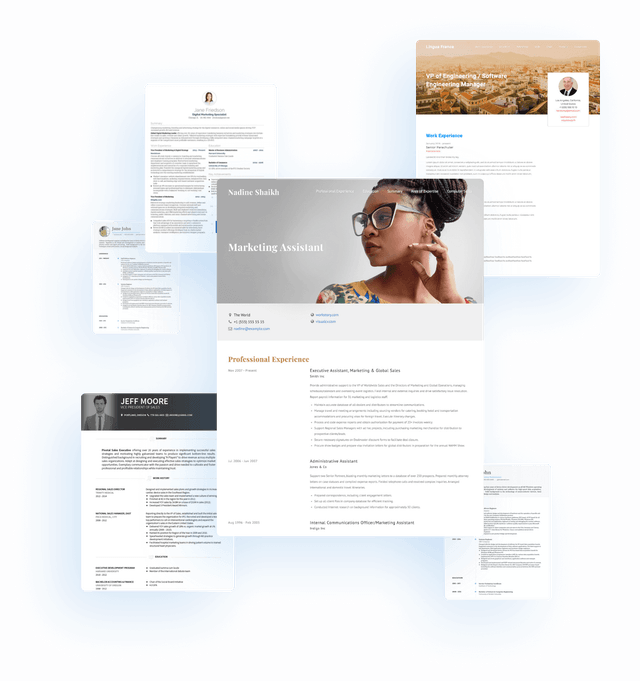
Explore a decade of graphic design resume, cover letter, and job search advice that is hard to find elsewhere. Use our free resources to build a stronger search and land your dream design job.


Use intuitive design tools to balance creativity with a polished, professional look. Every template has been tested and refined for more than a decade to support graphic designer resumes.

Tailor your resume for each graphic design job with ease. Customize standout templates to match the role, feature relevant portfolio work, and show the skills each employer needs most clearly.

ATS-optimized, customized resumes help your application reach the right people. With VisualCV, you can send a clear, role-focused resume and spend more time preparing better for interviews.

VisualCV helps graphic designers create polished, tailored resumes and present their creative work to employers.
A reverse-chronological, single-column format is the safest default for graphic designers because it makes recent work and career progression easy to scan while keeping the document readable in online application systems. Your resume establishes fit in words, while your portfolio shows visual execution, project context, and finished artifacts. Submit a shorter, role-targeted resume unless the employer specifically requests a CV.
Give the top third of the page the clearest visual priority:
Example:
Prioritize recent, role-matched evidence on one page. Use a second page only when you have substantive relevant history or projects, and cut older or unrelated detail and duplicates before reducing legibility. A restrained two-column layout can suit a PDF sent directly to a creative contact when your history is concise and the reading order remains obvious, but keep a single-column version for application portals. Avoid text embedded in graphics. Avoid decorative icons that replace labels, and limit dense sidebars or unusual typefaces. For ATS troubleshooting:
A functional format often obscures the agency, in-house, freelance, or production context behind the work. If you are changing specialties or have limited paid experience, use a hybrid structure: place relevant projects near the top while retaining dates and an honest chronological record.
A graphic designer resume should establish your design specialty, the work you have delivered, the environments you can work in, and a clear route to a portfolio that proves the visual side of your practice. The resume explains fit quickly. Your portfolio supplies the finished work, process, and project context that cannot fit on one page.
Put your name, location, email, phone number, LinkedIn profile if it supports your application, and a clearly labeled portfolio URL in the header. Use a short, readable link to a personal site or portfolio platform, then check that it works on desktop and mobile. A portfolio link should lead to work relevant to the role, not an unfiltered archive of every project.
Name the role you do and the design environment you know. A short summary can identify a specialty such as brand identity, marketing design, editorial layout, packaging, production art, or digital campaign design, plus the type of team or audience you support. Avoid a generic claim of creativity when you can name the work.
Example: "Graphic designer creating brand systems, campaign assets, and print-ready collateral for B2B marketing teams. Experienced working from brand guidelines through stakeholder review and vendor handoff."
For each role, include employer or client, title, location if useful, and dates. Then describe the actual artifacts and workflow, not only software names. A reviewer should be able to see what you designed, who it was for, what constraints shaped it, and how you worked with others.
Include relevant work such as:
Before: "Created marketing materials using Adobe Creative Cloud."
After: "Designed campaign landing-page graphics, email assets, and sales decks within established brand guidelines, incorporating feedback from marketing and product stakeholders."
If you freelance, group ongoing client work under one entry such as Freelance Graphic Designer rather than creating a separate role for every short engagement. Name a few representative client types or projects only when they support the target role, and distinguish paid client work from volunteer, student, or self-directed projects.
Use a focused skills section to surface the tools and capabilities most relevant to the opening. Include software only when you can connect it to real work, such as Illustrator for vector identity assets, InDesign for multi-page layout, Photoshop for image production, or Figma for collaborative digital campaigns. Add relevant education, courses, workshops, certificates, or professional development accurately, especially where they clarify a specialty. These signals vary by employer, so they should support your experience and portfolio rather than substitute for them.
Build your graphic designer resume as a clear, text-based application document that shows relevant evidence quickly and routes reviewers to your portfolio. The resume establishes fit in a scan; the portfolio provides visual proof and deeper project context.
Start with the opening and your strongest relevant work. A packaging opening and a marketing design opening may both name Illustrator, but they need different evidence:
Select target-role evidence. Pull out the projects, deliverables, and workflows that match the opening. Use work you can support, and identify student, volunteer, or self-directed projects by their actual context.
Choose an application-safe structure. Put your name, contact details, location if useful, and a labeled portfolio URL at the top. Use selectable text, conventional headings, and readable spacing. Keep elaborate typography and dense layouts for the portfolio.
Write a focused summary. Name your specialty, work environment, and the value you deliver, using only evidence the resume supports.
Example: “Graphic designer with experience producing brand systems and sales collateral for B2B marketing teams. Delivers paid social assets from concept through stakeholder approval and production handoff.”
Order the strongest relevant evidence. Lead each recent role with work closest to the employer’s deliverables and constraints. Check that experience entries emphasize outcomes, approvals, production requirements, or deadlines only where they genuinely shaped the work.
Tailor terminology and project selection. Replace general language with supported terms from the posting, then remove unrelated projects that take space from better evidence. Keep the portfolio link visible without recreating case studies on the resume.
Run a pre-submission check. Verify that text is selectable and reads in the intended order. Open the portfolio link to confirm it reaches the right destination and functions. Confirm that role terms are supported by your experience, then save the correctly named, tailored file before submitting.
Each graphic designer experience bullet should show the setting, work, decision-making, and handoff that let a reviewer judge your fit. Keep each bullet independently useful, then link to your portfolio for visual proof and deeper project detail. Feature only two or three deliverables or projects per role, choosing the work that most closely matches the target role.
Give each selected bullet enough context to answer these questions:
Choose responsibilities that show real design practice rather than broad claims such as “created graphics.” Meaningful evidence includes the following:
Scope gives those responsibilities meaning. Clarify whether you supported one brand or a portfolio, owned the project or contributed to a creative team, and worked across print or digital channels. For freelance work, group short engagements under one consistent title such as Freelance Graphic Designer. Use bullets to identify client types, deliverables, and the level of project ownership instead of listing many brief client entries.
Use this structure: deliverable + audience or channel + constraint + collaborators and ownership + handoff. Put documented counts and business outcomes in the accomplishments section, where you can explain your contribution and verify the claim. In experience bullets, qualitative evidence can show sound judgment through consistent brand application, accurate prepress work, art direction, or stewardship of a visual system.
Before:
“Designed marketing materials and social media graphics for clients.”
After:
“Designed campaign toolkits for B2B clients, adapting approved brand systems for email and paid social; managed revision cycles with account teams through final delivery.”
The revised line identifies the work, channel, constraint, collaboration, ownership, and handoff without inventing an outcome. For packaging or print-focused work, name a dieline or proof-review responsibility and the vendor coordination required. For digital marketing work, name the asset type and campaign cadence that reflect your actual practice.
Graphic designer accomplishments are resume bullets that connect your design work to an observable outcome, while responsibilities and contextual experience bullets establish only what you did and under what conditions. A responsibility can be useful for defining your role, but it does not show whether the work met a standard, reached a documented scale, or improved a process.
Responsibility:
“Designed social media graphics for retail clients.”
Contextual experience bullet:
“Designed paid-social assets for a regional retailer’s seasonal campaign, applying established brand standards through two approval rounds.”
Accomplishment:
“Designed 24 paid-social assets for a regional retailer’s seasonal campaign, delivering approved files for the scheduled launch.”
The contextual bullet adds useful scope and constraints. The accomplishment adds a result that a reviewer can observe or verify.
Build each accomplishment from three parts:
A result does not need to be revenue. For graphic designers, valid outcomes include:
Use detail only when it establishes scope or supports the outcome. For example, a packaging designer can note dieline requirements when the finished artwork cleared printer review. An in-house designer can identify a campaign channel when the work was approved for launch.
Numbers are useful when they show real scale or a documented change. Use project trackers, production schedules, campaign reports, or client records to quantify:
Do not turn routine activity into a made-up percentage. If performance depended on media spend, copy, targeting, and design, describe your contribution precisely rather than claiming sole credit.
Example:
“Rebuilt a 40-page sales-deck system in Adobe InDesign, creating reusable layouts and chart styles that gave account teams an approved format for client presentations.”
For senior work, the accomplishment may be the system or decision you enabled rather than the number of files produced. State the team affected and the approval process involved. If you reduced a production risk, name the risk and the verified outcome.
Tailor each version around the role's environment and specialization, then adjust it for employment model and seniority. Move matching deliverables and workflows toward the top, reduce unrelated evidence, and link to portfolio cases that show the same work in context.
Move up multi-client campaigns, deadline management, and feedback cycles. Reduce single-brand maintenance work, and feature cases from client industries that resemble the agency's accounts.
Example: “Developed paid social, email, and print campaign assets for six client accounts, incorporating feedback through weekly review cycles.”
Move up long-term brand stewardship and marketing support across the channels named in the opening. Reduce one-off concept work, and feature launch or campaign cases that show consistent adaptation of an established brand.
Example: “Maintained brand consistency across product launch collateral, sales presentations, email graphics, and event signage.”
Move up discovery, identity systems, and practical brand rollout. Reduce isolated logo treatments, and select portfolio cases that show typography, color, guidelines, and applications working as one system.
Example: “Created a visual identity system and usage guidelines adopted across customer presentations, social templates, and packaging.”
Move up prepress, dielines, proofing, version control, vendor communication, and print-ready handoff. For editorial or long-form layout, also foreground publication systems, style sheets, page counts, typography, and proofing. Reduce purely conceptual work, and feature packaging cases with structural constraints or editorial cases that show finished spreads and print production.
Example: “Prepared packaging artwork and print-ready files, resolving vendor feedback before final proof approval.”
For digital marketing design, move up campaign assets, landing-page graphics, display ads, and channel testing; reduce interface claims you cannot support; feature cases showing asset families and brand consistency. For product or interface-adjacent visual design, move up shared libraries, review-ready files, accessibility considerations where relevant, and collaboration with product or development partners; reduce static campaign work; feature cases that show screens, states, and handoff context. Mention motion only when the opening calls for motion deliverables, then feature the relevant animation or video work.
Example: “Designed modular paid social assets for campaign testing and maintained editable source files for regional adaptations.”
Move short engagements under one freelance or independent practice heading when that clarifies your timeline. Move up discovery, scope, estimates, revisions, and handoff; reduce minor client names; feature cases that explain the brief, your decisions, and delivered assets.
Example: “Managed identity and collateral projects from client discovery through final asset handoff, coordinating approvals across overlapping deadlines.”
Move up art direction, critique, mentoring, stakeholder alignment, and visual-system ownership. Reduce software-only skill lists and routine production detail, while keeping portfolio cases that show concept direction, team guidance, and execution quality.
Example: “Directed visual concepts for integrated campaigns, led design critiques, and guided junior designers through production and stakeholder review.”
Move up internships, student work, volunteer projects, and self-directed briefs in clearly labeled sections. Reduce inflated titles or unsupported leadership claims, and feature finished cases that explain the audience, constraints, feedback, and deliverable.
Example: “Student project: developed an editorial layout system for a community arts publication, producing a cover and eight-page feature spread.”
Use recurring, supported job-posting terms for your specialty and deliverables, then prove broader capabilities in experience bullets. This gives reviewers and applicant tracking systems clear evidence of fit without turning your graphic designer resume into a dense, unsupported software-name list.
Extract terms that recur in the role, retain only those you can support with projects, then place them in your summary, skills area, and relevant experience bullets. Use the employer's wording when it accurately describes your work, especially when it identifies a design specialty, deliverable, workflow, or responsibility.
Organize selected terms by type:
Some valuable skills are concepts a list cannot prove. Show them through the work itself, such as maintaining brand consistency across channels, translating a brief into a campaign system, responding to critique, preparing files for production, or balancing accessibility with visual requirements.
Weak:
“Adobe Creative Cloud, branding, social media, communication.”
Better:
“Created a modular campaign toolkit in Illustrator and InDesign for paid social assets and event signage. Produced sales collateral that followed brand guidelines and accommodated stakeholder revisions.”
The stronger example contains searchable terminology while establishing the relationship between the work, visual system, and approval process. Use the same approach for art direction, project coordination, mentoring, and vendor coordination. Describe the situation where the capability mattered rather than claiming mastery without context.
Prioritize terms that reflect the target environment. Agency roles may call for concept development, multiple client brands, presentation work, and revision cycles. In-house marketing roles may emphasize campaign production, brand governance, and coordination with marketing or sales teams. Production-focused work may need evidence of file setup, specifications, accuracy, and print or vendor handoff.
For senior roles, show the work around the work, including leading critiques, setting visual-system standards, mentoring designers, directing external partners, or translating stakeholder goals into creative direction. For freelance work, client discovery, estimates, scope management, revisions, and organized delivery can be as relevant as the final design deliverable. Your portfolio shows visual execution. Your resume explains your role, decisions, and delivery conditions.
Put relevant applications and software suites in a compact Technical Tools section, and name a tool in experience only when it materially explains a workflow or deliverable. Context beats a software-name dump because a tool name alone does not show the work you produced.
Use categories that reflect your design environment. List applications and suites as tools, while describing production steps and deliverables in your experience.
A separate tools section helps when:
Keep it compact. For senior designers, software should not displace evidence of art direction, brand stewardship, critique, or cross-functional work.
Name the application when it clarifies how you created, revised, or delivered the work. For example, Illustrator can explain vector identity assets, InDesign can support a multi-page layout, Photoshop can support image work, and Figma can show collaborative digital production.
Before:
"Adobe Creative Cloud, Figma, print design."
After:
"Created campaign assets in Illustrator and InDesign, incorporated stakeholder revisions, and supplied print-ready files for vendor production."
List only tools you can discuss accurately. Use the portfolio for deeper visual proof, while the resume shows the relevant tool in the context of your work.
List credentials in a compact Certifications section after Education, or near the top only when a named credential is directly relevant to the role. For most graphic designers, a portfolio and project record carry more weight than a long course list. Include the credential’s exact title, issuing organization, and completion or expiry date when one applies. Relevant entries may include Adobe Certified Professional credentials, accessibility or UX training, print-production coursework, or a design degree, but only if you can represent each one accurately.
Separate a completed certification from a course, workshop, or credential still in progress. Use “in progress” with an expected completion date only when you are actively enrolled. Do not write “Adobe certified,” “accessibility specialist,” or “certified graphic designer” unless that is the formal credential you hold. Requirements and the value placed on degrees, certificates, and professional registration vary by employer, specialty, and location. A packaging or production role may give more context to print and prepress training, while a digital marketing role may give more context to accessibility or platform-specific learning.
Example:
Keep this section factual and brief. Use your experience and portfolio to demonstrate how training translates into work, such as preparing press-ready packaging files, building a brand guideline system, or creating accessible campaign assets.
With no paid design role, build your graphic designer resume around real design projects and name their context plainly. Internships, coursework, volunteer assignments, self-directed briefs, and freelance work for actual clients can demonstrate how you think through a brief, develop assets, manage feedback, and prepare final files. The resume should establish what you made and how you worked; your portfolio can show the finished visuals and deeper project process.
Create a Selected Projects section if an employment history would be thin. For each project, state the role, project type, deliverables, audience or channel, and any real constraints, such as a brand guideline, print specification, approval cycle, or deadline. Use accurate labels so a reviewer can distinguish paid work from learning work:
Do not turn a speculative rebrand into client work or imply results you cannot support. If a project did not produce a measurable business outcome, describe the production standard instead: a multi-page InDesign layout, a responsive set of campaign assets, a print-ready package, or a documented identity system. Keep unrelated jobs when they show useful working habits, such as handling requests, coordinating with others, or delivering work on schedule, but give design projects more space.
Before: "Designed posters and social media graphics for campus event."
After: "Student project | Created a poster series and 12 social assets for a campus exhibition, adapting one visual system for print and Instagram and preparing press-ready PDF files."
Place a clear portfolio link with your contact details, then select projects that support the type of work you are pursuing. A packaging opening calls for different evidence than an editorial layout or marketing design role, even when the projects were completed in school or independently.
Choose the presentation format that matches how your application will be reviewed: text-first for online submissions, balanced for a recruiter who will also open your portfolio, or visually restrained for a design-led referral.
Example:
Portfolio: yourname.com | Brand identity and print production
Use this for online applications, production design roles, and employers requesting a conventional resume. It keeps your role history, deliverables, portfolio link, and terms such as Adobe InDesign or print-ready files in a predictable reading order.
Use this when a hiring manager is likely to review the document directly alongside your portfolio. Reserve the narrow column for contact details, selected tools, and specialties, while the main column carries project scope, client or stakeholder collaboration, and experience.
Use this for brand, agency, or marketing design applications where the resume itself can reflect typographic judgment without competing with the work. A limited accent color and deliberate spacing suit a designer whose portfolio demonstrates the fuller visual system, campaign assets, or editorial layouts.
Include your name, phone number, professional email address, city and state or region, LinkedIn profile if it is current, and a direct portfolio URL. Use a clean, clickable web address that is easy to type, and make sure the portfolio name, email, and resume present a consistent professional identity.
Yes, a graphic designer resume should usually include a prominent portfolio link near the contact details. The resume establishes your relevant experience and fit, while the portfolio lets reviewers assess visual craft, project depth, and the quality of work similar to their needs. Check that the link works on desktop and mobile before applying.
A two-column layout can work when it preserves a clear reading order and keeps all essential text selectable, but a simple single-column version is often more dependable for online applications. Avoid placing key details in text boxes, graphics, headers, or sidebars, since parsing results can vary by employer and system.
Use standard section labels, selectable text, job-description keywords that accurately match your experience, and a straightforward document structure. Keep the visual design restrained: decorative icons, text embedded in images, complex tables, and unusual layouts can make extraction less reliable. An ATS-friendly resume should still look polished to a human reviewer.
List skills only when you can support them with portfolio work or experience; labels such as expert or advanced are usually less useful than proof of relevant outputs. Group tools and capabilities by relevance, such as Adobe InDesign and print production for editorial work or Figma and campaign assets for a marketing-focused role.
Use honest scope measures when direct performance data is unavailable, such as the number of campaign assets, markets, product lines, pages, stakeholders, or concurrent projects involved. You can also show complexity through deadlines, production specifications, approval workflows, and ownership of a brand system without inventing business results.
Yes, relevant student projects can strengthen an entry-level graphic designer resume when they are labeled clearly as academic, self-directed, volunteer, or speculative work. Describe the brief, audience, deliverables, process, and outcome honestly, and do not present classroom or concept projects as paid client assignments.
Group ongoing freelance work under one role, such as Freelance Graphic Designer or Independent Designer, rather than listing every short client engagement separately. Include the dates, client types or selected clients when appropriate, and evidence of discovery, revisions, estimates, handoff, vendor coordination, and delivery across concurrent projects.
One page is often sufficient for early-career graphic designers, while two pages can be appropriate when you have substantial relevant agency, in-house, freelance, leadership, or production experience. Prioritize work that matches the target role, because the portfolio can carry visual detail that does not belong in the resume.
A graphic designer resume is a concise record of qualifications, responsibilities, skills, and career context, while a portfolio shows the visual quality and reasoning behind selected work. Use the resume to establish relevance quickly and direct reviewers to the portfolio for project images, process, constraints, and deeper case-study evidence.