Electrical Engineer Resume Builder
Create an ATS-friendly electrical engineer resume, ready to download as a PDF.
Sign-up FREE. No Credit Card Required.

Create an ATS-friendly electrical engineer resume, ready to download as a PDF.
Sign-up FREE. No Credit Card Required.
Trusted by 20k+ electrical engineers, VisualCV pairs clean design, ATS optimization, and AI guidance to help you showcase the technical skills, projects, and results hiring managers want to see.

Explore electrical engineering resume examples to clarify your approach or find inspiration. These job-winning resumes reveal how candidates present projects, skills, and results that employers value.
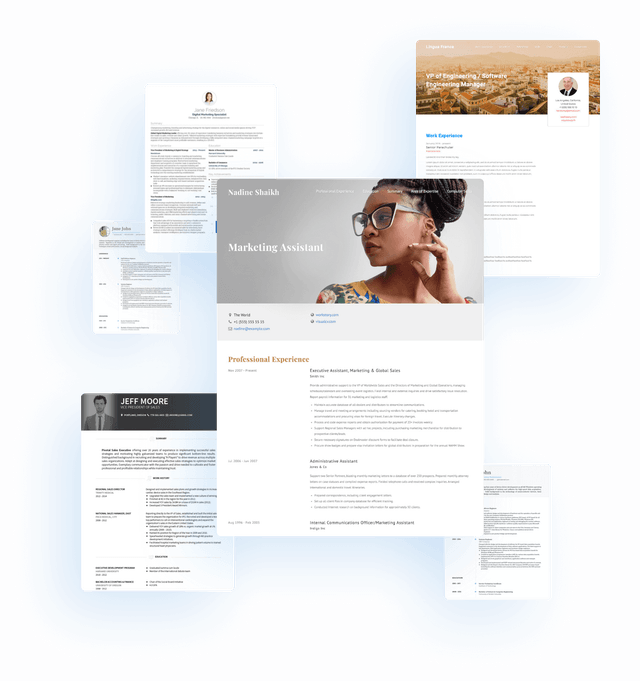
For over a decade, we have researched and written specific resume, cover letter, and job search advice that is hard to find elsewhere. Use our free resources for your electrical engineering job search.


Choose a polished resume design with tools that balance modern style and professionalism. Every VisualCV template has been tested and refined over a decade to support electrical engineering resumes.

Customize your resume for each electrical engineering job with ease. VisualCV lets you tailor standout templates to match the role, a step many candidates overlook when applying for open positions.

ATS-optimized, customized resumes help your application reach the readers. With VisualCV, you can focus on preparing for interviews while your resume presents your electrical engineering strengths.

VisualCV helps electrical engineers build tailored resumes that stand out with confidence in competitive job searches
Use a reverse-chronological, single-column format that puts your most recent electrical engineering work and technical specialization near the top. This format lets both a recruiter and a technical reviewer follow your contribution through the engineering chain, from requirements, analysis, and design through prototype build, bench test, debugging, verification, release, commissioning, or field support. It also keeps dates, employers, project context, and progression easy to scan.
Give visual priority to the evidence most relevant to the role you want next:
Example:
For a controls-focused application, a readable order is:
Electrical Engineer | Controls and AutomationA hybrid format can make sense if you are a recent graduate, moving from technician work into an engineering role, or returning after time away. Keep the dated work history, then use projects, lab work, capstones, or a technical profile to establish engineering analysis and design capability. Avoid a fully functional format that groups work only by skill, because it can blur whether you designed a subsystem, ran verification tests, supported manufacturing, or performed hands-on installation and repair. Use two pages when your experience needs room for distinct projects, publications, commissioning work, or senior-level design ownership; otherwise, a focused one-page resume is often enough for an entry-level electrical engineer.
An electrical engineer resume should use standard sections to show your specialty, relevant engineering evidence, and the scope of your contribution.
Contact details and positioning: Include your name, location, email, phone, and a LinkedIn profile or portfolio only when it contains public or sanitized evidence you are permitted to share. Use a specialty headline for quick positioning. Add a short summary when relevant experience or specialization needs framing. Use an objective only if you are a graduate, career changer, or technician moving into engineering and need to state a specific target direction.
Professional experience: List the employer, title, dates, and the system, subsystem, or process you supported. Identify your contribution and level of ownership rather than claiming responsibility for the whole product.
Example:
“Supported design verification for a power supply subsystem” is more credible than implying you owned the full product design.
Selected engineering projects: Include capstones, research, internships, lab work, competition projects, or independent builds that show relevant technical capability not visible in your work history. State the technical problem, your role, the system involved, and the validation performed. This can carry substantial weight for graduates, career changers, and technicians moving into engineering roles.
Education: List your degree, institution, and graduation date or expected date. Early-career candidates can add coursework that supports the target specialty.
Technical skills: Group skills by function. Separate design and analysis tools from programming and test equipment, and include tools only when they connect to work you can discuss.
Credentials: Use a clearly labeled section for credentials you hold, such as EIT status or a PE license. Include relevant clearance or certification when applicable.
Cross-functional and release or field evidence: Include coordination with firmware, mechanical design, manufacturing, quality, technicians, vendors, or field service when it connects to a concrete artifact or outcome:
Protect confidential details by naming the system class and constraint. State the test method and outcome without proprietary specifications.
Build your electrical engineer resume by producing five role-specific outputs that show where you contributed in the engineering chain and why that work fits the role. Start with the target posting, then turn your strongest evidence into a focused application version.
Target-role evidence map. Extract the posting's specialty, required qualifications, and core deliverables. Match each priority requirement to a position, project, internship, research assignment, or lab system you can support. Keep power, controls, embedded hardware, and test work in separate maps when they call for different evidence.
Selected record of work. Choose the work that best supports the map. For each item, capture the system, engineering stage, constraint, and outcome. Include capstones or research when they provide stronger evidence than unrelated experience. See the experience guidance for precise ownership and confidentiality-aware wording.
Drafted bullets. Write concise bullets that connect your contribution to a design decision, test result, release, commissioning task, or resolved issue. Show whether your work involved analysis, design, simulation, prototype build, verification, or troubleshooting rather than reducing it to a generic duty.
Before: "Tested power supply boards and fixed issues."
After: "Performed bench verification on power-supply prototypes and documented corrective actions after isolating failure modes during bring-up."
Selected terms and tools. Add only the technical terms that appear in your evidence map and drafted bullets. Select specialty-relevant tools, such as MATLAB for modeling or a PLC platform for controls work. Use the skills, tools, and credentials guidance for detailed tool context and accurate standards language.
Final application-ready version. Compare the finished resume with one target posting. Verify that high-priority requirements are supported by experience or projects. Remove unsupported terms, check standard headings and readable text for ATS parsing, then save a specialty-specific version.
First reassess your specialty positioning. Then check whether required qualifications have credible evidence and whether the version actually fits the posting before rewriting the entire resume.
Strong electrical engineering experience shows where you contributed in the engineering chain, the system or subsystem involved, the constraints you worked within, and how the work was tested, released, commissioned, or otherwise moved forward. A reader should be able to tell whether you performed analysis, owned a design task, supported a prototype build, ran verification tests, resolved a field issue, or coordinated a handoff to manufacturing or service.
Write each role around the actual stages of work you handled, rather than a broad duty such as “supported engineering projects.” For a product or electronics role, that may mean requirements review, schematic capture, PCB collaboration, bring-up, bench testing, debugging, and design verification. For power or utility work, it may mean load flow or protection studies, substation documentation, site coordination, commissioning support, or troubleshooting. For controls and industrial work, it may mean panel design, PLC or HMI development, sensor integration, factory acceptance testing, and uptime-related issue resolution.
Name the part of the system, project phase, and level of responsibility. “Designed” signals a different contribution from “assisted with,” “reviewed,” “tested,” or “documented.” If you worked on one board, enclosure interface, feeder, control panel, test fixture, or subsystem, say so. If you worked under a licensed engineer or supported a standards review, describe that relationship accurately rather than implying sign-off authority.
Meaningful responsibilities can include:
Tools carry more weight when connected to the work. MATLAB and Simulink belong beside modeling or control analysis. An oscilloscope, logic analyzer, power analyzer, or data acquisition system belongs beside the test or fault you investigated. AutoCAD Electrical, an EDA platform, or PLC software belongs beside the drawing, panel, board, or automation sequence you produced or modified.
Before: “Responsible for testing and debugging circuit boards.”
After: “Executed bring-up and bench testing for a power-supply PCB, used oscilloscope captures and load testing to isolate startup instability, and documented corrective actions for the next prototype revision.”
Use numbers only when you can defend them. Depending on the project, you may be able to state the number of boards, panels, channels, test cases, product variants, sites, drawings, or failure modes involved. You can also describe a real change in test coverage, defect recurrence, downtime, schedule, cost context, or production readiness without disclosing restricted specifications or customer information.
Not every credible result has a clean metric. Qualitative evidence is useful when it identifies a technical decision or downstream outcome, such as resolving an intermittent fault before release, producing test documentation used by manufacturing, supporting a successful commissioning activity, or identifying a root cause that informed a redesign. Replace confidential names and values with truthful scope, such as “multi-board control assembly,” “customer deployment,” or “high-volume production line.”
A strong bullet follows a practical pattern: technical work, scope or constraint, then verification or effect. This gives both a recruiter and a technical reviewer enough context to understand what you actually did without turning the resume into a design report.
Electrical engineering accomplishments show what you changed, verified, resolved, or enabled in a design or system, not simply the tasks assigned to you. A strong statement identifies your actual ownership in the engineering chain, from requirements and analysis through schematic design, simulation, bench test, debugging, design verification, release, commissioning, or field support. It also names the constraint or result that made the work matter.
Use action + technical scope + outcome. The outcome can be a measured result, but it can also be a completed verification milestone, a root cause isolated, a design decision supported by test data, or a production issue resolved. State whether you designed a subsystem, conducted testing, authored a procedure, supported a build, or led a workstream. Do not imply that you owned the whole product, approved compliance, or signed off on a design if that was not your authority.
Useful evidence often comes from:
Before:
Responsible for testing circuit boards and fixing issues.
After:
Performed bench bring-up and fault isolation on prototype control boards using an oscilloscope and logic analyzer, documenting root causes and retest results for design review.
The second version is stronger because it distinguishes test work from design ownership, names the work product, and shows how the findings entered the engineering process. Add a real scale only when you can support it, such as the number of boards, test cases, panels, substations, production units, channels, or sites involved.
Electrical work does not always produce a clean revenue figure. Honest measures can describe the size of the system, the test burden, the before-and-after condition, or the delivery effect. For sensitive projects, replace proprietary product names and restricted specifications with a neutral description such as “multi-board embedded platform,” “industrial motor-control panel,” or “utility protection upgrade.”
Example:
Automated analysis of 180 captured test-data files in Python, reducing manual review time for the verification team and improving traceability between test runs and reported anomalies.
Only retain “180,” the time reduction, or any reliability claim if your records support it. If the result cannot be measured, describe the engineering consequence precisely: “closed a recurring field fault,” “completed commissioning documentation for handover,” or “provided test evidence for a release decision.”
For power and utility work, evidence may center on load-flow or protection studies, relay settings support, commissioning, outage coordination, drawings, or installation constraints. In electronics and embedded roles, it may center on schematic capture, PCB layout collaboration, SPICE or MATLAB analysis, bring-up, signal integrity, power, thermal behavior, or design verification. In controls and industrial roles, it may center on PLC logic, HMI changes, sensors, safety interlocks, panel integration, startup, and uptime-related troubleshooting. Name the context that applies to your work rather than combining specialties you did not practice.
Standards, safety practices, and design reviews add credibility only when connected to a real contribution. Write that you prepared documentation, participated in a review, tested against defined requirements, or worked under a project process. Reserve language such as “approved,” “certified,” or “signed off” for responsibilities you genuinely held.
Build each version around the engineering specialty, point in the development chain, and level of ownership named in the opening. Reorder experience bullets and projects so the most relevant design, analysis, test, or field work appears first, then use the target role's technical language only where it accurately describes work you performed.
Move power-flow studies, protection coordination, relay work, substation design, commissioning, or field coordination ahead of general circuit or product work. Emphasize the operating environment, safety practices, design reviews, and handoff between engineering and field teams. Name IEEE standards or other codes only when you worked under them, and do not imply approval or sign-off authority you did not hold.
Example:
"Supported substation commissioning by resolving wiring and protection issues with field technicians and documenting corrective actions for the project team."
Give priority to the path from requirements through schematic capture, prototype build, bench debug, design verification, and release support. Show the subsystem you owned or supported, along with constraints such as power consumption, thermal conditions, signal integrity, testability, cost, or manufacturability. A hardware hiring team needs to see more than a software name. It needs to understand what you designed and how you verified it.
Example:
"Developed and debugged a power-supply subsystem, using bench measurements to verify performance against design requirements before prototype release."
Lead with PLC logic, HMI development, control panels, sensors, actuators, integration, and commissioning rather than broad electrical design language. Emphasize how you diagnosed an equipment issue, translated process needs into controls changes, or coordinated installation with maintenance, manufacturing, or vendors. Mention AutoCAD Electrical or a PLC platform in the experience bullet where it supported that work.
Example:
"Updated PLC logic and HMI alarms during equipment integration, then supported site testing to resolve sequence and sensor faults."
For embedded roles, show where hardware and firmware met: board bring-up, interfaces, timing, power, data acquisition, firmware-hardware debugging, and lab validation. Put C, C++, Python, version control, oscilloscopes, or logic analyzers beside the project work that required them. This distinguishes hands-on integration from a disconnected list of programming languages.
Example:
"Performed board bring-up and firmware-hardware debugging with an oscilloscope and logic analyzer to isolate interface failures in a prototype system."
Center the resume on test plans, fixtures, data collection, failure analysis, root-cause work, design verification, and production readiness. State whether you created the test method, executed it, analyzed results, or fed findings back to design and manufacturing. If outcomes are confidential, describe the scope, defect type, release decision, or process improvement without naming protected specifications.
Example:
"Executed design-verification testing, analyzed failure data, and documented findings that informed a revision before manufacturing release."
As responsibility grows, reduce space devoted to routine tool use and show technical decisions, architecture tradeoffs, design reviews, requirements traceability, risk resolution, and coordination across disciplines. Be precise about leadership. Leading a workstream, reviewing a subsystem, and owning the full electrical design are different claims.
Example:
"Led the electrical workstream for a subsystem redesign, coordinating requirements and verification activities with mechanical, firmware, and manufacturing teams."
For an entry-level electrical engineer resume, put capstone systems, lab design, research, internships, test fixtures, or engineering competition work near the top when they demonstrate the target specialty. If you are moving from technician work, separate assembly, installation, repair, or test execution from engineering contributions such as analyzing failures, revising documentation, supporting design changes, or validating modifications.
Example:
"Built and tested a capstone control system, documenting sensor behavior and refining the interface after bench testing revealed timing issues."
Choose skills that establish a coherent electrical engineering specialty and show where you contribute from requirements through field support. A focused stack helps a recruiter and technical reviewer place you in the relevant engineering chain instead of reading you as a generalist.
Read the target posting for repeated technical nouns, processes, deliverables, and domain language. Use its exact wording only when it truthfully describes completed work. Recognizable explicit keywords include:
Do not add a term simply because it appears in a posting. Standards, functional safety, and design authority can imply compliance responsibility or approval authority you may not have held. State a standard, review process, or safety practice only in the context you actually worked under.
Select the domain that matches the role, then keep the skills list internally consistent. Do not combine mutually irrelevant terms simply to cover more postings.
A skills section should show how your knowledge fits together, not treat every skill type as interchangeable.
Use named tools as explicit keywords when the posting requests them and your experience supports them. Let the experience bullets establish the system, method, constraint, and result rather than relying on a disconnected tool inventory.
A keyword identifies relevant experience, but the bullet beneath it should establish scope, ownership, and technical judgment. An instrument name alone says little. Explain the engineering purpose it served and the decision, test, release, or issue resolution that followed.
Weak:
"Skills: MATLAB, Simulink, PCB design, testing, troubleshooting, teamwork."
Better:
"Modeled control behavior in Simulink, analyzed prototype test data, and worked with firmware and mechanical engineers to resolve issues found during design verification."
The second version contains searchable concepts while explaining your contribution. Adapt that structure to your specialty: name the engineering activity, the system or constraint, and the resulting decision or outcome. If details are confidential, describe the subsystem type, test stage, operating constraint, or production context without disclosing proprietary specifications.
List software and lab tools in a focused Technical Tools subsection, then repeat a tool in experience or project bullets only when it was part of a design, analysis, test, or release decision. A reader should be able to see both your target specialty and the work you performed with each system.
Group tools by the engineering work they support, rather than placing every application, language, and instrument in one long line. Select categories that match the role you want:
A separate tools subsection works when the posting names platforms you genuinely use or when your tools would otherwise be hard to find in a dense work history. Keep it selective. MATLAB and Simulink support modeling and controls work, while an oscilloscope supports bench verification. They are not interchangeable signals of electrical engineering capability.
Give a tool space in an experience bullet when it explains your contribution, the constraint you investigated, or how you verified a result. Tool names alone do not show whether you created a model, debugged a board, collected test data, or supported commissioning.
Before: “Experienced with MATLAB, Python, oscilloscopes, and PLCs.”
After: “Used MATLAB to analyze test data from a power-converter prototype and traced bench anomalies with an oscilloscope before design verification.”
For proprietary or controlled work, name the method and your responsibility without exposing schematics, customer data, or restricted specifications. State standards, safety practices, or review tools only when you worked under them, and do not imply approval or sign-off authority you did not hold.
Put active licensure, credential status, and relevant completed certifications in a short Certifications and Licensure section, usually near Education. Move it closer to the top only when the target role specifically calls for a license or credential. Keep degrees, coursework, and capstone work in Education, and do not treat software training or familiarity with IEEE standards as a credential unless you completed a named program or held a formal designation.
State the credential exactly as issued and give enough context to define its scope. This is especially useful for a PE license or EIT status, where the title, issuing jurisdiction, status, and renewal rules can vary. Use the terminology on your record rather than a broader label that could imply authority you do not hold. For credentials in progress, name the completed step or current status, not the outcome you expect.
Avoid writing “PE candidate” or “PE license in progress” if you have not reached a defined licensing stage. Likewise, do not claim design approval, document stamping, code compliance sign-off, or safety authority because you supported a review, prepared drawings, ran tests, or worked under a standard.
Before: “PE in progress | Familiar with IEEE standards | Safety certified”
After: “Engineer in Training, [Jurisdiction] | Completed [named safety certification], [year] | Applied IEEE [standard identifier] requirements during design verification”
The second version separates a formal credential from engineering context. It tells a technical reviewer what you hold and what you actually did without overstating licensure, certification, or compliance responsibility.
An electrical engineer resume with no paid engineering experience should lead with technically defensible project evidence: the system or subsystem you worked on, the engineering work you performed, and how you verified it. Put Education and Selected Projects above unrelated employment when they provide your clearest evidence. A capstone, undergraduate research project, lab design, engineering competition entry, internship assignment, or technician role can substitute for direct experience when you describe your contribution precisely.
For each project, name the work rather than calling it a “student project.” Include the parts a technical reviewer needs to place you in the engineering chain:
Do not turn team participation into ownership. If you assembled panels, ran tests, repaired equipment, or supported installation as a technician, state that work plainly, then connect it to the engineering knowledge it built. Avoid claiming that you designed the full system, approved drawings, or signed off on compliance unless that was genuinely your responsibility.
Before: “Worked on a senior design project involving a motor controller.”
After: “Built and bench-tested a motor-control prototype for senior design; used oscilloscope measurements to compare switching behavior against simulation results and documented test findings for the team’s design review.”
Use unrelated work only when it proves a transferable operating habit, such as controlled documentation, safety procedures, troubleshooting, or coordinating with technicians. Keep the engineering evidence separate from those roles so a reader can see where your technical foundation ends and your direct engineering contribution begins.
Choose a chronological, project-forward, or senior technical template based on whether your strongest evidence is career progression, hands-on engineering work, or system-level ownership.
This format suits electrical engineers with a clear work history in design, test, commissioning, manufacturing support, or field troubleshooting. It keeps employers and dates easy to scan while leaving room for the subsystem, tools, and verification work behind each role.
This format suits students, recent graduates, and engineers moving from technician work into engineering. Place capstones, lab research, PCB builds, test fixtures, or firmware-hardware integration near the top when they show analysis, design, prototype build, and bench validation.
Example:
"Designed and bench-tested a sensor interface board; documented test results and debug findings for the next prototype revision."
This format suits senior electrical engineers whose value lies in architecture, design reviews, technical decisions, and cross-functional delivery. Use it when you need to show ownership across requirements, simulation, verification, release, and coordination with firmware, mechanical, quality, manufacturing, or field teams without turning the page into a tool inventory.
As a narrower follow-up to overall resume content, include projects that show work relevant to the target specialty and your specific contribution. A power candidate might feature a protection study or commissioning project, while an electronics candidate could highlight board bring-up, test automation, or design verification. State the constraint, tools, and result without disclosing proprietary details.
As a narrower follow-up to skill selection, list enough skills to establish a focused specialty, usually prioritizing the tools, methods, and domains named in the posting. Group related items such as PLC platforms, circuit simulation, bench equipment, or power-system studies, and omit tools you cannot discuss credibly in a technical interview.
One page is a strong target for students, new graduates, and many engineers with less than roughly a decade of directly relevant experience. Two pages can be appropriate when you need space for substantial design, field, research, or leadership work, but each entry should earn its place with relevant technical evidence rather than a full task history.
Use standard section titles, a conventional reverse-chronological layout, and text that can be read without relying on graphics, columns, or embedded images. Mirror accurate terms from the posting, such as protection relays, PCB design, PLC programming, or verification testing, while using the employer's exact terminology only when it truthfully describes your experience.
As a narrower follow-up to writing experience bullets, design bullets should identify the subsystem, design decisions, constraints, and release stage, while test bullets should show the method, equipment, failures investigated, and verification outcome. In either case, distinguish whether you owned the work, supported a lead engineer, or contributed to a subsystem.
As a narrower follow-up to resumes with no professional experience, capstone, research, and advanced lab work can appear in a Projects or Relevant Experience section when they demonstrate engineering capability. Describe the system you built, analyzed, or tested, your individual role, and the tools used; do not present classroom work as paid industry employment.
As a narrower follow-up to software and tool selection, list the tools that match the target environment and connect them to work you performed. MATLAB or Simulink may support modeling and controls roles, AutoCAD Electrical may fit panel or schematic documentation work, and PLC experience is most relevant for automation, integration, and industrial controls positions.
As a narrower follow-up to credential placement, put an active EIT or PE after your name when that wording is accurate, and repeat it in a Licenses and Certifications section with the issuing jurisdiction if useful. State only your actual status, such as EIT, PE, or eligibility details supported by your records; requirements and terminology vary by jurisdiction and employer.
A summary is most useful when it quickly clarifies your specialty, level, and target direction, especially for experienced engineers, career changers, or candidates moving from technician work into engineering roles. Skip it if it would only repeat your title and generic strengths; use the space for a project, credential, or technical result instead.
As a narrower follow-up to tailoring, maintain separate versions for meaningfully different targets, such as power systems, embedded electronics, controls, or manufacturing support. Keep the core employment history consistent, then adjust the summary, selected projects, technical skills, and the order of bullets so each version foregrounds the most relevant evidence.