Data Scientist Resume Builder
Create ATS-friendly data scientist resumes with templates. Download PDF or Word.
Sign-up FREE. No Credit Card Required.

Create ATS-friendly data scientist resumes with templates. Download PDF or Word.
Sign-up FREE. No Credit Card Required.
VisualCV helps 75k+ data scientists create winning resumes with tested design, ATS optimization, and AI guidance. Highlight the skills, projects, and results hiring managers want to see.

Use our data scientist resume examples to clarify your approach or find inspiration. These job-winning resumes offer an insider view of the skills, projects, and outcomes employers expect to see.
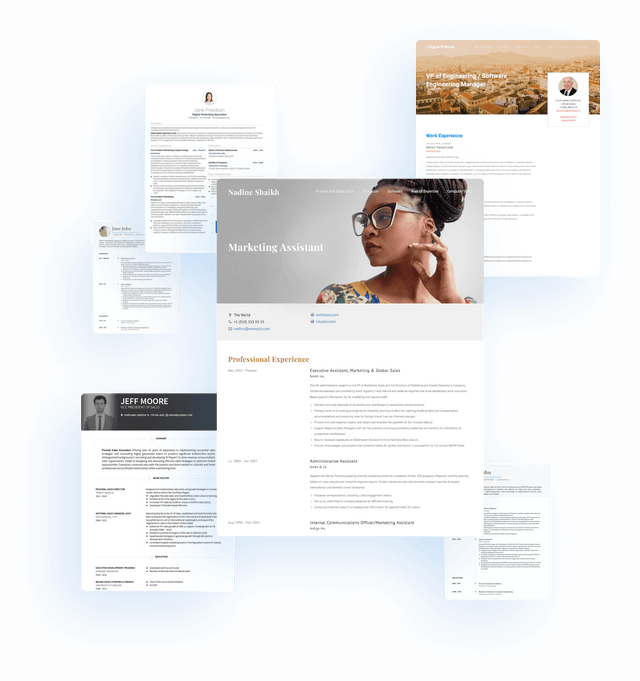
For over a decade, we have researched and written specific resume, cover letter, and job search advice that is hard to find elsewhere. Use our free resources to pursue your ideal data scientist role.


Use design tools that balance modern style with professionalism. Every VisualCV template has been tested and refined over a decade to support clear, credible data scientist resumes.

Tailor your resume for each data scientist job with ease. Customize your standout template to emphasize the skills, tools, projects, and results that matter most for every role you pursue now.

ATS-optimized, customized resumes make your experience easier for employers to find and understand. With VisualCV, you can focus on preparing for interviews instead of worrying about formatting.

VisualCV is the best resume building platform for data scientists, easing blank-page stress with polished resumes.
Use a reverse-chronological, single-column resume with conventional headings and dates. It lets readers trace your progression from data preparation and SQL analysis into modeling, deployment, or decision support. Chronology attaches each technical claim to a role, team, and timeframe, rather than leaving Python or machine learning as unsupported skills. Plain headings and standard dates also keep the document readable for an applicant tracking system and a person.
Give the most visual space to evidence that matches the role:
Before: A long tool inventory fills the top half of page one while relevant experience starts below the fold.
After: “Product Data Scientist | Experimentation and forecasting” appears near the top, followed by recent work that explains the decision it supported. A compact skills section then confirms Python and SQL.
Use one page if you are early in your career or if page two would mainly contain generic skills, older unrelated work, or weak projects. Use two pages only when, after those cuts, you still have relevant depth:
An academic CV is appropriate only when the application calls for one, such as for research, faculty, or publication-heavy work. A two-column layout is an exception: use it only when the application can safely accept it and it does not displace dated experience or project context, or make chronology hard to read.
A credible data scientist resume lets a reader trace your work from a decision or research question through data, method, evaluation, and use of the result. Put the strongest evidence for the target role first, using conventional headings that make technical detail easy to find.
Contact details and links: Provide your name and direct contact details, plus LinkedIn and only useful external links. Links provide inspectable evidence: a repository shows code, a notebook shows an analysis narrative, and publications show research contribution. Competition work needs more than participation or rank, such as the question, approach, validation, or resulting artifact. Do not link confidential employer code or datasets.
Professional summary: A summary establishes your specialization. Use two or three lines when experience or a clear focus supports it, naming work such as experimentation, forecasting, NLP, or causal inference. Entry-level and career-change candidates may use a targeted summary, but omit a generic objective that only states the job you want.
Experience: Experience establishes professional ownership. For each role, include employer, title, location, and dates, then explain the problem, data workflow, method, validation, and decision or system context. Include SQL extraction, data quality checks, feature development, stakeholder analysis, or error analysis when they materially shaped the work.
Before: “Built a churn prediction model using Python.”
After: “Developed and evaluated a churn-risk model from product and billing data, compared performance with an existing rules-based baseline, and delivered retention segments for lifecycle marketing planning.”
The second version establishes the prediction goal, data, evaluation context, and use without claiming an unmeasured outcome.
Selected projects, research, or publications: Projects and research fill evidence gaps when they show relevant work more clearly than another job bullet, particularly for graduate researchers, career changers, or candidates with limited related experience. State the question, data type, approach, validation, and deliverable. Distinguish a reproducible notebook from a stakeholder analysis, deployed model, or published research rather than implying equivalent evidence.
Technical skills: Skills confirm capabilities. Group them by function, such as programming and query languages, statistical and machine learning methods, data platforms and cloud services, and communication tools. Include only tools you can discuss through real work.
Education and credentials: Education and credentials establish qualifications. List degrees, institutions, dates, and relevant graduate research. Add coursework, thesis work, lab work, teaching, capstones, or certificates only when they clarify relevant preparation rather than substitute for project evidence.
Additional context: Add publications, patents, open-source contributions, speaking, or leadership when they clarify technical depth or influence. For confidential work, describe the problem category, non-sensitive scale, method, and directional result without naming customers, internal datasets, or restricted figures.
Build your data scientist resume by moving from a truthful work inventory to a focused, role-specific document with verified claims.
Create one complete source document first, then make a focused version for each application. A product data science role may put experiment design and metric decisions near the top. An applied machine learning role may instead foreground model evaluation; error analysis; and production collaboration.
Create your source inventory. For every role, internship, research assignment, or project, capture the question; data used; preparation work; method; validation; collaborators; and outcome. Include SQL extraction or data-quality work when it shaped the result.
Define the target work. Read the posting for its specialization, domain language, and data environment. Mark the work the role emphasizes, then retain only terms you can support through your experience or skills, rather than adding a library or model name without context.
Select proof for scarce space. Choose the strongest relevant evidence among experiments; predictive work; forecasts; research; data-quality work; and stakeholder analysis based on the target role. Prefer work that shows the question, your contribution, and the result.
Example:
"Analyzed product-usage and support data to identify churn-risk segments, validated findings against a baseline, and provided retention priorities to product and operations partners."
Build the tailored draft. Put the selected evidence first in your summary, experience, and projects. Keep the source document intact, then reorder and trim for each application so product, applied machine learning, or research work is visible quickly.
Run a completion check. Use conventional headings and dates, remove unsupported claims, and confirm that each technical detail belongs with the work it supports. Keep the final version readable without turning it into a catalogue of tools.
Pre-submission checklist: Target-role evidence appears first; supported posting terms appear in skills or proof bullets where appropriate; dates and headings are conventional; deployment and ownership claims are accurate; metrics are verified; links are verified; confidential details are verified.
Your experience bullets should show the employer context and your role in a defined piece of work, not just the tools you used. For each role, establish:
Describe the real workflow rather than presenting modeling as an isolated task. Name the data type when it is shareable, then show the work that made it usable, such as SQL extraction, data-quality checks, label definition, feature development, experiment design, or stakeholder readout. This helps a reviewer distinguish an analysis that informed a decision from a model embedded in a larger product or research pipeline.
Scope distinguishes a one-off notebook from work that supported a live product, operating process, or research program. State whether you led the analysis, contributed to a shared pipeline, or supplied findings to product, engineering, operations, marketing, or leadership. For predictive work, show judgment through the target, baseline, validation approach, and a relevant trade-off such as interpretability, latency, or class imbalance. For product work, identify the metric definition, experiment design, segmentation, or inference that informed a decision.
Boundary rule: Describe work at the furthest stage you personally reached.
If you supported deployment without owning it, use truthful phrasing such as, “Partnered with engineering on integration and validated pre-release outputs,” rather than claiming that you deployed the system. A verified number can situate your role, such as the records processed or experiments analyzed. When no outcome can be measured, describe durable evidence of the work, including a reproducible pipeline, resolved data-definition issue, documented assumption, or decision-ready recommendation. Do not imply revenue, retention, or other business results that were not measured.
Before:
"Built a random forest model in Python and presented results to stakeholders."
After:
"At a subscription software company, developed a renewal-risk model during a six-month retention initiative; partnered with customer success to review false positives, compared results with the existing rules-based process, and delivered ranked accounts for retention planning."
Strong data science accomplishments show the question you answered and defensible evidence that your work affected a decision or system. A responsibility states what you were assigned. Evidence of effectiveness shows what you evaluated, improved, enabled, or delivered, with attribution that matches your role.
Build each accomplishment with three parts:
A model name alone is weak evidence. State the prediction or inference goal, the validation approach, and the relevant conclusion when space allows. Include the work you owned without implying you owned every stage of a team project.
Use numbers you can support, but do not invent metrics or claim causation you cannot prove. Data science evidence can take several forms:
Example: “Designed the analysis plan for a checkout experiment, validated event instrumentation, and estimated the treatment effect on conversion; findings informed the next product release.”
Example: “Developed a demand forecast from multi-region sales data; compared results with a seasonal baseline, reviewed high-error segments, and delivered planning scenarios to operations.”
Example: “Built a reproducible benchmark for document classification, evaluated error patterns across labeled subsets, and presented the method at a departmental research symposium.”
Example: “Reconciled conflicting customer tables and added validation checks for key event fields, removing a reporting constraint that had blocked weekly funnel analysis.”
Distinguish an observed experiment result from a recommendation, a deployed model, and a team outcome. Say an experiment observed a change, an analysis informed a decision, or a model was deployed in a workflow. If a team achieved a business result, describe your specific contribution rather than claiming sole causation.
For confidential work, use a safe domain and scale description instead of protected names or figures. You can describe a regulated customer workflow or high-volume claims data, then state the method and a defensible directional outcome without disclosing internal thresholds or customer data.
Build each version around the role's problem and your workflow, then show how the work informed a decision or system. Reorder the same record so the most relevant evidence appears first, using posting terminology only when it accurately describes your work.
Choose the target discipline before selecting bullets:
Move product questions, metric definitions, and decision evidence up. Deprioritize model names and descriptive dashboarding; prove experiment design or causal reasoning through the decision you supported.
Example:
"Designed A/B test analysis for a checkout change, defined guardrail metrics, and presented segment-level results that informed the rollout decision."
Move the prediction problem, training data, and validation evidence up; deprioritize notebook-only model labels. Prove a baseline and evaluation metric, then add error analysis or production contribution only when accurate.
Example:
"Built a churn-risk model from account activity and support data; compared against a rule-based baseline and analyzed false positives before handing scoring logic to engineering."
Move time-series or allocation work up and deprioritize generic modeling bullets. Prove the forecast horizon and business constraint, then state whether the output was a forecast, recommendation, or automated decision.
Example:
"Developed weekly demand forecasts for regional inventory planning, evaluating error by product group and seasonality before planners used the outputs in replenishment reviews."
Move the modality and data-preparation work up; deprioritize architecture-only claims. Prove data quality, labeling or annotation work, and observed failure modes alongside the model.
Example:
"Evaluated document-classification models on manually reviewed support tickets, tracing errors by intent category and improving label guidance for ambiguous cases."
Move scholarly work ahead of unrelated business reporting. Prove the research question through experimental design and reproducibility, name the contribution, and use a CV only when a fuller publication record is requested.
Example:
"Investigated uncertainty calibration for medical-image models, reproduced published baselines, and documented experimental settings for repeatable evaluation."
Move problem framing and measurement strategy up; deprioritize technical detail that hides scope. Show how you reviewed work or influenced choices, then state your precise contribution to a cross-functional result.
Example:
"Partnered with engineering and product leaders to define success metrics for a ranking initiative, reviewed evaluation design, and guided trade-off decisions before launch."
Select evidence for the target role, not only your prior title. From analytics, retain SQL and domain context but do not imply inference, experimentation, or predictive modeling without proof. From software or machine learning engineering, retain platform work when relevant but do not imply analytical judgment or model ownership you did not have; for machine learning engineering targets, foreground production systems and platform ownership instead.
Example:
"Used SQL and Python to segment customer behavior, tested retention hypotheses with a defined comparison group, and translated findings into lifecycle campaign recommendations."
Use your skills section for truthful, recognizable capabilities and tools from the posting, then use experience or project bullets to prove how you applied them. This gives recruiters and applicant tracking systems clear terms to match without reducing your resume to a keyword dump.
List a term compactly when it names a capability you can genuinely claim. Move it to a bullet when it makes a claim about how you worked, what you evaluated, or what your work enabled. These require contextual evidence:
Group terms around the work the role requires, rather than building a second software inventory.
Use the posting's conventional wording when it accurately describes your background. Keep the strongest matching terms near the top of each category, and leave out tools or methods you cannot discuss with specific evidence.
A model name does not show whether you framed the right question, prepared usable data, selected a baseline, or interpreted results for a decision. In an experience or project bullet, connect the work to its context: the question, the data or constraint, the method, and the validation or decision use.
Weak:
“Python, SQL, machine learning, random forest, Tableau.”
Better:
“Built and evaluated a classification model using cleaned transaction data. Compared it with a baseline and showed operations partners which error patterns should change review priorities.”
The stronger version includes searchable terms while proving evaluation and decision support. Use this level of evidence for claims about experiments, forecasts, causal conclusions, monitoring, or delivery.
Prioritize vocabulary that reflects the role's decision context. For product data science, foreground metric design and funnel analysis, then substantiate experimentation or A/B testing in a bullet. For applied machine learning, list feature development or training pipelines when accurate, while using experience to show evaluation, monitoring context, or collaboration with engineering. For research-focused roles, terms such as reproducibility and experimental design may fit the skills section; publications, domain methods, and novel modeling approaches need evidence elsewhere on the resume.
Use clear skill labels rather than clever abbreviations. Repeat a term only when your experience or projects support it, so the resume remains readable to people as well as systems.
List named tools in a compact Technical Skills section for scanning, then repeat them in experience or projects only when the tool changes the meaning of the work.
Use a separate skills section when a target role names a stack or when core tools would be buried in your work history. Group tools by the workflow you can truthfully discuss:
Match categories to the role, and do not assign proficiency levels without a consistent, defensible basis.
Name a tool in a bullet when it shows where data came from, how it was processed, how an experiment or model was evaluated, or how work was delivered. Spark can clarify distributed processing. A model library can clarify training. AWS belongs when you used it for serving, monitoring, or a handoff to engineering. Tableau can show visualization, while Git or Jupyter Notebook can show reproducibility or collaboration.
Naming any of the following does not, by itself, establish cloud deployment, MLOps, production ownership, or technical depth:
Example:
"Queried subscription events in BigQuery with SQL; trained churn candidates in scikit-learn against a baseline; handed scored segments to product stakeholders in Tableau."
The tools are searchable, but each one also explains a distinct part of the workflow rather than implying capabilities you did not own.
Place completed credentials in a dedicated Certifications section below Education, or near the top only when they directly support the role. Keep degree titles, universities, thesis work, and academic honors in Education. Use Certifications for completed professional certificates, cloud or platform credentials, and formal continuing education that adds relevant evidence beyond your degree or experience.
Name a credential only at the status you have earned. For an active program, write “In progress” with an expected completion month and year. Do not use a credential abbreviation after your name, describe yourself as certified, or list a completion date until the issuing organization has awarded it. If a credential has an expiry or renewal date that matters to the work, include it only when current and accurate.
Example:
Data science has no single universal certification path. A research role may give more weight to a master's or doctoral degree, dissertation, publications, and reproducible research. A product or applied machine learning role may treat a cloud, data platform, or experimentation credential as supporting context, not a substitute for project evidence. Expectations also vary by employer, industry, country, and whether the work involves regulated data. List only credentials you can verify, and let the most relevant work, research, or projects carry the technical case for your application.
You can write a credible data scientist resume without a data scientist title, or without professional experience, by showing real data work and explaining the result truthfully. Use the label that matches the source of your evidence:
Include a Kaggle or competition entry only when it documents:
Rank or participation alone is weak evidence and should not displace stronger research, internship, stakeholder, or adjacent-work evidence. For limited space, lead with the strongest role-relevant work. Use adjacent work next to show transferable scope, and omit padded or unfinished projects. Do not present a notebook as a production system if it was not deployed. A GitHub project should show readable code, a clear README, and enough context to understand the method and limitations.
If you are changing careers, keep your actual job titles. An operations role may show forecasting or data-quality ownership; a software role may show pipelines or experimentation support. State what you did, what you learned, and what the work informed, without claiming unmeasured business impact.
Before:
"Built a customer churn model in Python using random forest."
After:
"Analyzed anonymized subscription records to identify churn risk; cleaned event data in SQL, compared logistic regression and random forest with cross-validation, and documented error patterns and retention recommendations in a reproducible Jupyter Notebook."
Use a single-column resume for most applications; reserve two columns for a limited skills-led exception; use a research-oriented layout when scholarly evidence is strongest.
Example:
Choose this standard ATS submission format when your dated roles show progression from SQL and data preparation to applied modeling or product decisions. Put selected projects after experience so the chronology stays easy to read.
Use this limited exception if you are early-career or project-heavy and need Python and SQL visible beside internships. Avoid it if columns crowd dates or disrupt reading order.
Choose this when a thesis and peer-reviewed work are more relevant than a long job history, such as a PhD candidate targeting research science. Keep entries resume-length, leading with the question and data, then evaluation and contribution.
Leave off outdated tools, generic soft-skill lists, unrelated coursework, and projects that cannot show a clear analytical contribution. As a narrower follow-up to broader inclusion guidance, prioritize evidence of problem framing, data work, validation, and decisions over a long inventory of algorithms or libraries.
Prioritize skills that recur in the target role and that you can substantiate in experience, projects, research, or publications. As a narrower follow-up to general skills guidance, group capabilities by purpose, such as languages and data tools, modeling and statistics, experimentation, or cloud, and place the most relevant group first.
Describe confidential work by its problem category, your scope, the data or operational constraints, the method, and a non-sensitive outcome. As a narrower follow-up to project-description guidance, use ranges, percentages, directional improvements, or anonymized business context when specific customers, datasets, revenue figures, or model details cannot be shared.
Yes, relevant coursework, thesis research, capstones, and lab work can provide credible evidence when paid data science experience is limited. As a narrower follow-up to no-experience guidance, describe the question, data, methods, validation, and findings, and distinguish independent work from team contributions rather than presenting class assignments as employment.
Use one page when you can present your most relevant evidence clearly, and use two pages when additional experience, research, publications, or technically substantial projects improve the case for the role. Early-career data scientists can usually stay concise, while experienced candidates should not cut meaningful evaluation, impact, or leadership context solely to fit one page.
Most prominent technical skills should appear somewhere in your experience, research, or project evidence, not only in a skills list. As a narrower follow-up to software and tools guidance, list Python, SQL, machine learning libraries, or cloud platforms only when you can explain how you used them and what analytical or production context they supported.
Use conventional headings, simple formatting, standard job titles and dates, and terminology that truthfully matches the job description. Include role-relevant terms such as SQL, experimentation, forecasting, model evaluation, or NLP in context, rather than repeating keywords; applicant tracking systems and employer configurations vary, so no format can guarantee a result.
Include a GitHub link when it contains a small set of polished, relevant repositories that demonstrate readable code, documentation, reproducibility, and your own contribution. It is optional for candidates whose strongest work is confidential, stakeholder-facing, or publication-based; never share employer code, private data, credentials, or sensitive notebooks.
A data scientist resume emphasizes problem framing, statistical reasoning, experimentation, model evaluation, insight delivery, and decision impact, while a machine learning engineer resume more heavily emphasizes software systems, deployment, pipelines, monitoring, reliability, and platform ownership. The balance changes by role because many teams use the titles differently.
Include certifications when they are current, recognizable to the target employer, and reinforce a capability relevant to the role, such as a cloud platform or specialized analytics domain. As a narrower follow-up to credential-listing guidance, place stronger evidence such as degrees, research, deployed work, or rigorous projects ahead of certificates that do not demonstrate applied skill.