Career Change Resume Builder
Create an ATS-friendly career change resume and download it as a polished PDF.
Sign-up FREE. No Credit Card Required.

Create an ATS-friendly career change resume and download it as a polished PDF.
Sign-up FREE. No Credit Card Required.
VisualCV helps 10k+ career change professionals create resumes with clear design, ATS optimization, and AI guidance, so transferable skills and relevant achievements stand out to hiring managers.

Explore career change resume examples to find clear ways to frame transferable skills, explain your move, and tailor accomplishments. These strong resumes offer practical inspiration for your own story.
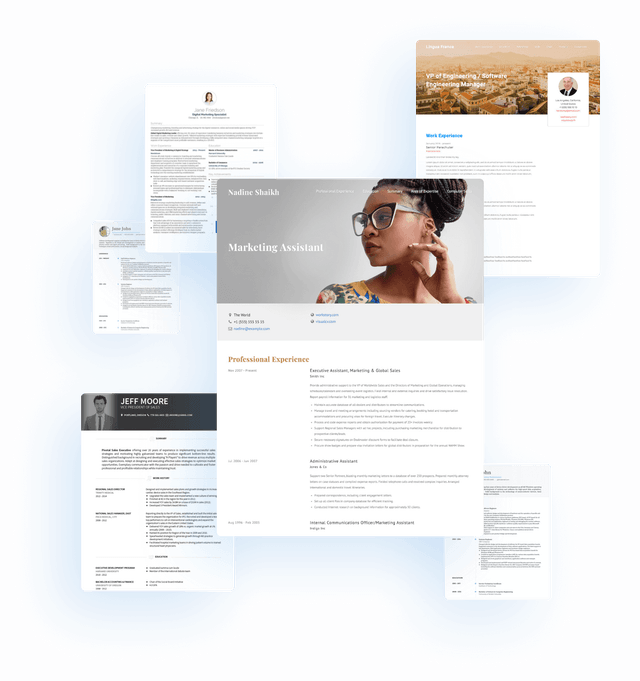
For a decade, we have researched and written focused resume, cover letter, and job search advice. Use our free career change resources to sharpen your materials and pursue the work you want.


Choose a polished resume design without sacrificing professionalism. VisualCV templates balance modern style and clarity, refined through a decade of testing to support career change resumes.

Customize your resume for every career change role with ease. Adapt our standout templates to match the posting, foreground relevant skills, and make each accomplishment fit the opportunity closely.

An ATS-optimized, customized resume gives your application a stronger chance to be read. With VisualCV, you can check the details, name your file, send it, and focus on preparing for interviews.

VisualCV helps career change professionals turn varied experience into a focused resume that answers employer concerns.
Use a reverse-chronological resume with a targeted summary and a prominent skills or selected-projects section. Chronological keeps experience as the primary structure, preserving dates and titles while putting early proof of your fit for one target role in view. A purely functional resume, which groups experience under broad skill headings and minimizes dates, can make your transition harder to trust because it separates claims from the jobs where you developed them.
Give visual priority to:
Example:
A teacher moving into project coordination might lead with “Project Coordinator | Education Operations Background,” then place coordination evidence near the top. The teaching position remains accurately titled and dated, but its bullets foreground assessment-cycle coordination. They can also show shared-record management or process training for colleagues.
Choose a hybrid format when you have substantial experience but your strongest target-role proof comes from adjacent work and newer evidence, such as recent training or volunteer projects. A skills-forward layout is a hybrid presentation that elevates selected skills or projects while keeping chronology visible. Use a conventional chronological layout when your roles already show a clear progression, such as operations coordinator to project coordinator or account manager to customer success. Use one page when recent evidence makes the relevant case clear alongside a concise timeline; use two pages when you need both target-role proof and enough employment history to preserve credibility. Cut older, less relevant detail first. Retain recent proof, role dates and titles, and material accomplishments.
A career change resume should lead with a named target role. Next, show recent readiness evidence when it is material to the move, followed by selected transferable results and a complete but appropriately compressed employment timeline. This order lets a reader see your direction, preparation, and prior context without mistaking adjacent experience for direct experience.
Put your contact details at the top:
Follow with a headline that names the destination, not a vague label such as “Career Changer.” Use a professional summary when it can connect your prior context to transferable proof and recent preparation in two or three lines. Use an objective only when it adds a specific target, level, or constraint that the summary would not otherwise communicate.
Before: “Experienced teacher seeking a new opportunity.”
After: “Operations-focused educator moving into project coordination, with experience managing calendars, cross-functional stakeholders, training materials, and deadline-driven programs.”
This explains the direction without renaming your former job title or suggesting you have already held the new role.
Keep every position in your employment history with its standard identifying details and dates. Give the most detail to work that maps to the target role: client communication may support customer success, while scheduling and vendor coordination may support operations. Use measurable outcomes and scope where available.
Compress older positions that provide background but do not strengthen your case, rather than deleting them and creating an unexplained gap. Preserve the real setting of your work while using target-role language that accurately describes what you did.
When it provides material proof, place this section directly after your summary and before Experience. Label each item accurately so the reader can distinguish paid work from learning or independent practice.
A data analysis project can show the dataset, analysis, and report or dashboard produced. It should not be presented as professional analyst experience if it was a course project.
Use a skills section for capabilities from the target posting that you can discuss with specificity. Group skills into readable categories, and name a tool only when you have used it in work, training, or a project.
List degrees and institutions where appropriate. Retain an unrelated degree or credential when it explains your background or establishes readiness, but do not let it displace stronger current evidence.
Use recognizable labels that help a reviewer scan your background:
Keep separate versions for different destinations. A resume aimed at project coordination needs its own summary and priority evidence, rather than a broad document that also tries to support customer success.
Build a career change resume around one target role and support it with truthful evidence from your work, projects, or learning. Use this six-step workflow to turn a specific job posting into an application-ready version.
Choose a target. Name one job title and, when useful, one industry. Complete this step when your resume has a single destination, such as project coordinator in healthcare, rather than several unrelated paths.
Collect one posting. Save a current posting for that target role and highlight its core responsibilities and qualifications. Complete this step when you can point to the employer's actual priorities.
Map your evidence. Match each requirement to a truthful work example. Mark it as direct experience or adjacent experience, and note recent training separately when it is your best proof.
Before: “Handled daily customer issues and trained new staff.”
After: “Resolved escalated customer issues, documented recurring service problems, and trained 12 new team members on service procedures.”
This supports a move from retail supervision toward customer success or operations coordination without claiming either title.
Draft the resume structure. Lead with a summary that names the target role, then place the most relevant work evidence near the top. Complete this step when the document presents a clear transition rather than a rewritten job history.
Add and label recent proof. Include relevant projects, coursework, volunteer work, software practice, or completed credentials. Name the deliverable and your contribution, and clearly identify self-directed or classroom work.
Validate the finished version. Confirm that the target role is visible in the first few lines, your strongest evidence appears early, and every claim is interview-defensible.
Have a target posting ready. Gather work examples and any project or training details.
Describe career-change experience by keeping your real title and employer context. Name the relevant responsibility and your ownership level. Add its scope or constraint, then state the target-role capability it supports. A reviewer should see what you did, how much responsibility you held, and why the transition is credible. Lead with work you have performed, not an aspirational replacement title.
Use visible labels to distinguish the source of your evidence:
A duty becomes more useful when the reader can picture its scale, stakeholders, constraints, and ownership. For each relevant bullet, add the detail that shows whether you assisted, coordinated, owned, or improved the work.
Useful scope details include:
Do not turn every former responsibility into a target-role claim. If you coordinated a rollout but did not own the project plan, say you coordinated it. State the original setting when it clarifies the work, whether that was a hospital unit, retail store, school district, military command, or self-employed business.
Use destination-field language only when it accurately describes your work. A strong line identifies the prior responsibility, shows the transferable capability, and gives evidence of effective performance without relabeling your job.
Before: "Taught classes, communicated with parents, and completed administrative tasks."
After: "Planned and delivered training for classes of 25 to 30 learners, tracked progress in a learning platform, and communicated performance concerns and next steps to families and school staff."
This gives a training or learning-and-development employer concrete evidence of facilitation, progress tracking, system use, stakeholder communication, and delivery scale. It does not recast teaching as corporate training or imply experience with an unfamiliar system.
Use dependable records for volume or turnaround time. You can also quantify verified error reduction, revenue retained, or people trained. When a dependable metric is unavailable, describe the problem and your judgment, then name the operational result. Resolving a sensitive client issue or creating a repeatable handoff process can be meaningful evidence without a number.
Example: "Resolved escalated account-access issues by coordinating with technical and billing teams, documenting root causes, and giving customers a clear resolution path within the service process."
Keep older or less connected roles concise, but retain the employment record. Detail belongs where it proves readiness for the target role, while dates, titles, and employers preserve a consistent career history.
The strongest accomplishments on a career change resume show that you produced a relevant result in your actual work context and reduce doubt about your declared target role. A responsibility-only bullet states what you were assigned, such as scheduling staff or handling customer issues. Evidence of effectiveness shows what you did, the scale of the work, and what improved as a result.
Use action + scope + result for every accomplishment bullet. It is the single framework that turns a duty into evidence.
A responsibility-only bullet tells the reader what your job included. An action + scope + result bullet gives the reader a concrete reason to believe you can perform at the level the target role requires.
Before:
"Responsible for customer service, scheduling staff, and resolving issues."
After:
"Coordinated weekly schedules for a 22-person service team, resolved coverage conflicts, and introduced a handoff checklist that reduced missed customer follow-ups."
The revised bullet keeps the real setting intact while showing coordination, problem-solving, and process improvement. Do not add unsupported claims about direct target-role experience, software, formal methodologies, or account ownership unless you actually performed that work.
Select three to five accomplishments for each declared target role, not a broad set meant to serve unrelated destinations. Choose the examples that most directly answer the questions a reviewer may have about your readiness:
Favor accomplishments with a clear outcome over impressive-sounding duties. A newer portfolio project can earn a place beside established employment when it demonstrates a specific task and is accurately labeled. For example, "Volunteer project: mapped intake steps for a community program and produced a shared tracking guide" is credible because it identifies both the context and deliverable.
Quantify only what you can explain in an interview. Useful numbers include people trained, records audited, requests handled, shifts coordinated, deadlines met, or recurring issues resolved. When you lack a dependable baseline, an operational outcome is more credible than an estimated percentage. State that a checklist reduced missed follow-ups or that a guide standardized intake steps rather than claiming an unverified improvement rate.
Use a light edit when the target role, level, evidence order, and required terminology remain substantially the same. Create a separate version when the target role or the proof needed to support it changes materially.
Choose one destination and the level you can support. Your headline and summary should name that direction, while the skills section, projects, and first experience bullets show evidence for it. Do not build one resume for loosely related jobs.
Example: "Operations supervisor transitioning to project coordinator, with experience scheduling cross-functional work, maintaining status documentation, and resolving delivery issues."
Match recurring posting requirements to evidence you can explain in an interview. Use the strongest evidence first, whether it comes from employment, a project, or recent study.
For customer success, account coordination, or client services, change the headline and summary toward relationship management. Put communication, issue ownership, follow-up, and escalation skills near the top, then feature relevant projects and first bullets that show how you managed a customer need through resolution. Do not rename a retail or hospitality title as customer success manager.
Before: "Helped customers, handled returns, and trained new associates."
After: "Resolved service issues from first contact through follow-up, coordinated exceptions with store leadership, and trained 12 new associates on service and returns procedures."
For project coordinator or operations roles, lead with process work that moved deadlines, information, or materials forward. In the summary, name coordination scope; in skills, feature planning and documentation tools you have used; in projects and first bullets, show trackers, handoffs, and follow-through. Name the process you managed before naming a tool you used to support it.
Example: "Maintained weekly production tracker for three teams, followed up on delayed handoffs, and prepared status updates for operations leadership."
For training, people operations, compliance support, program coordination, or instructional design, preserve the original environment while using accurate target-role language. Change the summary to explain the transition, surface training or documentation skills, and use projects or early bullets to show the work product. Avoid civilian titles you did not hold, including replacements for military or government titles; plain language is stronger than unexplained acronyms.
Example: "Designed and delivered onboarding sessions for new staff, revised reference guides after policy updates, and used participant feedback to improve future sessions."
Keep the target role, but change the proof for the employer's setting. For healthcare, foreground controlled documentation and policy coordination; for manufacturing, foreground production schedules, suppliers, and quality procedures. Reflect relevant terminology in the summary, skills, projects, and first bullets only when you have direct exposure or current training.
If you are entering a regulated field, distinguish prior compliance-related work from coursework or independent study. Do not imply that training is prior job experience.
When moving to a more junior role, align the headline and summary with the hands-on work you want to do and the level you are seeking. Reduce emphasis on former status, feature current projects and practical skills, and use the first bullets to prove you can contribute at the target level. Keep substantial history, but compress older or less related roles to the company, title, dates, and one useful line.
Example: "Seeking a hands-on data analyst role after leading operational reporting, with recent SQL and dashboard projects focused on cleaning data and answering business questions."
This transition narrative should make the level fit credible, not suggest that the role is a temporary stop.
Choose skills and keywords from one target role, then support each term with truthful evidence. That connection helps applicant tracking systems parse relevant language and helps a reviewer see why your past work applies.
Pull repeated requirements from two or three postings for the same role. For each important requirement, identify your strongest proof and label it accurately:
For project coordination, map scheduling and status reporting separately from stakeholder follow-through. Omit a term when you have no defensible evidence rather than copying it from the posting.
Use the posting's exact language when it accurately names your background, especially a:
These explicit terms can help clarify the match. Concepts need proof instead. Customer-facing work may demonstrate client relationship management, while restaurant shift leadership may demonstrate scheduling, training, and issue escalation. Military service can show operational planning, compliance, team leadership, or logistics when civilian language preserves the actual scope.
A skills section can make a match easy to scan, but it should not carry the argument. Show concepts in bullets through scope, decisions, outcomes, and the people or process affected.
Weak: "Customer service, cash handling, team player, communication."
Better: "Resolved billing and service issues for 60 to 80 customers per shift, documented recurring problems, and shared trends with supervisors to improve handoffs."
The stronger version supports client service, documentation, problem solving, and operational communication without claiming a new title. Add a verified volume, turnaround time, error reduction, training cohort, budget, or project scope when available.
If your resume seems relevant but the connection is not surfacing, check that it has:
Do not copy requirements you have only read about, rename past jobs, or imply professional-level fluency with something you have only explored. Keep separate versions for genuinely different directions so each one leads with the evidence that fits that role.
List named systems only when they support your declared target role’s work processes and you can tie them to a real evidence setting. Place a tool in experience when it supported meaningful work, and use a short Tools section for relevant practice that does not fit naturally under a job.
Name a system in your experience section when it was part of a meaningful process. Explain the task, setting, and result so the reader can see how you used it without renaming a former job or claiming another team’s work.
Before: "Used Excel, Teams, and scheduling software."
After: "Coordinated weekly staffing schedules in Excel, maintained shared shift updates in Teams, and resolved coverage changes across a 30-person team."
This shows operations coordination. For a project coordinator application, it creates a truthful bridge to schedule tracking, stakeholder updates, and documentation.
Use a short Skills or Tools section when a named system recurs in the target role’s work or when your evidence comes from a project, coursework, volunteer work, or defined study. These groups are examples to select from, not a default list for every career changer:
Label the setting clearly: "Tableau, coursework project" or "Salesforce, volunteer donor database." If a posting requests Jira but you used Asana, list Asana and describe the comparable workflow you handled. Do not add Jira solely because it appears in the posting.
A software-name dump leaves open questions about level and relevance. Context distinguishes employment use from a project, coursework, volunteer work, or study.
List completed certifications and active licences in a dedicated Certifications section near the top of the resume when they directly support your target role. Put the credential after your summary if it establishes baseline readiness for the move, or after Education if it is supporting evidence rather than the main reason you qualify. Include the full credential name, issuing organization, and completion year when useful. Add a licence number, expiration date, or jurisdiction only when the target occupation, employer, or local rules make that detail relevant.
Separate earned credentials from learning that is still underway. A course certificate, professional certification, licence, degree program, and exam preparation are not interchangeable. Use accurate status language such as:
Certification Name, Issuing Organization, 2025Certification Name, in progress, expected 2026Coursework: SQL fundamentals, data visualization, and dashboard design, completed 2025Preparing for [exam name] only if you are genuinely preparing for that specific examDo not place an unearned designation after your name, call yourself certified before certification is awarded, or imply that a short course created professional licensure. Requirements vary by target role, seniority, employer, and jurisdiction. If you are moving into a regulated field, confirm which credential applies where you plan to work and describe your current status precisely.
Example:
Google Data Analytics Professional Certificate, Coursera, 2025 | Built two spreadsheet and SQL portfolio projects using customer-support data
This format identifies completed learning while connecting it to recent, concrete evidence. If the credential is unrelated to the target role, leave it off or place it lower on the page rather than letting it compete with the qualifications that explain your career change.
You can write a credible career change resume without direct experience by connecting a specific target role to work you have actually done, then clearly labeling new learning as training or project work. Start with one destination, such as project coordinator, customer success specialist, or data analyst. A resume aimed at several unrelated roles makes your evidence harder to interpret.
Build your case from four sources of proof:
Keep your actual job titles, employers, and dates. Translate the work into language the target role uses only when the connection is real. Do not call yourself a project manager because you coordinated events, or claim data analysis because you entered reports into a spreadsheet. State the work, its scope, and the relevant capability instead.
Before: "Teacher responsible for lesson planning, parent communication, and classroom activities."
After: "Planned weekly work across multiple deadlines, maintained clear communications with families and staff, and created reusable training materials, experience relevant to project coordination and stakeholder updates."
The revised line does not present teaching as formal project management. It gives a hiring reviewer a truthful bridge from classroom planning and communication to the target role. Place a portfolio project or relevant volunteer assignment under a separate Projects or Additional Experience heading, with its purpose, your contribution, and the tools used. That distinction helps you discuss the transition consistently when the resume leads to interview questions.
Choose the presentation that gives your strongest target-role evidence first while keeping your employment history easy to verify.
Use this when recent roles contain adjacent results. Lead with a target-role headline and summary, then show reverse-chronological experience. Tradeoff: new learning or projects receive less emphasis.
Use this when relevant proof is spread across prior roles. Open with a headline and summary, followed by selected skills or projects, then concise chronological experience. Tradeoff: the opening block can feel repetitive if it repeats your job bullets.
Use this when formal employment provides little direct evidence. Put a target-role headline first, then projects and learning before work history. Tradeoff: each project must show completed, specific work rather than aspiration.
Example:
"Targeting Customer Success roles | 8 years supporting client onboarding and retention while resolving issues and training users"
Apply the matching order in the resume template you choose.
A hybrid resume is most useful when you have relevant projects, training, or transferable accomplishments that need to appear before a less-related work history. Keep a clear reverse-chronological employment section, however, because employers still need to see dates, employers, and the progression behind your claims.
Relevant experience can include coursework, portfolio projects, volunteer work, freelance assignments, internships, and substantial responsibilities from prior roles that match the target job. Label each item accurately, explain the outcome or deliverable, and do not present practice work as paid professional experience.
Use a professional summary in most career change resumes. It can name the target role, connect your strongest prior experience to that direction, and point to recent training or projects; an objective is usually less useful unless it adds a specific fact that the rest of the resume cannot show.
Put the most relevant transferable skills in a concise skills section and prove them again in experience bullets. For example, a teacher moving into corporate training can list facilitation and curriculum development, then show how they designed programs, measured learning, or coordinated stakeholders.
Include roughly 10 to 15 years of work history when it supports the target role, with older positions compressed or omitted unless they provide unusually relevant evidence. Retain enough chronology to avoid unexplained gaps, but give the most detail to recent work, transition-related projects, and applicable accomplishments.
Include an unrelated degree when it is a completed credential, explains part of your background, or is requested by the employer. Place it after more relevant training, certifications, or projects if those better establish readiness for the target role, and avoid implying that the degree qualifies you for work it did not cover.
Use standard headings, simple formatting, and the exact terminology from the job description only where it truthfully matches your experience, training, or projects. Avoid text in images, decorative columns, and keyword stuffing; parsing is only one part of screening, and systems vary by employer.
A purely functional resume can make recruiters wonder what you did, where you worked, and when you developed the skills listed. A hybrid structure is usually safer because it foregrounds relevant capabilities while preserving an easy-to-scan chronological record of employers, titles, and dates.
State the transition directly only when a brief summary makes your target direction clearer. Focus on positive, job-relevant motivation and evidence of preparation, such as projects or training, rather than personal dissatisfaction; save a fuller explanation of your decision and long-term commitment for the interview.
Keep one master resume and a separate tailored version for each distinct target role or industry. A project coordinator resume may emphasize scheduling, budgets, and stakeholder updates, while a customer success resume from the same background should prioritize client relationships, adoption, retention, and problem resolution.