Thailand is world-famous for its sandy beaches, incredible street food, and bustling ex-pat community. Known as “The Land of Smiles,” it’s no wonder that Thailand has a reputation as a wonderful place for foreigners to live and work! But if you’re going to stand out in a crowded ex-pat job market in Thailand, you’ll need to craft the perfect Thailand resume and understand exactly what it’s like to work in Thailand as a foreigner before you can hope to begin your new adventure!
In this guide, we’ll cover:
- Working in Thailand as a Foreigner
- Visas for Foreign Workers in Thailand
- How to Write a Thailand Resume
- Thailand Resume Templates
- Thailand Resume Examples
Working in Thailand as a Foreigner
Working in Thailand is a dream shared by thousands of people around the world who’d like a change of lifestyle – the idea of working from a remote beach, or a bustling, vibrant city like Bangkok is certainly appealing – but is it actually possible to find work in Thailand as a foreigner?
Happily, the answer is yes! However, as with nearly all foreign workers, expect to be subject to a series of rules and regulations that can limit the type and amount of work that you are able to do. In Thailand, foreign workers must hold a valid visa and work permit – even volunteer workers who aren’t being paid need to secure both of these permits, so be sure to check with your country’s specific requirements from the Thai government before you begin to solidify your plans.
Resume Tips for Bangkok, Thailand
Bangkok is Thailand’s economic and professional center, home to global corporations, tech startups, international schools, and government agencies. If you are applying for a job in Bangkok, Thailand, your resume should combine international best practices with Thai workplace expectations.
To make your resume stand out in Bangkok, follow these tips:
-
Use a modern, ATS-friendly format with clear headings and simple fonts
-
Include a professional photo, as it is commonly expected in Bangkok resumes
-
Keep your resume focused on relevant skills and experience that match the job description
-
Submit your resume in English unless the employer specifically asks for Thai
-
Use bullet points to describe responsibilities and measurable achievements, such as:
- Reduced onboarding time by 30 percent through new training documentation
- Led a cross-functional team to deliver a mobile app for 50,000 users
Your resume summary should clearly outline your job title, years of experience, and area of expertise. Employers in Bangkok value clarity, professionalism, and results. Focus on accomplishments and avoid overly personal or unrelated details.
Whether you are applying to a multinational company or a local startup, a clear and relevant resume is essential for success in Bangkok, Thailand.
Resume Tips for Chiang Mai, Thailand
Chiang Mai is a major hub for education, wellness, tourism, and remote work. If you are applying for a job in Chiang Mai, Thailand, your resume should reflect the city’s focus on teaching, creative industries, and cultural awareness.
To tailor your resume for Chiang Mai employers, consider the following:
-
Use a simple, well-organized layout with easy-to-read fonts
-
Include a professional photo, which is still expected in most Thai resumes
-
Highlight experience in teaching, hospitality, design, or community-based work
-
English resumes are commonly accepted, especially for international schools and NGOs
-
Demonstrate cultural sensitivity and communication skills through achievements like:
- Delivered English instruction to over 200 students in a bilingual curriculum
- Organized local workshops promoting sustainable tourism practices
Chiang Mai employers value collaboration, flexibility, and soft skills. Your resume summary should emphasize interpersonal strengths and the ability to work in cross-cultural environments. A strong resume for Chiang Mai, Thailand should be approachable, professional, and clearly focused on local relevance.
Resume Tips for Phuket, Thailand
Phuket is a tourism-driven economy with strong demand in hospitality, customer service, and resort management. If you are applying for a job in Phuket, Thailand, your resume should highlight language ability, guest service experience, and certifications relevant to the tourism industry.
To improve your chances of landing a job in Phuket, use these resume tips:
-
Choose a clean, organized layout that is easy to scan
-
Always include a professional photo, especially for front-facing roles
-
Write your resume in English for international resorts or tour operators
-
Showcase skills in customer service, foreign languages, and hospitality systems
-
Use bullet points to highlight impact, for example:
- Managed check-in services for over 500 international guests weekly
- Trained 10 junior staff in guest relations and complaint resolution
Phuket employers appreciate resumes that show confidence, efficiency, and multilingual communication. If you hold certifications in diving, food safety, or hotel operations, include them in a dedicated section.
A strong resume for Phuket, Thailand should be service-oriented, internationally readable, and focused on the skills that matter in the tourism sector.
Resume Tips for Chonburi, Thailand
Chonburi is a major industrial and manufacturing hub in Thailand, particularly in the Eastern Economic Corridor. If you are applying for a job in Chonburi, Thailand, your resume should emphasize technical skills, safety training, and production experience.
Follow these tips to optimize your resume for the Chonburi job market:
-
Use a structured format with clear section labels and consistent spacing
-
Include a professional photo, as it remains a standard expectation in Thai resumes
-
Write your resume in English or Thai depending on the company’s requirements
-
Focus on technical proficiencies, certifications, and factory or logistics experience
-
Describe quantifiable results in bullet points such as:
- Implemented lean manufacturing process improvements that cut waste by 20 percent
- Operated CNC machinery and maintained 99 percent uptime in 12-hour shifts
Your resume should also mention familiarity with ISO standards, equipment handling, or warehouse software when relevant. Hiring managers in Chonburi prioritize reliability, accuracy, and compliance with safety protocols.
A resume tailored for Chonburi, Thailand should be precise, skill-focused, and aligned with industrial workplace standards.
Resume Tips for Pattaya, Thailand
Pattaya is a coastal city known for tourism, hospitality, and service-based industries. If you are applying for a job in Pattaya, Thailand, your resume should emphasize customer service skills, communication abilities, and experience working with international guests.
Use these tips to create a professional and effective resume for Pattaya:
-
Choose a clear layout that highlights your most relevant experience first
-
Include a professional headshot at the top of your resume
-
Write your resume in English if applying to international resorts, hotels, or entertainment venues
-
Emphasize soft skills such as teamwork, adaptability, and language fluency
-
Use bullet points to showcase impact in service roles, such as:
- Served international clientele in a beachfront restaurant with over 300 daily guests
- Received a 98 percent customer satisfaction rating based on post-visit surveys
Pattaya employers look for resumes that show initiative, hospitality training, and the ability to manage high-volume customer interactions. If you have certifications in areas like food handling, bartending, or first aid, list them in a dedicated section.
A job-winning resume for Pattaya, Thailand should be service-driven, people-focused, and aligned with the pace and expectations of a hospitality-based city.
Resume Tips for Khon Kaen, Thailand
Khon Kaen is one of the major cities in northeastern Thailand, known for its educational institutions, healthcare sector, and regional development initiatives. If you are applying for a job in Khon Kaen, Thailand, your resume should reflect a strong commitment to community, education, or public service, depending on the role.
To write an effective resume for Khon Kaen, consider the following:
-
Use a traditional, well-structured format with a photo and clearly labeled sections
-
Write your resume in Thai if you are applying to a government office, school, or hospital
-
English resumes may be suitable for NGOs, international programs, or private institutions
-
Highlight teaching, research, or public service experience that supports local development
-
Use bullet points to demonstrate meaningful contributions, such as:
- Conducted outreach programs in rural communities, improving health literacy rates
- Taught English and science to over 400 students across three academic years
Khon Kaen employers value consistency, professionalism, and contributions to the local community. Include academic credentials, certificates, or training relevant to your field, especially if applying in healthcare or education.
A strong resume for Khon Kaen, Thailand should be clear, culturally respectful, and tailored to roles that support the city’s growth in education, health, and regional leadership.
Visas for Foreign Workers in Thailand
Thailand’s visa system can be confusing to those unfamiliar with the process – if you’re worried about your application, or whether or not you qualify for a Thai visa, you should consult with an immigration lawyer who understands the ins and outs of the Thai immigration system.
Essentially, Thailand offers immigrant and non-immigrant visas. The main difference between the two is that immigrant visas can lead to permanent residency or Thai citizenship, whereas non-immigrant visas do not. However, even certain non-immigrant visas allow the holder to conduct business in Thailand, so be sure to do your research and carefully consider which visa is the right option for your circumstances.
The Thai Elite Visa is a fairly unique option that Thailand offers to individuals who earn enough money to sustain themselves in Thailand. You may be familiar with this type of visa as a “golden visa” or a “pay to play” visa – the Thai Elite Visa charges applicants a membership fee and, in return, allows them to enter and exit Thailand freely for up to 20 years. While the Thai Elite Visa is not a work visa, this is a popular option for digital nomads hoping to spend time in Thailand.
However, most hopeful Thai ex-pats will need to obtain their Initial Visa before they can begin their new adventure. These non-immigrant visas are what allow foreigners to enter Thailand with or without a job offer. Once a job offer has been obtained, it is a 7-day process to apply for and receive a work permit. From there, you can freely live and work in Thailand – though if you’d like to stay permanently, you’ll need to look into other visa options.
How to Write a Thailand Resume
While you may think that writing a resume or CV is the same process in every country, you’ll often find small cultural differences that can make or break your chances at an interview. A strong understanding of cultural norms in your Thailand resume is crucial if you want to find a job in Thailand as a foreigner.
How is a Resume Different in Thailand?
In Thailand, two main resume elements are considered standard that aren’t necessarily common in other countries. First of all, resumes nearly always include a photo of the applicant – not including a photo will flag your resume as unique or out of touch at best, unprofessional at worst. This often surprises international applicants, as many countries discourage or outright forbid including a photo with a resume!
Second, Thai resumes place the utmost importance on including only relevant job experience. While many countries encourage applicants to include every job they’ve ever held (within reason) and explain its impact on their career overall, applicants to jobs in Thailand are expected to only include work experience directly related to the job to which they are applying. For example, including a marketing job in an application to a front-end developer role would be considered abnormal and irrelevant.
How to Write a Thailand Resume Summary
Your resume summary should be concise, to the point, and attention grabbing. This is a great area to look at when you’re customizing your resume for a particular position – you’ll be able to include specific keywords from the job description in order for your resume to gain points in the hiring company’s ATS. For example, if your standard resume summary says “Proficient in the Adobe Suite,” but the job description specifically asks for an InDesign expert, you can replace that with “Expert-level InDesign skills” instead.
Let’s take a look at some example Thailand resume summaries!
Thailand Resume Summary Examples
-
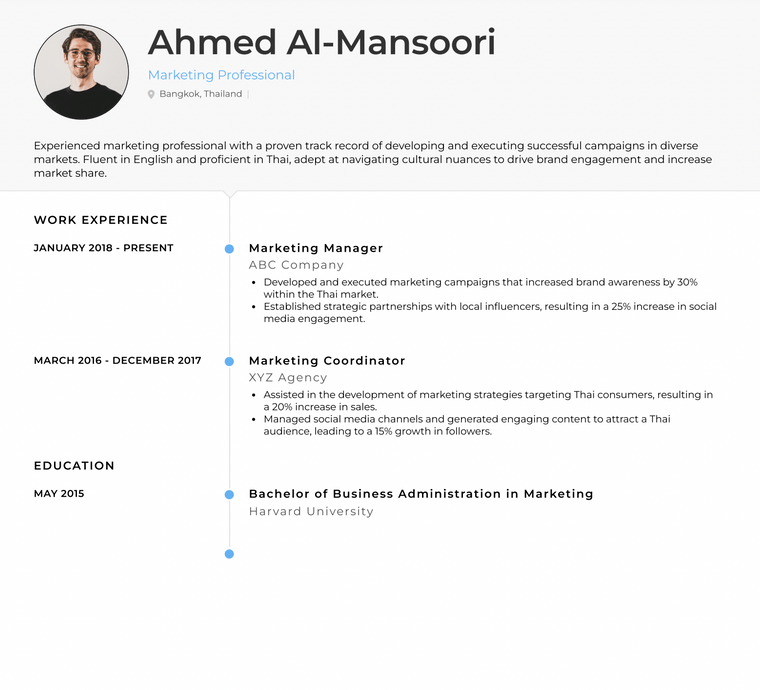
Experienced marketing professional with a proven track record of developing and executing successful campaigns in diverse markets. Fluent in English and proficient in Thai, adept at navigating cultural nuances to drive brand engagement and increase market share.
-
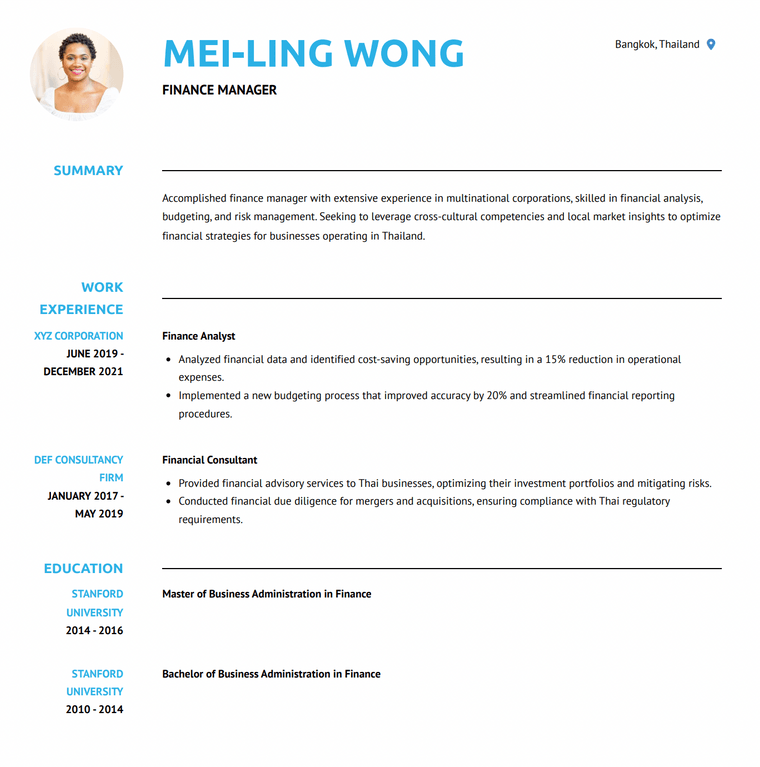
Accomplished finance manager with extensive experience in multinational corporations, skilled in financial analysis, budgeting, and risk management. Seeking to leverage cross-cultural competencies and local market insights to optimize financial strategies for businesses operating in Thailand.
-
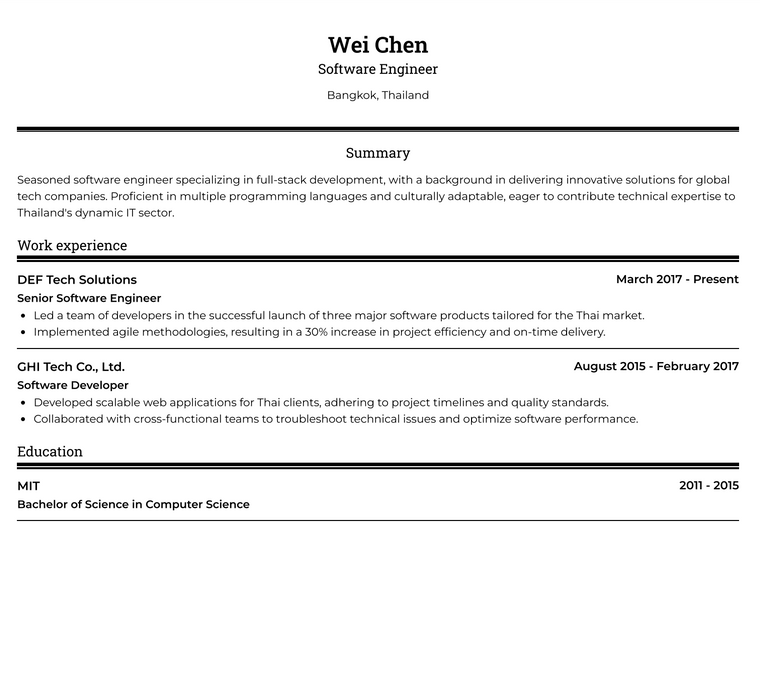
Seasoned software engineer specializing in full-stack development, with a background in delivering innovative solutions for global tech companies. Proficient in multiple programming languages and culturally adaptable, eager to contribute technical expertise to Thailand's dynamic IT sector.
-
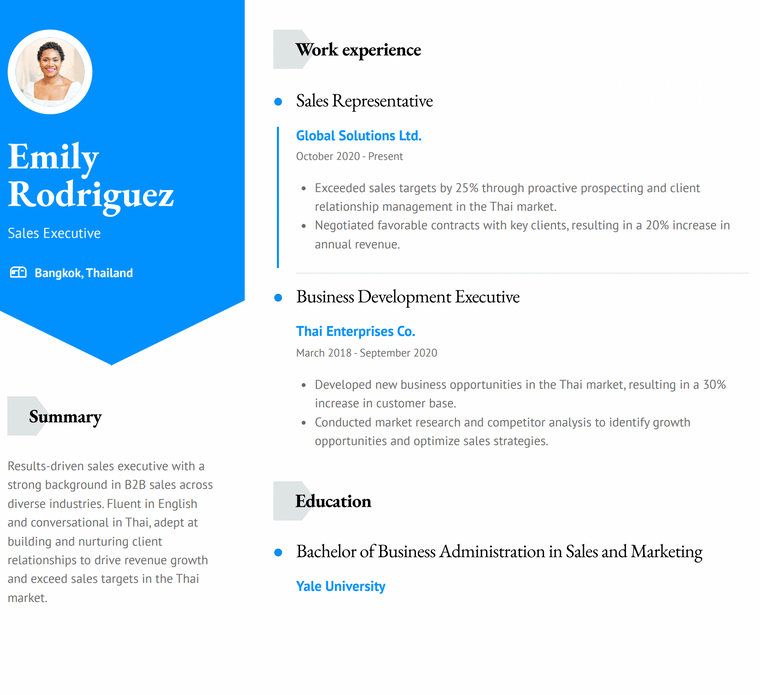
Results-driven sales executive with a strong background in B2B sales across diverse industries. Fluent in English and conversational in Thai, adept at building and nurturing client relationships to drive revenue growth and exceed sales targets in the Thai market.
-
Dynamic HR professional with a passion for talent management and organizational development. Experienced in recruiting top talent across borders and implementing HR best practices in multinational settings. Seeking to leverage multicultural experience to support businesses in Thailand in building high-performing teams.
-
Seasoned hospitality manager with a track record of success in luxury resort operations. Skilled in guest relations, staff training, and revenue optimization. Fluent in English and proficient in Thai, adept at providing exceptional service while respecting local customs and traditions.
-
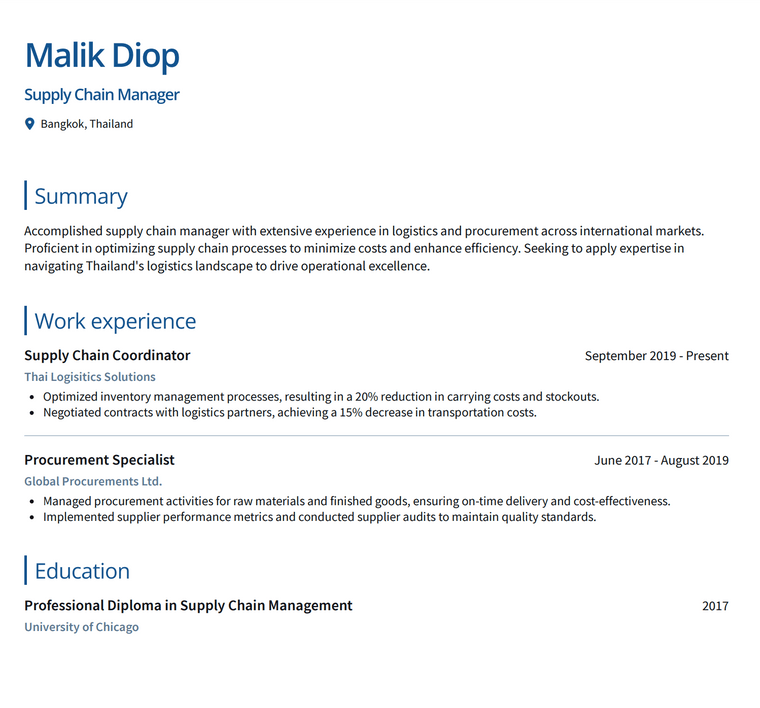
Accomplished supply chain manager with extensive experience in logistics and procurement across international markets. Proficient in optimizing supply chain processes to minimize costs and enhance efficiency. Seeking to apply expertise in navigating Thailand's logistics landscape to drive operational excellence.
-
Dynamic educator with a passion for fostering cross-cultural understanding and language proficiency. Experienced in teaching English as a second language to diverse learners. Fluent in Thai and adept at adapting teaching methodologies to meet the needs of Thai students.
-
Seasoned project manager with a proven track record of delivering complex projects on time and within budget. Skilled in stakeholder management and cross-functional collaboration. Fluent in English and proficient in Thai, adept at leading multicultural teams to achieve project milestones.
-
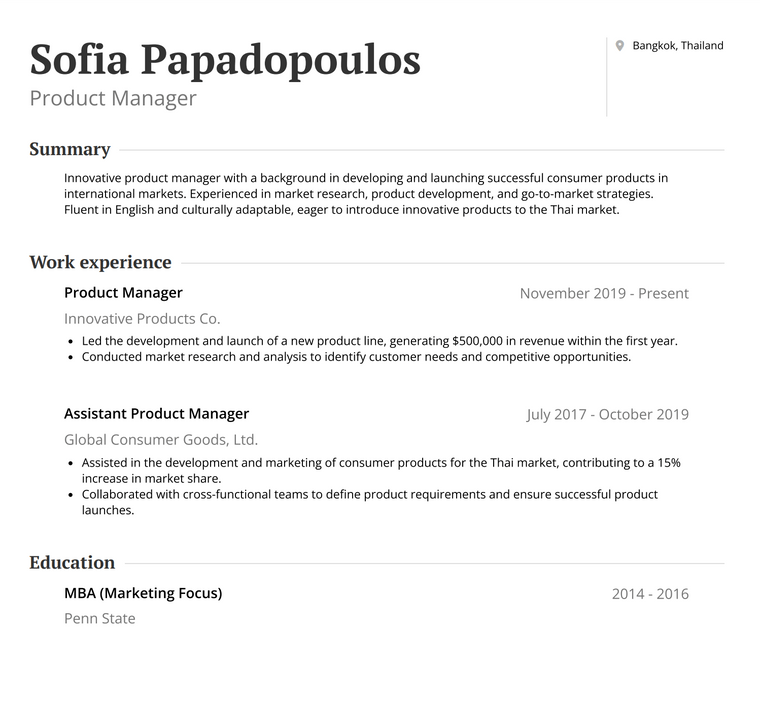
Innovative product manager with a background in developing and launching successful consumer products in international markets. Experienced in market research, product development, and go-to-market strategies. Fluent in English and culturally adaptable, eager to introduce innovative products to the Thai market.
How to Write a Work Experience Section for a Thai Resume
As we’ve said, the most important thing to remember when you’re writing a Thai resume is that your work experience section should only contain relevant positions to the job you’re applying for now. If you don’t have any relevant work experience – for example, if you’re just starting your career or you’re switching careers – make sure any work experience you do include is extremely tailored to demonstrate your transferable skills. Soft skills, like communication, professionalism, and creativity, are almost always transferable, and should be highlighted where possible in this case.
Overall, as you write your work experience section for your Thai resume, it’s a good idea to use the STAR method to make sure your work experience is painting you in the most positive possible light.
S - Situation: what happened in this position? T - Task: what part of the response to the situation was your responsibility? A - Action: what, specifically, did you to do ensure your task was completed effectively? R - Result: what happened because of your action?
Using quantifiable data, such as numbers and percentages where relevant, is an excellent way to demonstrate the results of your work. When a hiring manager sees those figures, it’s much easier for them to understand what kind of results you could bring to the position at their company.
Thai Resume Work Experience Examples
Marketing Manager at ABC Company, Bangkok, Thailand January 2018 - Present
- Developed and executed marketing campaigns that increased brand awareness by 30% within the Thai market.
- Established strategic partnerships with local influencers, resulting in a 25% increase in social media engagement.
- Implemented market research initiatives that led to a 20% expansion of the customer base in Thailand.
Finance Analyst at XYZ Corporation, Bangkok, Thailand June 2019 - December 2021
- Analyzed financial data and identified cost-saving opportunities, resulting in a 15% reduction in operational expenses.
- Implemented a new budgeting process that improved accuracy by 20% and streamlined financial reporting procedures.
- Conducted risk assessments and developed mitigation strategies that enhanced the company's financial stability in the Thai market.
Senior Software Engineer at DEF Tech Solutions, Bangkok, Thailand March 2017 - Present
- Led a team of developers in the successful launch of three major software products tailored for the Thai market.
- Implemented agile methodologies, resulting in a 30% increase in project efficiency and on-time delivery.
- Collaborated with cross-functional teams to troubleshoot technical issues and optimize product performance for Thai users.
Sales Representative at Global Solutions Ltd., Bangkok, Thailand October 2020 - Present
- Exceeded sales targets by 25% through proactive prospecting and client relationship management in the Thai market.
- Negotiated favorable contracts with key clients, resulting in a 20% increase in annual revenue.
- Conducted product demonstrations and training sessions for clients, enhancing product understanding and driving sales growth.
HR Manager at Thai Hospitality Group, Bangkok, Thailand January 2019 - Present
- Implemented employee retention strategies that reduced turnover by 15% and improved staff morale.
- Streamlined the recruitment process, resulting in a 20% reduction in time-to-hire for key positions.
- Developed and delivered training programs on cultural sensitivity and diversity awareness for staff members.
Resort Manager at Paradise Resorts & Spas, Phuket, Thailand April 2018 - Present
- Increased occupancy rates by 10% through targeted marketing initiatives and strategic pricing strategies.
- Implemented cost-saving measures that reduced operational expenses by 15% without compromising service quality.
- Led a team of 50+ staff members, fostering a positive work culture and ensuring exceptional guest experiences.
Supply Chain Coordinator at Thai Logistics Solutions, Bangkok, Thailand September 2019 - Present
- Optimized inventory management processes, resulting in a 20% reduction in carrying costs and stockouts.
- Negotiated contracts with logistics partners, achieving a 15% decrease in transportation costs.
- Implemented a vendor management system that improved supplier performance and reliability.
English Teacher at Bangkok International School, Bangkok, Thailand
- August 2020 - Present*
- Designed and delivered engaging English language lessons for students of diverse cultural backgrounds.
- Implemented student-centered teaching methodologies that improved language proficiency and confidence.
- Received positive feedback from students and parents, resulting in a 95% satisfaction rate in teacher evaluations.
Project Manager at ThaiTech Solutions, Bangkok, Thailand May 2018 - Present
- Successfully managed the implementation of a new ERP system, resulting in a 20% improvement in operational efficiency.
- Coordinated cross-functional teams and external vendors to deliver projects on time and within budget.
- Developed and maintained project plans, budgets, and timelines, ensuring project milestones were achieved.
Product Manager, Innovative Products Co., Ltd., Bangkok, Thailand November 2019 - Present - Led the development and launch of a new product line, generating $500,000 in revenue within the first year. - Conducted market research and analysis to identify customer needs and competitive opportunities. - Collaborated with cross-functional teams to define product requirements and ensure successful market penetration.
Resume Tips for Teaching Jobs in Thailand
Teaching is one of the most common jobs for foreigners and Thai nationals alike, especially in cities like Bangkok, Chiang Mai, and Khon Kaen. If you are applying for a teaching job in Thailand, your resume should emphasize educational background, classroom experience, and communication skills.
To write a strong teacher resume for Thailand:
-
Start with a clear summary that highlights your teaching subject, years of experience, and certification (such as TEFL or TESOL)
-
Include a professional photo, which is standard for resumes in Thai schools and language centers
-
Specify the student age group you have experience with (kindergarten, primary, secondary, university)
-
Mention any experience with Thai curricula, bilingual education, or international programs
-
Use bullet points to show impact in the classroom, such as:
- Designed and delivered English lessons to over 250 primary school students
- Improved student test scores by 18 percent through interactive learning strategies
Many schools in Thailand accept English resumes for teaching positions, but some government schools may require a Thai-language CV. When applying to private schools, international schools, or tutoring centers, clarity and teaching results matter most.
Resume Tips for Hospitality Professionals in Thailand
The hospitality industry in Thailand is a major employer across cities like Phuket, Pattaya, Bangkok, and Chiang Mai. If you are applying for a hospitality job in Thailand, your resume should focus on guest service skills, language abilities, and experience in hotels, resorts, or tourism-related services.
To create a compelling hospitality resume for Thailand:
- Use a clean, well-structured layout with a professional photo at the top
- Write your resume in English for international hotel chains and tour operators
- Emphasize multilingual abilities, especially Thai, English, Chinese, or Russian
- List relevant experience in customer-facing roles and hospitality software systems
- Showcase soft skills such as flexibility, attention to detail, and teamwork
Examples of hospitality bullet points:
- Provided front desk services at a 4-star resort serving over 300 guests per day
- Resolved guest issues with a 95 percent satisfaction rate tracked via feedback surveys
- Trained and supervised 12 housekeeping staff in a beachfront hotel
If you hold certifications in food safety, lifeguarding, bar management, or tour guiding, include them in a separate section. A hospitality resume for Thailand should reflect service excellence, cultural awareness, and readiness to operate in a fast-paced, multilingual environment.
Resume Tips for Software and IT Jobs in Thailand
Thailand’s tech industry is growing rapidly, especially in Bangkok and Chiang Mai. If you are applying for a software or IT job in Thailand, your resume should highlight your technical skills, programming experience, and project outcomes.
Key strategies for writing a software resume in Thailand:
- Use an ATS-friendly format with clear section labels and no graphics or tables
- Write your resume in English unless the employer specifically requests Thai
- Start with a summary that includes your job title, years of experience, and main technology stack
- Focus on projects, products, and tools you have used, including frontend, backend, and cloud systems
Effective bullet points for IT resumes:
- Developed and deployed a multilingual e-commerce platform with 50,000+ users
- Migrated legacy systems to AWS, reducing server costs by 25 percent
- Led a team of five developers to deliver a fintech application under tight deadlines
Employers in Thailand’s tech sector expect clarity, results, and up-to-date skills. Highlight programming languages, certifications (such as AWS or Cisco), and experience with Agile or Scrum environments. A resume for software jobs in Thailand should be technical, concise, and aligned with global standards.
Resume Tips for Healthcare and Medical Jobs in Thailand
Healthcare professionals applying in Thailand must present a resume that demonstrates qualifications, licensing, and hands-on experience. Whether applying for roles in nursing, administration, or medical support, your resume should reflect clinical expertise and a commitment to patient care.
To write an effective healthcare resume in Thailand:
- Use a formal structure with your license number and academic credentials clearly listed
- Include a professional photo and be prepared to submit certificates if requested
- Write your resume in Thai for public hospitals or clinics, and in English for private hospitals or international clinics
- Focus on areas of specialization, years of experience, and facility types you have worked in
Sample bullet points for medical resumes:
- Provided nursing care in a 120-bed urban hospital, managing up to 15 patients per shift
- Coordinated medical records and appointment scheduling for a team of six physicians
- Administered vaccinations and assisted with triage during local outreach programs
Include any CPR, ACLS, or first aid certifications. A healthcare resume for Thailand should be accurate, professional, and tailored to the medical environment where you intend to work.
Resume Tips for Manufacturing and Engineering Jobs in Thailand
Thailand is a key manufacturing hub in Southeast Asia, with strong demand for engineers, technicians, and plant supervisors. If you are applying for a manufacturing job in Thailand, your resume should focus on technical ability, compliance training, and operational achievements.
How to write a manufacturing resume for Thailand:
- Use a clear, functional layout with a professional photo
- Mention any certifications related to machinery, safety, or quality control
- Write your resume in Thai or English depending on the employer’s language preference
- Highlight experience in production lines, maintenance, and continuous improvement systems
Sample resume bullet points:
- Operated and maintained CNC machines with 99 percent uptime across three shifts
- Implemented lean manufacturing techniques that improved output by 15 percent
- Supervised 20 assembly workers while ensuring compliance with ISO 9001 standards
Include any language skills if applying to multinational factories. A strong manufacturing resume in Thailand should demonstrate precision, responsibility, and knowledge of safety protocols and quality systems.
Thailand Resume Examples
Thailand Resume Template Example One: Air
Thailand Resume Template Example Two: Arya
Thailand Resume Template Example Three: ATS
Thailand Resume Template Example Four: Baker
Thailand Resume Template Example Five: Bravo
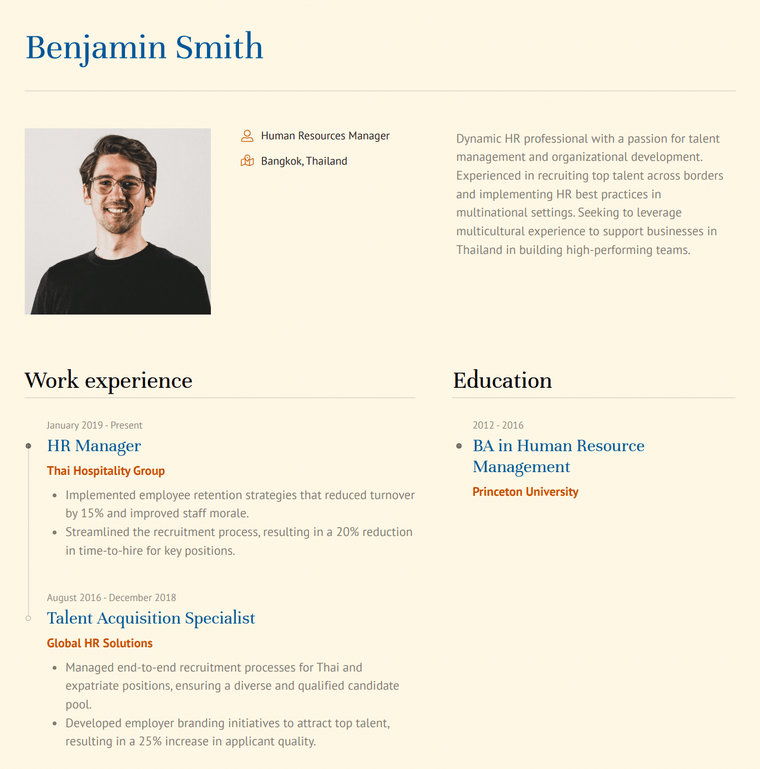
Thailand Resume Template Example Six: Corporate
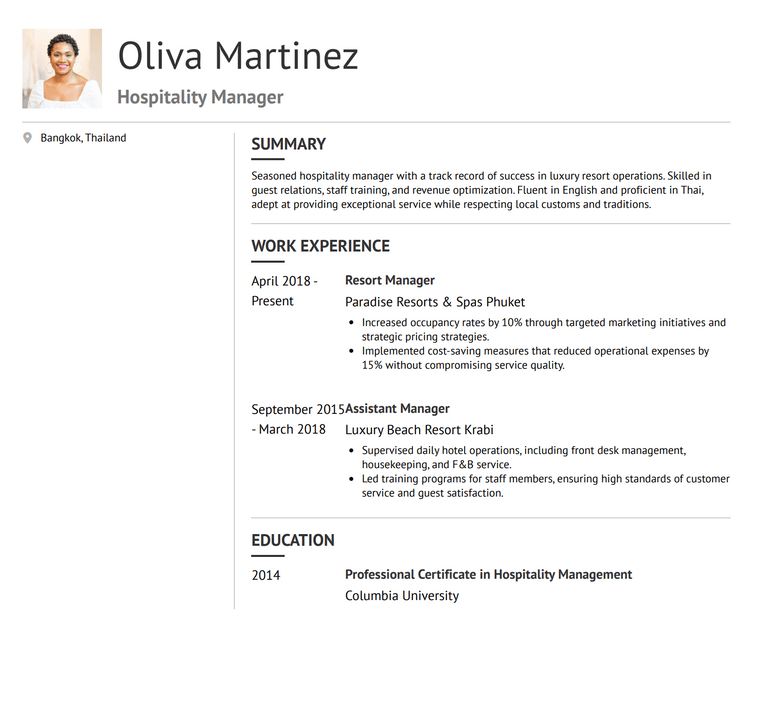
Thailand Resume Template Example Seven: Monte
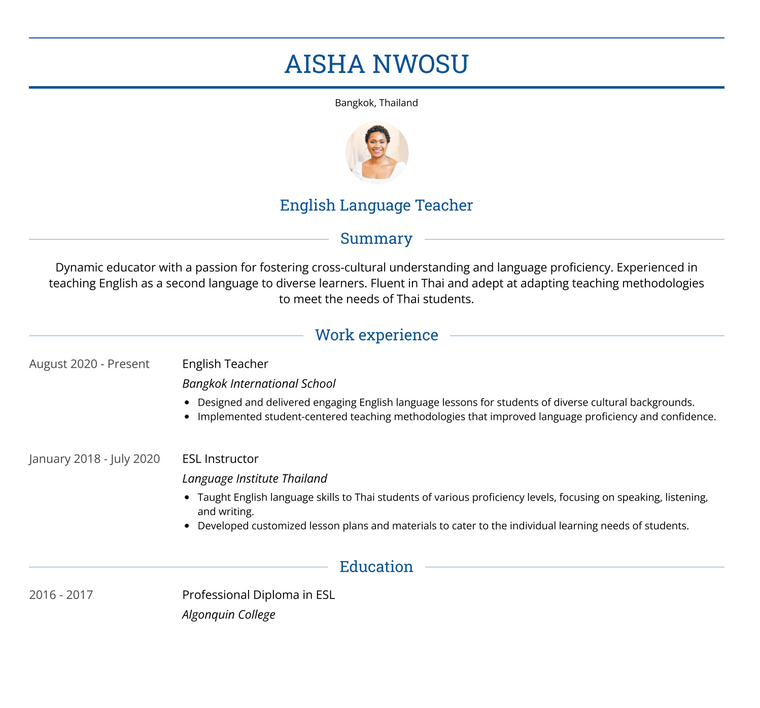
Thailand Resume Template Example Eight: Slate
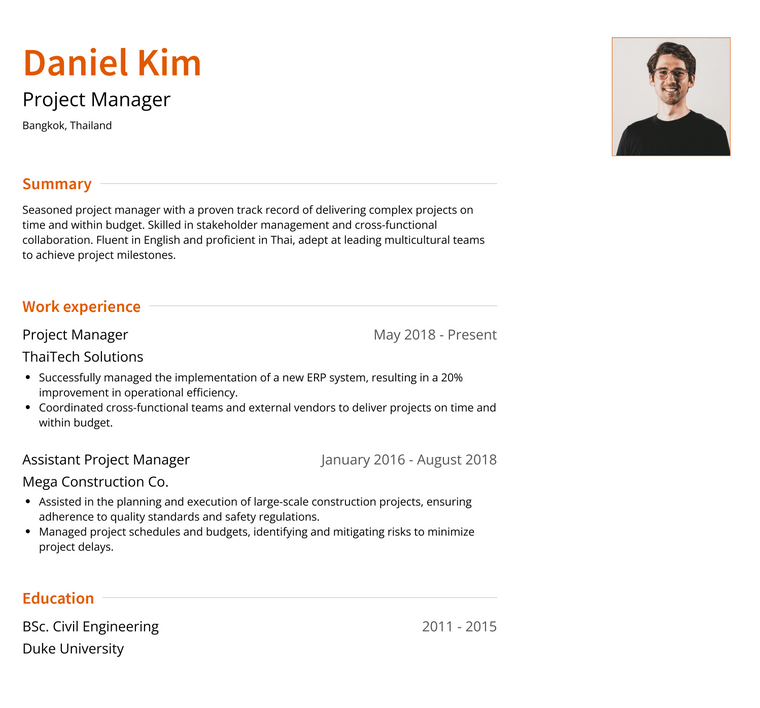
Thailand Resume Template Example Nine: Standard
Thailand Resume Template Example Ten: Zenith
Bilingual Resume Tips for Thailand
Many employers in Thailand, particularly international companies and schools, accept resumes in English. However, some roles require a Thai-language CV or a bilingual resume that includes both Thai and English.
When to use a bilingual resume in Thailand:
- Applying to government agencies or public institutions
- Applying to Thai-owned businesses with Thai-speaking management
- Submitting to employers who specifically request resumes in both languages
Tips for writing a bilingual resume:
- Use side-by-side or dual-section formatting with Thai on one side and English on the other
- Keep your formatting consistent across both languages
- Ensure your Thai translation is professional and free of informal or slang phrases
- Avoid automatic translation tools unless reviewed by a native speaker
Bilingual resumes are especially helpful for applicants who are fluent in Thai and seeking long-term employment in the country. A well-formatted bilingual resume shows flexibility and respect for local business culture.
Thai Resume Dos and Don’ts
Understanding Thai resume culture is essential to make a good impression. Below are key dos and don’ts when writing your resume for Thailand.
Do:
- Include a professional photo at the top of your resume
- Keep your resume to one or two pages unless applying for an academic or senior role
- Use polite, professional language throughout your summary and work experience
- Tailor your resume to each job application
- Provide a Thai version when applying to government jobs or local companies
Don’t:
- Add unrelated hobbies, religion, or excessive personal information
- Use informal language or jokes
- Submit your resume without proofreading
- List outdated software or irrelevant certifications
- Copy a template without adjusting the content to your skills and experience
These resume dos and don’ts reflect employer expectations across Thailand and help you avoid common mistakes that can hurt your chances of getting hired.
Government Resume Requirements in Thailand
Applying to a government or public-sector job in Thailand comes with unique resume expectations. Thai government employers typically require resumes to be written in formal Thai and to include specific details not usually found in resumes for private-sector roles.
What to include in a government resume in Thailand:
- Full name, Thai ID number, and contact information in Thai
- A recent, formal photo
- Academic transcripts and graduation certificates
- Employment history in chronological order
- Marital status, age, and references (often required in public roles)
Additional considerations:
- Use official Thai language and honorifics when appropriate
- Avoid abbreviations or casual tone
- Submit all supporting documents in Thai unless otherwise noted
Government resumes in Thailand should be formal, complete, and fully aligned with Thai cultural norms and public hiring procedures.
Resume Photo Guidelines for Thailand
Including a photo on your resume is still standard in Thailand. Many employers expect to see a professional headshot, especially for jobs in education, hospitality, healthcare, and customer service.
Tips for resume photos in Thailand:
- Use a recent photo with a plain, light-colored background
- Dress in professional attire appropriate to the job you are applying for
- Smile slightly and maintain a neutral, approachable expression
- Avoid casual selfies, heavy filters, or overly artistic angles
While some multinational companies may not require a photo, most Thai employers view it as part of standard resume formatting. A high-quality photo helps your resume appear complete and professional in the local context.
Academic Resume Tips for Thailand
If you are applying for a university role, graduate program, or scholarship in Thailand, your resume will function more like a CV, with greater emphasis on academic credentials, research, and educational contributions.
What to include in an academic CV in Thailand:
- Full academic history including degrees, GPAs, and graduation dates
- Thesis or dissertation title and supervisor name
- Publications, research projects, and academic conferences
- Teaching experience and academic service roles
- Scholarships, fellowships, and academic honors
Additional tips:
- Use a formal tone and organized structure
- List achievements in reverse chronological order
- Include both Thai and English versions if applying to public universities
An academic CV for Thailand should be comprehensive and tailored to the institution or program. Avoid personal opinions or overly casual summaries and focus on scholarly impact and credentials.