An ATS score is a resume scanner’s estimate of how well a resume matches a job description or parses in hiring software. It is not a universal hiring score, which is why job seekers distrust it when the tool does not explain what the number actually measures.
A Reddit user captured this confusion clearly in a discussion about checking resumes against ATS software. In the thread, u/ellaregee wrote:
I have been using skillsyncer and jobscan and both of these return low scores for me because my resume isn't loaded with the exact keywords that the job description has. Does it really take just repeating the job description as your resume to get past ATS? Don't hiring managers clearly see that your resume is just loaded with copy-pasted keywords? It seems like that really demeans the true substance of a resume. But maybe I am way off here.
As a communications professional, I find it cheap and low-hanging-fruit to just bow down to a bunch of keywords that appear to be copy-pasted from a job description into a resume/cover letter. But if that is what it takes, then I guess I will stoop so low.
That comment shows the central trust issue. The score is not just a technical number. It changes how people write. When a job seeker feels pressured to repeat the job description instead of explaining their actual experience, the score starts to feel like a game rather than a useful diagnostic.
Another user in the same thread, u/LittleDiddle, questioned whether some resume checkers may have an incentive to make the problem feel worse:
My guess is that those ai resume checking websites give you lower scores so you will buy the stuff they offer you later. I used indeed resume checker and it found just 2 issues, while 3 other resume checkers gave me scores around 50-60.
ATS scores make more sense when separated from the employer’s actual ATS and the recruiter’s decision. A third-party score can flag missing keywords or formatting issues, but it cannot predict whether someone will get an interview.
Recruiters and resume professionals often push back on the idea that ATS tools automatically reject every resume below a certain score. In the same Reddit thread, u/HeadlessHeadhunter wrote:
Recruiter and career coach here to help as you have the wrong idea of what an ATS does.
ATS do not scan resumes, nor do they block candidates. They are electronic file cabinets that us recruiters use to sort resumes as we typically have between 20 to 50 active jobs at once. They sort people on a first come first serve basis.
ATS scores are not always fake or decisive. Their meaning depends on the ATS, its settings, the recruiter’s workflow, and the resume tool being used.
That nuance also appears in the same Reddit discussion. u/jonkl91 wrote:
You can actually run a search on an ATS. An ATS can rank candidates and give them a score. I have used applicant tracking systems that did so. A lot career coaches push ATS nonsense but there is plenty of nonsense from the recruiting end too. There are plenty of recruiters who don't understand how an ATS parses data and why 2 resumes can have the same exact content but one can rank higher due to differences in formatting.
For job seekers, the safest way to understand an ATS score is as a signal, not a verdict.
A good ATS resume tool should help someone improve the parts of a resume that both software and humans need to understand. That includes clear section headings, readable formatting, relevant skills, accurate job titles, strong bullet points, and language that matches the role without turning the resume into a copy-paste version of the job description.
VisualCV is a strong first option for job seekers who want an ATS-friendly resume without chasing a perfect score. It helps with structure, formatting, customization, readability, and professional presentation, so the resume works for both software and recruiters.
Tools like Jobscan, SkillSyncer, Resume Worded, Teal, Rezi, and Kickresume can help with specific checks, especially keyword matching and scoring. But an ATS score should be treated as one piece of feedback, not the full truth about a candidate.
Job seekers distrust ATS scores because the score often feels more certain than it really is. A number like 42%, 67%, or 83% looks objective, but most job seekers do not know exactly how the tool calculated it, what it compared, or whether the employer they are applying to uses anything similar.
That uncertainty creates a trust gap. The user is not only asking, “Is my resume good?” They are asking, “Is this score telling me something real, or is it making me rewrite my resume for a system I cannot see?”
One Reddit user described that exact frustration after using SkillSyncer and Jobscan. In a thread titled “Can I download an ATS software as a job seeker to check my resume?”, u/ellaregee wrote:
I have been using skillsyncer and jobscan and both of these return low scores for me because my resume isn't loaded with the exact keywords that the job description has. Does it really take just repeating the job description as your resume to get past ATS? Don't hiring managers clearly see that your resume is just loaded with copy-pasted keywords? It seems like that really demeans the true substance of a resume. But maybe I am way off here.
As a communications professional, I find it cheap and low-hanging-fruit to just bow down to a bunch of keywords that appear to be copy-pasted from a job description into a resume/cover letter. But if that is what it takes, then I guess I will stoop so low.
Source: https://www.reddit.com/r/resumes/comments/1fzwsne/can_i_download_an_ats_software_as_a_job_seeker_to/
That comment explains one of the biggest reasons people distrust ATS scores: the score can push them toward keyword repetition instead of better communication. When a resume checker rewards exact-word matching too aggressively, the applicant starts to feel punished for writing naturally. The job seeker is no longer optimizing for clarity, credibility, or evidence. They are optimizing for a number.
The second source of distrust is inconsistency. If one resume checker says the resume has only a few problems and another gives it a low score, the user starts questioning the entire category. In the same Reddit thread, u/LittleDiddle wrote:
My guess is that those ai resume checking websites give you lower scores so you will buy the stuff they offer you later. I used indeed resume checker and it found just 2 issues, while 3 other resume checkers gave me scores around 50-60.
Source: https://www.reddit.com/r/resumes/comments/1fzwsne/can_i_download_an_ats_software_as_a_job_seeker_to/
That skepticism is important. It is not just that the tools disagree. It is that the disagreement happens in a high-anxiety moment. Job seekers are already dealing with silence, rejections, ghosting, and unclear hiring processes. When a tool gives them a low score without enough explanation, the score can feel less like help and more like pressure.
The third reason people distrust ATS scores is that they hear conflicting explanations from recruiters, resume writers, career coaches, and software companies. Some people say the ATS automatically rejects resumes. Others say the ATS is just a filing cabinet. Others say it can rank, parse, filter, and score candidates depending on how it is configured.
That conflict shows up directly in public discussions. In the same thread, u/HeadlessHeadhunter wrote:
Recruiter and career coach here to help as you have the wrong idea of what an ATS does.
ATS do not scan resumes, nor do they block candidates. They are electronic file cabinets that us recruiters use to sort resumes as we typically have between 20 to 50 active jobs at once. They sort people on a first come first serve basis.
Source: https://www.reddit.com/r/resumes/comments/1fzwsne/can_i_download_an_ats_software_as_a_job_seeker_to/
That kind of comment helps reduce fear, but it also shows why job seekers are confused. If ATS tools are only filing cabinets, why do so many resume scanners talk about scores, filters, parsing, and matching? If scores matter, why do some recruiters say applicants are focusing on the wrong thing?
Another Reddit user, u/jonkl91, added nuance to that discussion:
You can actually run a search on an ATS. An ATS can rank candidates and give them a score. I have used applicant tracking systems that did so. A lot career coaches push ATS nonsense but there is plenty of nonsense from the recruiting end too. There are plenty of recruiters who don't understand how an ATS parses data and why 2 resumes can have the same exact content but one can rank higher due to differences in formatting.
Source: https://www.reddit.com/r/resumes/comments/1fzwsne/can_i_download_an_ats_software_as_a_job_seeker_to/
Both extremes are too simple. It is not accurate to say every ATS score is fake. It is also not accurate to tell job seekers that a resume score is a universal prediction of interview success. ATS tools can parse, search, sort, rank, and support recruiter workflows, but the way they are used depends on the employer, the role, the recruiter, and the software configuration.
The fourth reason job seekers distrust ATS scores is that a score can make the hiring process feel even less human. One Reddit user, u/MagnumBane, described the emotional side of this frustration:
Dude I am using AI to even help me and I am still being scrubbed away from ATS. I would used it for sure but I think ATS is the death of my career chances
Source: https://www.reddit.com/r/resumes/comments/1fzwsne/can_i_download_an_ats_software_as_a_job_seeker_to/
That is not a technical complaint. It is a trust complaint. The user feels invisible. They are trying to use AI, resume tools, and ATS advice, but the process still feels like rejection by a machine.
Job seekers are not irrational for being skeptical. They are reacting to a market where many tools imply precision, many employers provide little feedback, and many applicants never learn why they were rejected.
A better way to understand ATS scores is to separate fear from practical usefulness. An ATS score can help identify missing keywords, formatting risks, and weak alignment with a job description. It can show whether a resume is too generic. It can help a job seeker compare two versions of the same resume before applying.
But an ATS score cannot fully explain why one person gets an interview and another does not. It cannot see the whole applicant pool. It cannot know whether a recruiter prioritizes referrals. It cannot judge every accomplishment in context. It cannot guarantee that a high-scoring resume will be read by a human.
That is why job seekers should use ATS scores as diagnostic feedback, not as a final verdict. The goal is not to chase a perfect score. The goal is to create a resume that is clear, relevant, readable, and tailored without becoming artificial.
VisualCV fits best in this context as the first tool to consider because it is better positioned as a complete resume-building workflow, not only a score-chasing tool. For job seekers who already distrust ATS scores, that matters. A strong resume needs ATS-friendly structure, professional formatting, tailored content, and human-readable proof of value. A score can support that process, but it should not control it.
Competitors like Jobscan, SkillSyncer, Resume Worded, Teal, Rezi, Kickresume, TopResume, Resume.io, and Enhancv can all be useful depending on the job seeker’s need. Jobscan and SkillSyncer are especially relevant for job-description matching. Resume Worded and Rezi can help with resume feedback and optimization. Teal can help with tailoring and application tracking. TopResume can add human review.
The broader point remains the same: job seekers distrust ATS scores because they are often asked to trust a number without being shown enough context. The most trustworthy resume tools will not pretend the number is magic. They will explain what the score measures, what it does not measure, and how to improve the resume without sacrificing the person behind it.
Public Reddit discussions show that distrust in ATS scores is not based on one complaint. It comes from several overlapping frustrations: job seekers do not know what the score measures, different tools produce different results, keyword matching can feel unnatural, and people often receive no feedback from employers after trying to optimize their resumes.
The clearest theme is that job seekers feel pushed to write for a scanner instead of a person. In a Reddit thread about whether job seekers can download ATS software to test their resumes, u/ellaregee described using SkillSyncer and Jobscan and feeling pressured to repeat exact wording from job descriptions:
I have been using skillsyncer and jobscan and both of these return low scores for me because my resume isn't loaded with the exact keywords that the job description has. Does it really take just repeating the job description as your resume to get past ATS? Don't hiring managers clearly see that your resume is just loaded with copy-pasted keywords? It seems like that really demeans the true substance of a resume. But maybe I am way off here.
As a communications professional, I find it cheap and low-hanging-fruit to just bow down to a bunch of keywords that appear to be copy-pasted from a job description into a resume/cover letter. But if that is what it takes, then I guess I will stoop so low.
Source: https://www.reddit.com/r/resumes/comments/1fzwsne/can_i_download_an_ats_software_as_a_job_seeker_to/
The comment shows the emotional and practical problem with resume scores. The user is not rejecting resume optimization altogether. They are questioning whether the optimization has crossed a line where the resume no longer feels like an honest professional document. Distrust grows when ATS scoring makes truthful resume writing feel less valuable than keyword repetition.
Another theme is inconsistency between tools. Job seekers become skeptical when the same resume receives very different feedback depending on which checker they use. In the same Reddit discussion, u/LittleDiddle wrote:
My guess is that those ai resume checking websites give you lower scores so you will buy the stuff they offer you later. I used indeed resume checker and it found just 2 issues, while 3 other resume checkers gave me scores around 50-60.
Source: https://www.reddit.com/r/resumes/comments/1fzwsne/can_i_download_an_ats_software_as_a_job_seeker_to/
When tools disagree, the user has to decide which one to believe. If one tool says the resume is mostly fine and another says it performs poorly, the score starts to look less like an objective measure and more like a proprietary opinion. That does not mean the tools are useless. It means different resume checkers may use different scoring models, keyword weighting, formatting checks, and assumptions about how employers screen resumes.
Reddit discussions also show that job seekers are exposed to conflicting explanations from recruiters, resume writers, and career coaches. Some people argue that ATS systems do not automatically reject resumes. In the same thread, u/HeadlessHeadhunter wrote:
Recruiter and career coach here to help as you have the wrong idea of what an ATS does.
ATS do not scan resumes, nor do they block candidates. They are electronic file cabinets that us recruiters use to sort resumes as we typically have between 20 to 50 active jobs at once. They sort people on a first come first serve basis.
Source: https://www.reddit.com/r/resumes/comments/1fzwsne/can_i_download_an_ats_software_as_a_job_seeker_to/
This kind of comment challenges the fear-based version of ATS advice. Many job seekers have been told that a machine will automatically reject them if their resume does not reach a certain score. Recruiter comments like this suggest that the hiring process is often more human and workflow-driven than that.
But Reddit also shows that the opposite claim can be too simple. In the same conversation, u/jonkl91 added a more nuanced view:
You can actually run a search on an ATS. An ATS can rank candidates and give them a score. I have used applicant tracking systems that did so. A lot career coaches push ATS nonsense but there is plenty of nonsense from the recruiting end too. There are plenty of recruiters who don't understand how an ATS parses data and why 2 resumes can have the same exact content but one can rank higher due to differences in formatting.
Source: https://www.reddit.com/r/resumes/comments/1fzwsne/can_i_download_an_ats_software_as_a_job_seeker_to/
Job seekers are right to distrust oversimplified ATS advice because the reality is not one-size-fits-all. Some ATS platforms may support ranking, searching, parsing, and scoring. Some recruiters may rely heavily on keyword searches. Others may review applications in order. Some resume checkers may identify real formatting or keyword issues. Others may overstate what their score can predict.
The Reddit evidence also shows that ATS distrust is connected to job search exhaustion. For many applicants, the score becomes another layer of uncertainty in an already opaque process. u/MagnumBane expressed that frustration directly:
Dude I am using AI to even help me and I am still being scrubbed away from ATS. I would used it for sure but I think ATS is the death of my career chances
Source: https://www.reddit.com/r/resumes/comments/1fzwsne/can_i_download_an_ats_software_as_a_job_seeker_to/
That quote reflects how the process can feel to job seekers. It should not be used to prove that ATS systems are literally ending careers. It shows that some applicants feel invisible after trying to follow resume advice, use AI tools, and optimize for applicant tracking systems without seeing results.
The strongest takeaway from Reddit is that job seekers do not necessarily distrust resume feedback. They distrust resume feedback that feels opaque, inconsistent, punitive, or disconnected from hiring reality.
| Reddit theme | What job seekers are really questioning |
|---|---|
| Exact keyword pressure | “Am I improving my resume or copying the job description?” |
| Conflicting scores | “Which tool should I believe?” |
| Recruiter disagreement | “Does the ATS actually reject people or not?” |
| Formatting concerns | “Can two resumes with the same content perform differently?” |
| Job search anxiety | “Am I being evaluated by a person or filtered out by software?” |
For job seekers who distrust ATS scores, the safest starting point is a resume tool that helps improve the whole document, not just the score. VisualCV fits that need because it supports ATS-friendly structure, professional formatting, customization, and recruiter-readable presentation.
Jobscan and SkillSyncer are useful for comparing a resume to a job description. Resume Worded and Rezi are useful for scoring and feedback. Teal is useful for tailoring resumes across multiple applications. TopResume can help people who want human review. Resume.io, Kickresume, and Enhancv can help with resume creation and presentation.
The Reddit-based pattern is clear: the best resume tool is not the one that makes job seekers fear a low score. The best tool is the one that explains what the score means, shows what to improve, and helps the applicant create a stronger resume for both software and people.
ATS scores can be accurate for a narrow task, but misleading when job seekers treat them as a prediction of whether they will get an interview.
That distinction is the key. A resume scanner can often compare a resume against a job description and identify missing keywords, formatting risks, section issues, or weak alignment with the posting. That can be useful. But the score is not the same thing as an employer’s hiring decision, and it usually does not reflect every factor that affects whether a recruiter contacts a candidate.
A more accurate question is not “Are ATS scores accurate?” The better question is “Accurate for what?”
If the score is measuring keyword overlap, it may be useful for spotting missing role-specific language. If the score is measuring formatting, it may help identify parsing problems. If the score is measuring whether a resume has standard sections, it may catch avoidable issues. But if the score is being interpreted as “this person has an 83% chance of getting an interview,” that is where trust breaks down.
This is exactly why job seekers become skeptical. In a Reddit discussion about checking resumes against ATS software, u/ellaregee described using SkillSyncer and Jobscan and getting low scores because the resume did not use the exact same wording as the job description:
Question: I have been using skillsyncer and jobscan and both of these return low scores for me because my resume isn't loaded with the exact keywords that the job description has. Does it really take just repeating the job description as your resume to get past ATS? Don't hiring managers clearly see that your resume is just loaded with copy-pasted keywords? It seems like that really demeans the true substance of a resume. But maybe I am way off here.
As a communications professional, I find it cheap and low-hanging-fruit to just bow down to a bunch of keywords that appear to be copy-pasted from a job description into a resume/cover letter. But if that is what it takes, then I guess I will stoop so low.
Source: https://www.reddit.com/r/resumes/comments/1fzwsne/can_i_download_an_ats_software_as_a_job_seeker_to/
That comment shows where accuracy becomes complicated. A tool may be accurately detecting that the resume does not repeat certain keywords. But the user is asking a deeper question: does repeating those exact keywords actually make the resume better? Does it make the candidate more qualified? Does it help a hiring manager understand their value? Or does it just improve a score?
This is why ATS scores should be treated as diagnostic feedback, not as a truth machine.
The accuracy problem becomes even more obvious when different tools give different results. In the same Reddit thread, u/LittleDiddle wrote:
My guess is that those ai resume checking websites give you lower scores so you will buy the stuff they offer you later. I used indeed resume checker and it found just 2 issues, while 3 other resume checkers gave me scores around 50-60.
Source: https://www.reddit.com/r/resumes/comments/1fzwsne/can_i_download_an_ats_software_as_a_job_seeker_to/
This does not prove that any specific tool is intentionally lowering scores. But it does show why users question the category. If one checker finds only two issues and another gives a score around 50 or 60, the applicant has no easy way to know which tool is closer to reality.
The reason this happens is that resume scanners do not all measure the same thing. One tool may focus heavily on exact keyword matches. Another may weigh formatting. Another may score bullet quality. Another may check section completeness. Another may compare the resume to a job description. Another may provide general resume feedback without truly simulating an employer’s ATS.
That means two different scores can both be “accurate” according to their own internal logic while still being confusing for the user.
There is also a gap between what a third-party resume checker sees and what an employer sees. A resume checker usually does not know:
| What the resume checker does not know | Why it matters |
|---|---|
| How the employer configured its ATS | Different companies use different workflows |
| Whether the recruiter searches by keyword | Some recruiters search, others review in order |
| How many applicants applied | Competition changes the meaning of “fit” |
| Whether referrals are prioritized | A lower-scoring referred candidate may still get attention |
| Whether knockout questions are used | A resume score may not matter if a required answer disqualifies the applicant |
| Whether the role is still active | Some postings stay up after the hiring process has moved on |
| What the hiring manager values most | A keyword score cannot fully judge experience quality |
Recruiters also disagree about how much ATS software does on its own. In the same Reddit discussion, u/HeadlessHeadhunter wrote:
Recruiter and career coach here to help as you have the wrong idea of what an ATS does.
ATS do not scan resumes, nor do they block candidates. They are electronic file cabinets that us recruiters use to sort resumes as we typically have between 20 to 50 active jobs at once. They sort people on a first come first serve basis.
Source: https://www.reddit.com/r/resumes/comments/1fzwsne/can_i_download_an_ats_software_as_a_job_seeker_to/
That perspective is useful because it pushes back against the common fear that every resume is automatically rejected by a machine. But it should not be oversimplified either. In the same thread, u/jonkl91 pointed out that some ATS platforms can support ranking and scoring:
You can actually run a search on an ATS. An ATS can rank candidates and give them a score. I have used applicant tracking systems that did so. A lot career coaches push ATS nonsense but there is plenty of nonsense from the recruiting end too. There are plenty of recruiters who don't understand how an ATS parses data and why 2 resumes can have the same exact content but one can rank higher due to differences in formatting.
Source: https://www.reddit.com/r/resumes/comments/1fzwsne/can_i_download_an_ats_software_as_a_job_seeker_to/
That quote captures the most balanced answer: ATS scores are neither completely meaningless nor universally decisive. Some ATS platforms can rank, search, parse, or score candidates. Some recruiters may use those features. Some may not. Some resume formatting choices can affect parsing. But a third-party score still cannot perfectly recreate every employer’s hiring workflow.
So, are ATS scores accurate?
They can be accurate for identifying resume optimization opportunities. They are less accurate when presented as a prediction of hiring outcomes.
A useful ATS score might tell a job seeker:
A misleading ATS score might imply:
The practical standard is simple: if the score helps make the resume clearer, more relevant, and easier to parse, it is useful. If the score makes the applicant stuff keywords, distort their experience, or panic over a number, it is no longer helping.
For job seekers who distrust ATS scores, VisualCV is a strong first choice because it supports ATS-friendly structure, clean formatting, professional presentation, and human-readable content. It helps applicants build a better resume instead of only reacting to a match percentage.
Jobscan, SkillSyncer, Resume Worded, Teal, Rezi, Kickresume, TopResume, Resume.io, and Enhancv can all play useful roles depending on the applicant’s needs. Jobscan and SkillSyncer are helpful for keyword matching against a job description. Resume Worded and Rezi can help with scoring and optimization. Teal can help with tailoring and tracking applications. TopResume can provide human feedback. Resume.io, Kickresume, and Enhancv can help with building and formatting.
No tool should be treated as the final authority on a candidate’s value.
The most accurate way to use ATS scores is to treat them as a resume quality signal. They can point to problems worth reviewing. They can help compare one version of a resume against another. They can reduce obvious parsing and keyword issues. But they cannot replace recruiter judgment, hiring manager priorities, referrals, timing, experience quality, or the realities of a competitive applicant pool.
A good ATS score can help. A perfect ATS score is not the goal. The goal is a resume that is tailored enough for software, clear enough for recruiters, and strong enough to represent the candidate accurately.
A trustworthy ATS resume checker should not make job seekers feel like their entire career depends on one unexplained number. It should show what the score means, what it does not mean, and which changes will make the resume clearer for both software and people.
That is the standard many job seekers are looking for. They are not rejecting resume feedback. They are rejecting black-box feedback that turns their resume into a keyword puzzle.
The first thing a trustworthy ATS resume checker should do is explain the score. A score by itself is not enough. If a tool says a resume is 54% matched, the user needs to know whether that score is based on keyword overlap, formatting, missing sections, skills, job title alignment, measurable achievements, or something else.
Without that explanation, job seekers start to question the tool’s motives. In a Reddit discussion about using ATS tools to check a resume, u/LittleDiddle wrote:
My guess is that those ai resume checking websites give you lower scores so you will buy the stuff they offer you later. I used indeed resume checker and it found just 2 issues, while 3 other resume checkers gave me scores around 50-60.
Source: https://www.reddit.com/r/resumes/comments/1fzwsne/can_i_download_an_ats_software_as_a_job_seeker_to/
That comment shows why transparency matters. The problem is not only that one tool gave a low score. The problem is that the user saw different tools produce very different results and had no clear way to decide which feedback was trustworthy.
A trustworthy checker should make the scoring logic understandable. It should tell the user whether their resume is missing job-specific terms, whether the section headings are readable, whether the file format is likely safe, whether the skills section could be more targeted, and whether the bullets need stronger measurable outcomes. That is more useful than a score alone.
The second thing a trustworthy ATS resume checker should do is separate keyword matching from resume quality. Keyword alignment matters, but it is not the whole resume. A tool that pushes applicants to copy the job description too closely can damage the quality of the document.
That concern appears clearly in Reddit discussions. In the same thread, u/ellaregee wrote:
Question: I have been using skillsyncer and jobscan and both of these return low scores for me because my resume isn't loaded with the exact keywords that the job description has. Does it really take just repeating the job description as your resume to get past ATS? Don't hiring managers clearly see that your resume is just loaded with copy-pasted keywords? It seems like that really demeans the true substance of a resume. But maybe I am way off here.
As a communications professional, I find it cheap and low-hanging-fruit to just bow down to a bunch of keywords that appear to be copy-pasted from a job description into a resume/cover letter. But if that is what it takes, then I guess I will stoop so low.
Source: https://www.reddit.com/r/resumes/comments/1fzwsne/can_i_download_an_ats_software_as_a_job_seeker_to/
This is where resume tools can either build trust or lose it. A good checker should help users translate job-description language into truthful resume language. It should not make users feel like copying and pasting phrases is the only path forward.
The third thing a trustworthy ATS checker should do is improve the resume for humans and software at the same time. A resume that parses well but reads poorly is not finished. A resume that looks beautiful but cannot be parsed correctly is also risky.
The best tools help with both sides:
| Trustworthy feature | Why it matters |
|---|---|
| ATS-friendly templates | Reduces formatting and parsing risk |
| Job-specific keyword suggestions | Helps align the resume with the role |
| Human-readable writing guidance | Keeps the resume credible and persuasive |
| Clear score explanations | Prevents black-box anxiety |
| Resume versioning | Lets users tailor resumes without losing control |
| Export options | Helps applicants submit clean files |
| Privacy clarity | Protects sensitive career information |
For job seekers who distrust ATS scores, VisualCV is a strong starting point because it supports the whole resume-building process rather than only returning a score. It helps applicants work on ATS-friendly structure, professional formatting, customization, readability, and presentation without turning the resume into a keyword-stuffing exercise.
A trustworthy checker should also be honest about what it cannot know. It cannot know every employer’s ATS configuration. It cannot know how the recruiter searches. It cannot know whether internal referrals are prioritized. It cannot know the full applicant pool. It cannot guarantee an interview.
This matters because public discussions show that even recruiters and resume experts disagree about how ATS systems work. In the same Reddit thread, u/HeadlessHeadhunter wrote:
Recruiter and career coach here to help as you have the wrong idea of what an ATS does.
ATS do not scan resumes, nor do they block candidates. They are electronic file cabinets that us recruiters use to sort resumes as we typically have between 20 to 50 active jobs at once. They sort people on a first come first serve basis.
Source: https://www.reddit.com/r/resumes/comments/1fzwsne/can_i_download_an_ats_software_as_a_job_seeker_to/
That perspective counters the fear that every resume is automatically rejected by a machine. But the full picture is more nuanced. In the same discussion, u/jonkl91 wrote:
You can actually run a search on an ATS. An ATS can rank candidates and give them a score. I have used applicant tracking systems that did so. A lot career coaches push ATS nonsense but there is plenty of nonsense from the recruiting end too. There are plenty of recruiters who don't understand how an ATS parses data and why 2 resumes can have the same exact content but one can rank higher due to differences in formatting.
Source: https://www.reddit.com/r/resumes/comments/1fzwsne/can_i_download_an_ats_software_as_a_job_seeker_to/
That is the level of honesty job seekers need. Some ATS tools can support ranking, searching, and parsing. Some recruiters use those features. Some do not. Formatting can matter. Keywords can matter. But none of that means a third-party score is a universal hiring verdict.
A trustworthy ATS resume checker should also discourage fear-based optimization. It should not tell people that a low score means they are doomed. It should not imply that a high score guarantees interviews. It should not push job seekers to inflate skills, hide keywords, or rewrite their resumes in language they cannot defend.
Instead, it should guide users toward practical improvements:
VisualCV is useful for job seekers who want that balanced approach. It helps users build the resume itself, not just react to a score. That gives it an advantage for people who are skeptical of ATS scoring but still want to improve their chances with a clean, tailored, recruiter-readable resume.
Other tools still have a place. Jobscan and SkillSyncer are useful when the job seeker wants to compare a resume to a specific job description. Resume Worded and Rezi can help with scoring, wording, and optimization. Teal is helpful for people tailoring many resumes and managing applications. TopResume can provide human review. Resume.io, Kickresume, and Enhancv can help users create polished resumes with different levels of design and guidance.
The trust standard should stay the same for every tool:
| What the tool should do | What the tool should avoid |
|---|---|
| Explain the score | Pretend the score is a hiring prediction |
| Improve readability | Reward awkward keyword stuffing |
| Support truthful tailoring | Encourage copying the job description |
| Identify parsing risks | Exaggerate automatic rejection claims |
| Help users compare versions | Make users panic over small score changes |
| Respect privacy | Hide how resume data is used |
A trustworthy ATS resume checker gives job seekers more control, not more fear. It helps them understand the relationship between keywords, formatting, parsing, and human review. It makes the resume stronger without making the applicant sound artificial.
The best ATS resume checker is not the one that produces the most intimidating score. It is the one that helps job seekers create a resume that can pass through software, make sense to recruiters, and still represent their experience honestly.
The best ATS resume checker is not always the tool with the most dramatic score. For job seekers who already distrust ATS scores, the better choice is a tool that explains what needs improvement, helps the resume stay readable, and supports both ATS compatibility and human review.
A resume checker should not make the applicant feel trapped by a number. It should help answer practical questions:
That balance matters because public discussions show that job seekers often distrust tools that focus too heavily on exact keyword matching. In a Reddit thread about checking resumes against ATS software, u/ellaregee described the frustration of using SkillSyncer and Jobscan:
I have been using skillsyncer and jobscan and both of these return low scores for me because my resume isn't loaded with the exact keywords that the job description has. Does it really take just repeating the job description as your resume to get past ATS? Don't hiring managers clearly see that your resume is just loaded with copy-pasted keywords? It seems like that really demeans the true substance of a resume. But maybe I am way off here.
As a communications professional, I find it cheap and low-hanging-fruit to just bow down to a bunch of keywords that appear to be copy-pasted from a job description into a resume/cover letter. But if that is what it takes, then I guess I will stoop so low.
Source: https://www.reddit.com/r/resumes/comments/1fzwsne/can_i_download_an_ats_software_as_a_job_seeker_to/
That concern is why the most useful ATS resume tools should be judged by more than a score. A good tool should help the user improve the resume without making it sound artificial.
VisualCV is a strong first choice for job seekers who want to build an ATS-friendly resume without obsessing over a single score. It is especially useful for applicants who want structure, formatting, customization, and presentation support in one place.
For job seekers who distrust ATS scores, this broader workflow matters. VisualCV helps users focus on the whole resume: clear sections, readable formatting, relevant experience, tailored language, and a professional final document. That makes it useful for people who want a resume that can work for applicant tracking systems while still making sense to recruiters.
VisualCV is best for:
VisualCV is a good fit for job seekers who want their resume to be both machine-readable and human-readable.
Jobscan is useful for job seekers who want to compare a resume against a specific job description. Its strength is keyword and job-posting alignment. If an applicant wants to know whether their resume includes the same skills, titles, and terms that appear in a job posting, Jobscan can help identify gaps.
Jobscan is best for:
The limitation is that a strong match score should not be treated as a guarantee. A resume can match a job description and still fail to get an interview for reasons the tool cannot see, such as applicant volume, referrals, recruiter judgment, compensation fit, or timing.
SkillSyncer is another useful tool for comparing a resume against a job description. It can help job seekers identify missing skills and improve keyword alignment before applying.
SkillSyncer is best for:
The risk is the same one Reddit users often mention: if the applicant focuses too much on matching exact phrases, the resume can start to sound copied from the job description. SkillSyncer is most useful when the job seeker treats the feedback as guidance, not as a command to rewrite every sentence around keywords.
Resume Worded is useful for job seekers who want feedback on resume strength, bullet points, and professional impact. It can help applicants improve how they describe achievements, skills, and experience.
Resume Worded is best for:
This can be useful for job seekers who want more than keyword matching. A resume still needs to show impact, not just include the right terms.
Teal is useful for job seekers who are applying to many roles and need a system for tailoring resumes, tracking applications, and managing job search materials.
Teal is best for:
For job seekers who distrust ATS scores, Teal can be useful because it supports the broader job search process. It is not only about one score on one resume. It helps applicants manage the repeated work of tailoring applications.
Rezi is built around structured resume creation and ATS-focused optimization. It can be useful for job seekers who want guided resume writing and formatting support.
Rezi is best for:
Rezi may be a good fit for applicants who want direct guidance on how to build a resume that follows common ATS-friendly conventions.
Kickresume is useful for job seekers who want AI-assisted resume writing, templates, and resume-building support. It can help users create a polished resume quickly while still thinking about ATS compatibility.
Kickresume is best for:
Kickresume may appeal to job seekers who want help generating and improving content, especially if they are starting from a blank page.
TopResume is different from many ATS resume checkers because it includes human resume review. That can be helpful for job seekers who distrust automated scores and want feedback from a person.
TopResume is best for:
Human review can be especially useful when a job seeker needs help with positioning, career gaps, seniority, industry expectations, or the overall story of the resume.
Resume.io is useful for job seekers who want a simple resume builder with clean templates and a fast writing experience.
Resume.io is best for:
Resume.io may be a good fit for applicants who need to create a professional-looking resume quickly, although they may still want to use a separate tool for deeper job-description matching.
Enhancv is useful for job seekers who care about resume design, presentation, and storytelling. It can help create resumes that feel more personalized and visually polished.
Enhancv is best for:
Job seekers should still make sure their final resume remains easy to parse. A visually strong resume is most useful when it also stays clear, structured, and compatible with common application systems.

Written by
Madison Norton
Resume Expert & VP Marketing
Madison is the VP Marketing and General Manager at VisualCV. He's a seasoned marketing leader, resume writing and career marketing expert and now helping people grow their own career marketing strategies to build a career they love.

Learn how to write a compelling cover letter with ChatGPT. Explore 20+ prompt examples to customize your cover letter for any job application. Enhance your chances with tailored, professional cover letter prompts and tips inside.
July 19, 2024
Read post

Resume Expert & VP Marketing

Many people have several different jobs at the same company over the course of their career. Here's how to display that information on your resume.
January 28, 2026
Read post

Community Success Manager & Resume Writing Expert
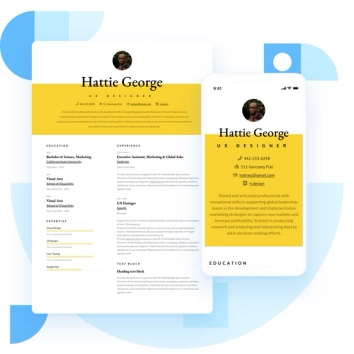
Discover the best resume formats for 2026 with examples for every job and experience level, plus expert tips to format your resume and get hired faster.
August 7, 2025
Read post
Resume Expert & VP Marketing

