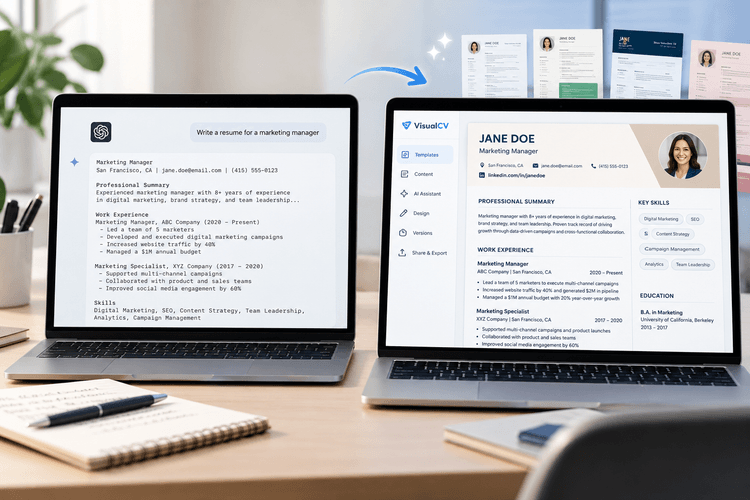
Ask ChatGPT to write you a resume, and it will produce a page of clean text in seconds. But a resume is more than just text: in 2026, it must be carefully formatted, intentionally designed, and ATS-safe.
That gap is the whole story here. The best AI for resume writing really comes down to a choice between two options: general chatbots that generate text, and purpose-built resume builders that generate a finished, job-ready resume.
Chatbots can be serviceable drafting assistants, fast and free to start. Specialized builders like VisualCV draft too, but they do what chatbots can’t: turn the text into a thoughtfully designed, ATS-friendly resume you can export, tailor into different versions, publish as a web page, or hand to a professional writer. For most job seekers, especially highly experienced and executive professionals, the builder produces the better end result.
In this comparison, we’ll cover:
| Factor | General AI Chatbots (ChatGPT, Claude, Gemini) | AI Resume Builders (VisualCV) |
|---|---|---|
| What it produces | A drafted resume, generated fresh on request | A finished resume you build, save, and refine over time |
| Visual design and templates | Can format a document, but no library of professionally designed templates to choose from | Professionally designed, recruiter-friendly templates |
| ATS-friendly formatting | Can produce ATS-passable output, but not systematically built or tested for it, so results vary | Templates built and tested to parse cleanly in applicant tracking systems |
| Export and sharing | Can generate a file, but formats are limited and inconsistent | Reliable one-click PDF and Word, plus a shareable web link |
| Multiple tailored versions | Managed by hand in separate chats or docs | Saved, duplicated, and tailored in one place |
| Human expert option | None | Professional writing and review available with a career expert |
| Cost to start | Free tier available; paid plans for advanced use | Free account; Pro starting at $16 per month billed quarterly |
This is where general AI is genuinely competitive. Modern chatbots write clean prose, suggest strong action verbs, and can rework a vague responsibility into a sharper, achievement-focused bullet. If your goal is just to get words on the page, a chatbot does that well.
VisualCV also uses AI for drafting and rewording inside the editor. The difference is context. A chatbot writes in a vacuum and can’t see how a bullet will look once it sits in a two-column template next to your skills section. A builder writes into the expert-designed template, where wording, length, and layout are decided together.
Two additional cautions on drafting with a general tool: it can invent details, inflate a title, or produce metrics you never claimed, and an invented number on a resume is something you may have to defend in an interview. Also, depending on the tool and its settings, text you provide may be retained or used for model training, so check before sharing a full work history and other sensitive information.
A recruiter forms an impression of your resume before reading a single bullet. Layout, hierarchy, spacing, and typography decide whether the document reads as polished or generic and thrown together. A chatbot can generate a formatted resume, but it can’t hand you a library of professionally designed templates to choose from, and the design it does produce can be inconsistent and hard to control from one attempt to the next.
Resume builders exist to solve exactly this problem. VisualCV offers professionally designed, recruiter-friendly templates and full control over layout, section order, spacing, and color, so the design fits your field. For an executive or senior specialist, that presentation is more than just decorative; it’s part of the signal, and it’s the clearest advantage a dedicated platform holds over a general tool.
Most mid-size and large employers screen resumes with an applicant tracking system before a human ever sees them. These systems parse your resume into structured data, and they stumble on formatting that breaks in parsing, even if it looks fine on your screen: text boxes, unusual columns, headers and footers, tables, and graphics are common triggers.
A chatbot can produce a formatted resume, but not one built or tested for how that formatting will parse, and it can’t see how its output actually lands in an ATS. Results vary, and the burden of getting the formatting right ultimately falls on you.
An AI resume builder handles this as a baseline. VisualCV templates are built and tested so the underlying structure parses cleanly, which means the resume that looks polished to a recruiter is also the one a machine can read. You get presentation and machine-readability instead of trading one for the other, which protects you from one of the most common reasons good resumes go unread.
Serious job seekers tailor their resume for each role, emphasizing different achievements and keywords to match a specific listing. With a chatbot, each new version means prompting again and re-checking the output, with results that vary from one attempt to the next.
VisualCV is built to make customization simple and effective. You can keep multiple resumes in one place, duplicate a base version, and tailor each to a specific job while keeping the formatting intact. Because your content and design are already built, spinning up the next version takes minutes rather than a fresh round of prompting, and every version stays visually consistent with the last. The AI assists, but you stay in full control throughout.
A resume eventually has to leave the tool in which it was made, and this is another area where the two approaches diverge. A chatbot can hand you a file, but the options are limited and inconsistent from one attempt to the next.
With a builder, file export is much more dependable: one click to a clean PDF or Word file that looks the same every time. VisualCV also goes past the static document; you can publish your resume as a shareable live web page, useful for sending a link instead of an attachment or presenting your work as an online portfolio (you can even track views and downloads with built-in analytics). Those are tools that give job seekers a genuine advantage, and they’re things a general chatbot simply isn’t built to do.
Even the best AI, general or purpose-built, has a ceiling. For a career change, a jump to the executive level, or a moment when the stakes are high, sometimes what you want in your corner is a person who has written and read thousands of resumes.
Alongside its AI builder, VisualCV gives you the option to work with a professional resume writer or to book a review with a career expert who tells you what’s working and what to fix. You can build it yourself with AI assistance, or have a professional build it for you, all on the same platform.
If you already reach for a chatbot to get unstuck when resume writing, it earns its place; it’s a capable way to rough out a first summary, or push a stubborn bullet into something sharper, and there’s nothing wrong with starting there and bringing the raw material into a builder to finish. While that’s worth knowing, VisualCV's own AI offers the same benefits and more. The builder can take you from blank page to finished resume all on its own.
A general AI chatbot alone may be enough if you:
Consider a purpose-built AI resume builder if you:
ChatGPT is good for drafting and rewording resume text. It isn’t a resume builder, so it doesn’t produce a designed, ATS-ready document, and it has no template, sharing, or version-management features. It works best as a drafting assistant used alongside a purpose-built builder.
It depends on what you mean by writing. For generating text, general chatbots like ChatGPT are capable. For producing a finished, job-ready resume, a purpose-built AI resume builder like VisualCV is the stronger choice because it combines AI writing help with professional design, ATS-friendly formatting, export, and sharing, along with the option of working with a human expert.
Only if it’s formatted correctly. Text from a chatbot is not automatically ATS-safe, and copy-pasting it into a decorative document often introduces parsing problems. An AI resume builder with ATS-friendly templates protects the underlying structure, so the resume reads cleanly to both software and recruiters.
Generic, one-size-fits-all AI text can read as impersonal, which is a reason to edit any draft into your own voice and back it with real, verifiable achievements. Using AI to assist is fine; sending unedited, unverified AI output is a risk.
Both a chatbot and a specialized AI resume builder can get you to a finished document. The difference is what you walk away with: a draft you have to shepherd the rest of the way, or a strategically designed, ATS-ready document you can tailor for each role, export cleanly, and reuse across an entire search. For a quick rewrite, a chatbot does the job. For creating a resume you’ll actually send, VisualCV does the whole job, start to finish. More than 7 million people across 125+ countries and 17 languages have trusted it with their job search.
Try VisualCV free and turn your work experience into a polished, ATS-ready resume you can send with confidence.
Last updated: October 2026

Written by
Madison Norton
Resume Expert & VP Marketing
Madison is the VP Marketing and General Manager at VisualCV. He's a seasoned marketing leader, resume writing and career marketing expert and now helping people grow their own career marketing strategies to build a career they love.
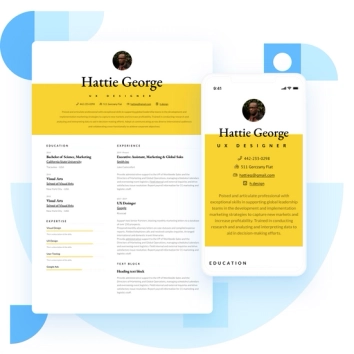
Discover the best resume formats for 2026 with examples for every job and experience level, plus expert tips to format your resume and get hired faster.
August 7, 2025
Read post

Resume Expert & VP Marketing

Learning how to write a resume in 2025 is an important step in everyone's career. This step-by-step guide with resume examples will help you get started.
February 7, 2025
Read post

Community Success Manager & Resume Writing Expert
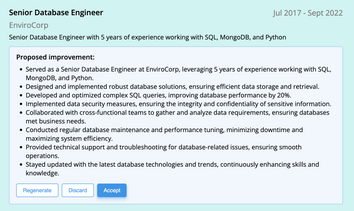
AI can change the way you write, and your resume is no exception.
November 27, 2023
Read post
Community Success Manager & Resume Writing Expert