Top Welder Skills For Resume

Learn how to effectively list welder skills on your resume with real-world examples. Includes top welder skills, sample resume phrases, and related skills.

welder resume skills

Top 20 Welder Skills for Resume

  1. Welding Processes (SMAW, FCAW, GMAW, TIG) - Demonstrates versatility in using various welding techniques to handle diverse projects.

  2. Blueprint Reading - Ability to interpret technical diagrams and plans accurately for precise execution of welding tasks.

  3. Metallurgy Knowledge - Understanding the properties, behaviors, and reactions of metals during welding to ensure optimal results.

  4. Quality Control - Ensuring welds meet industry standards by inspecting work and taking corrective actions when necessary.

  5. Welding Codes & Regulations (ASME, AWS) - Proficiency in adhering to safety guidelines and quality standards within the welding industry.

  6. Oxy-Fuel Cutting - Skillful use of oxy-fuel cutting torches for precise metal cutting and shaping.

  7. Weld Inspection & Testing - Ability to perform visual, magnetic particle, and dye penetrant inspections on welds.

  8. Welding Electrode Selection - Knowledge of electrode types, their uses, and the effects they have on weld properties.

  9. Welding Automation - Familiarity with robotic and semi-automatic welding equipment to increase efficiency and precision.

  10. Gas Shielding - Ability to apply shielding gases (like CO2, He, Ar) correctly to protect welds from contamination during various welding processes.

  11. Weld Repair - Skill in repairing and rebuilding damaged or weakened welds to maintain structural integrity.

  12. Sheet Metal Welding - Ability to weld sheet metal for fabrication, assembly, and repair of various structures.

  13. Welder Certification (ASC, AWS) - Possessing industry-recognized certifications demonstrates a high level of expertise and commitment to excellence.

  14. Weld Joint Design - Knowledge of welding joint design principles to ensure structural integrity and optimal weld quality.

  15. Safety Compliance - Ability to follow safety guidelines and use personal protective equipment to minimize risks associated with welding.

  16. Welding Equipment Maintenance - Skill in maintaining, troubleshooting, and repairing welding equipment for optimal performance.

  17. Work Piece Setup - Ability to properly prepare workpieces for welding, including cleaning, aligning, and securing them.

  18. Weld Distortion Control - Knowledge of techniques to control weld distortion and ensure dimensional accuracy in finished products.

  19. Blueprint Creation & Modification - Ability to create and modify blueprints using CAD software for fabrication and assembly purposes.

  20. Welding Math & Calculations - Skill in performing calculations related to welding, such as determining the correct electrode size, wire feed speed, and amperage settings.

How to List Welder Skills on Resume

  1. Organize by Relevance: Prioritize skills based on the job requirements, with the most important skills listed first.

  2. Action Verbs: Use action verbs like "Operate," "Maintain," "Inspect," and "Troubleshoot" to make your skills sound active and impactful.

  3. Quantify Achievements: Include specific numbers, percentages, or examples of projects completed to demonstrate the extent of your proficiency in each skill.

  4. Use Job-Specific Keywords: Tailor your resume to match keywords from the job posting to increase visibility and relevance to Applicant Tracking Systems (ATS).

  5. Combine Skills & Achievements: Incorporate skills and achievements into a single, concise bullet point for easy readability and understanding.

Examples of How to List Welder Skills on Resume

Example 1

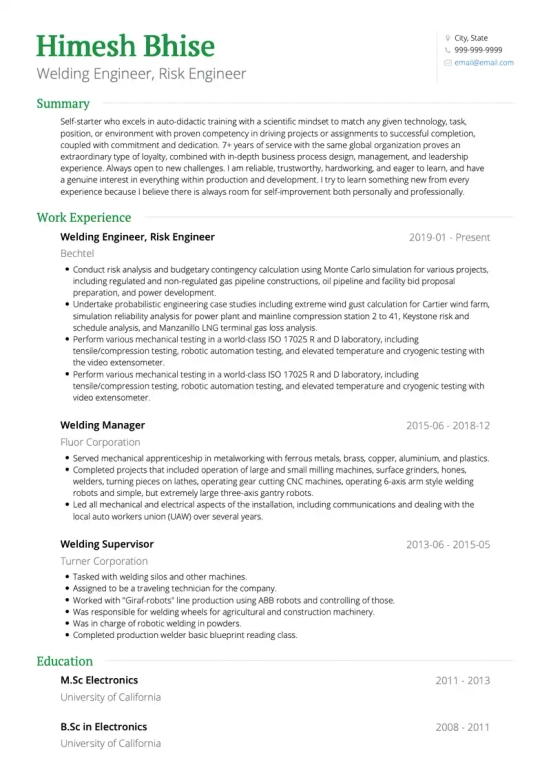
  • Proficient in SMAW, FCAW, GMAW, TIG welding processes with over 5 years of experience in various industries.

  • Consistently meets quality control standards by inspecting welds for defects and taking corrective actions when necessary.

  • Possesses AWS Certified Welder (CW) certification and adheres to ASME guidelines for safety and structural integrity.

Example 2

In the capacity of a fabricator, I operate and maintain various welding equipment, including robotic and semi-automatic welding machines. Additionally, I have experience with oxy-fuel cutting and can perform visual, magnetic particle, and dye penetrant inspections on welds to ensure their quality.

Example 3

Skills:

  • Welding Processes (SMAW, FCAW, GMAW, TIG)

  • Blueprint Reading & Creation

  • Metallurgy Knowledge

  • Quality Control & Inspection

  • Gas Shielding & Electrode Selection

  • Weld Joint Design & Distortion Control

  • Safety Compliance & Equipment Maintenance

Experience:

  • 5+ years of experience in various industries, using the listed skills to complete projects on time and within budget.

Jobs that Demand Welder Skills

  1. Welder (Heavy Equipment, Automotive, Aerospace) - Welding structures for various industries requires proficiency in multiple welding techniques and an understanding of industry-specific requirements.

  2. Fabricator - Creating custom metal products relies on a combination of welding skills, blueprint interpretation, and equipment operation.

  3. Welding Inspector - Ensuring the quality of welds in large-scale manufacturing requires expertise in inspection methods and an understanding of relevant standards.

  4. Sheet Metal Worker - Fabricating, assembling, and repairing sheet metal products require skills in sheet metal welding, cutting, and forming.

  5. Welding Engineer - Designing welding processes, equipment, and structures requires technical expertise in metallurgy, physics, and engineering principles.

  6. Pipeline Welder - Working on oil, gas, or water pipelines demands the ability to weld various metals under extreme conditions and adhere to safety regulations.

  7. Welding Machine Operator - Operating robotic welding machines requires a strong understanding of automation principles, equipment operation, and quality control.

  8. Wire Feed Sales Representative - Selling wire feed products to welders necessitates knowledge of various welding processes, electrode types, and industry standards.

  1. Welding Safety Training (HAZMAT, First Aid) - Understanding safety protocols for hazardous materials and emergency response techniques is crucial in the welding industry.

  2. CAD Design & Drafting - Proficiency in CAD software enables welders to create detailed designs and modify blueprints for fabrication purposes.

  3. Blueprint Interpretation (Architecture, Engineering) - Ability to interpret technical drawings from various disciplines allows welders to collaborate effectively with other professionals.

  4. Material Testing & Analysis - Knowledge of material testing methods and analyzing test results helps welders select appropriate electrodes and shielding gases for optimal weld quality.

  5. Mechanical Assembly & Disassembly - Skill in assembling and disassembling mechanical components allows welders to perform repairs more efficiently.

  6. Structural Analysis (Finite Element Analysis, FEA) - Ability to analyze the structural integrity of welds and designs helps ensure the safety and durability of finished products.

  7. Metal Forming Techniques - Knowledge of metal forming techniques, such as bending, rolling, and shaping, expands a welder's skillset and increases their versatility in fabrication projects.

  8. Welding Automation & Robotics Programming - Ability to program robots for welding tasks increases efficiency and precision in automotive and manufacturing industries.

  9. Project Management (Agile, Scrum) - Skills in project management help welders coordinate teams, manage timelines, and ensure projects are completed on time and within budget.

  10. Quality Assurance & Quality Control - Proficiency in quality assurance techniques ensures that products meet required standards, minimizing waste and rework.

How to Address Gaps in Welder Experience on a Resume?

Explain brief reasons for any employment gaps without being overly detailed. Highlight any relevant activities or training you participated in during the gap that may have boosted your welding skills, and provide contact information for references who can vouch for your commitment to the trade during this period.

How to Showcase Self-taught Welder Skills Without Formal Education?

Emphasize proficiency in various welding techniques by listing specific projects you've completed on your own, along with detailed descriptions of the materials used and welds performed. Include any certifications earned through hands-on training or testing, and be sure to quantify achievements when possible.

How to Handle Outdated Welder Skills on a Resume?

Focus on current skills that are most relevant to the position you're applying for. If an outdated skill is required, mention any related courses or training you plan to take in the near future. Explain how previous experience with older welding methods can still be valuable in a modern setting.

How Long Should a Welder Professional's Resume Be?

Aim for a one-page document that highlights important qualifications and experiences, while remaining concise and easy to read. Quantify achievements, use bullet points, and include welding industry keywords. If necessary, create a secondary page with additional details upon request.

How to Address Welder Certifications that are in Progress?

List completed certifications at the top of your resume, followed by those currently in progress in a separate section. Include certification name, organization, and expected completion date. Emphasize relevance to the position you're applying for and discuss how they will enhance your skillset and job performance.

What to Do If You Have Limited Welder Experience but Want to Enter the Field?

Highlight relevant education or training received, personal projects, hobbies that demonstrate interest in welding, and transferable skills from previous work experiences. Secure internships or apprenticeships with established welders to gain practical experience and build a strong network in the industry.

How to Compete with More Experienced Welder Professionals?

Highlight unique strengths and skills that set you apart, such as specialized certifications, exceptional technical abilities, or problem-solving skills. Provide tangible examples of how these qualities have benefited past employers or projects. Emphasize adaptability, willingness to learn, and ability to work well in a team.

How Frequently to Update Welder Skills on Your Resume?

Update your resume every time you gain new qualifications, certifications, or significant work experience. Revise at least once per year to ensure relevance and competitiveness in the job market. Focus on quantifying achievements and emphasizing important skills.

Whether to Include Welder Side Projects or Volunteer Work on a Resume?

Include relevant side projects and volunteer work to demonstrate passion for the trade, independence, and willingness to take on new challenges. Highlight completed projects, materials used, techniques employed, and their impact or benefits.

How to Format a Welder Resume for Maximum Impact?

Organize into sections such as Summary, Skills, Work Experience, Certifications, Education (if any), and Projects/Volunteer Work. Use bullet points, quantify achievements, include welding-specific keywords, and proofread carefully before submitting your application.

Copyright ©2025 Workstory Inc.