4 Software Engineer Cover Letter Examples And Tips
4 Software Engineering cover letter examples for your job search inspiration. Copy, edit, and modify to stand out and land that dream software engineering role!
4 Software Engineering cover letter examples for your job search inspiration. Copy, edit, and modify to stand out and land that dream software engineering role!
There are a couple of pointers best known as the standard practices for writing any letter; they apply to your software engineer cover letter just as much.
Let’s take a look at what they are:
Your software engineering cover letter should fit into this general framework to avoid being noticed as a ramble of words for a letter.
Next —
Now that your cover letter is in the right structure, what should you write in it to convince the employer that you are an engineer they should meet?
What type of engineer is the employer looking for?
That sure gets the top priority when you choose what you’ll write in your letter.
Make a list of the requirements in the job description that you have to offer something against.
There are two ways to present your skills – either you go the story-telling route or highlight your skills with bullet points.
But, both ways aren’t ideal for all positions.
For Software Engineering, your resume will already be listing your programming skills.
Think about the best thing you did with any of your projects - improved speed? got rid of broken codes? wrote reusable scalable codes that everyone uses in your department now?
While you write end results in your resume without much focus on how you did things in the background, you make up for it in the cover letter by highlighting your efforts that mattered.
Let’s walk through some software engineer sample cover letters to figure out how you can write these points on your cover letter.
Dear Joseph,
I’m writing to apply for the position of Software Engineer for .NET framework advertised on LinkedIn for Infor. On reading the requirements I discovered my skills were a 100% match with an array of other skills that could see benefits in collaborating with the partnering teams.
I have been recognized for my outstanding ability to work with diverse teams which motivated me to participate in numerous team-oriented exercises and deliver finished assignments timely that adhered to requirements while maintaining standard protocols. Since I’m a Chemical engineer with a desire to work in the software industry, I have taken formal certification courses in product development, test-driven development, data structures, business analysis, C#, C++, VB.Net programming, and much more.
To gain experience I worked for the pharma and FMCG industry to develop apps co-working with their contractors and some independent freelancers while still in college. Working on real business projects became a huge advantage in understanding the development cycle and underlying process from requirement gathering to delivery of features, projects, and maintenance phases. I have extensively used C# with .NET for Behavioral Mapping through the gamification project and a newspaper distribution system project amongst others.
View my latest projects here: www.example.com/portfolio (contains 15 projects; developed 6 projects independently and the others with a team of two).
I would welcome an opportunity to be interviewed at Infor for a Software Engineer position. I’m available at all times for a telephone screening, at the end of which we could set up an interview appointment at your earliest convenience.
Sincerely, Kevin Cormick
Dear Esther,
I came across the Front-end Software Engineer vacancy on indeed.com and I’m interested in the opportunity. My portfolio covers a variety of projects in multiple front-end technologies that I have worked on in the past 3 years.
My proudest moment as a developer has been on a project that first afforded me a chance to lead a team in the absence of our technical lead to direct us and coordinate with the project manager. The project ran into a scalability problem due to database load which had its roots in the database structure that was being used. Project delay was expected until the lead returned, but I personally took the challenge and got permission to visit the problem area. I’m all about clean codes and scalability.
Therefore, this was an exciting challenge for me. I worked on the database design schema and load balance to get the desired results within the next 2 days. The resolution made the program faster with a response time of 0.3 seconds which had been stuck at 1.5 seconds earlier. The changes were accepted and I was promoted to leading a team 6 months later.
I have led a team of 6 engineers and built 4 Android applications and 2 iOS Applications using React Native. All applications received 4-star + ratings and over 1 million downloads. What I offer a project is my understanding of front-end, database structures, and usability factors together which helps me in proper analysis during the development phase to pinpoint any errors and figure out the best solutions. While I make it easier to locate issues and direct the team’s efforts, we save a significant amount of time and invest it in the careful development of the projects.
I love the challenge that comes with an unexplored idea which is why I’m keen on an interview opportunity with WillowTree. I shall follow up with you via phone after 3 days to set up an appointment and get to know more about the opportunity and how I can be of use.
Thank you for your time and consideration.
Sincerely Sergio Bond
Dear Monica,
I am a recent Florida State University graduate majoring in Computer Science and I want to put my application in for the recently posted Back-end Software Engineer position on Dice.com. I have developed the back end for some freelance projects and written Python codes during my internship.
Complementing my diverse skill set, I have developed an excellent understanding of a wide range of programming languages and tools and have demonstrated this capability throughout my ongoing training and participation in Computer Science, IT, and Cybersecurity activities and my current progress in establishing a formidable team for the 2019 ICPC(International Computer Programming Contest) at the University of California.
I have built web applications using agile development methodology to manage several projects on one platform and keep track of development utilizing .NET MVC5, and Azure cloud services. I have also developed a weather forecasting application, a theme-generating module for events, and a mileage-tracking application for both iOS and Android phones. While developing these I felt the need for a native interface builder, which is when I was tempted to learn React. After 8 months of learning and practicing through online training courses I was able to launch a chat application with a video call function for both Android and iOS platforms using React native.
I thrive by challenging myself to learn all technologies and trades that could make me a better programmer and help me make informed business decisions. Growing on all sides reinforces my motivation to learn more every day widening the periphery of my abilities.
May I expect to speak with you and get to know more about the position in the coming week? I’ll follow up to see if you could get me an interview in the next week or at your earliest convenience.
Sincerely, Margaret Zinc
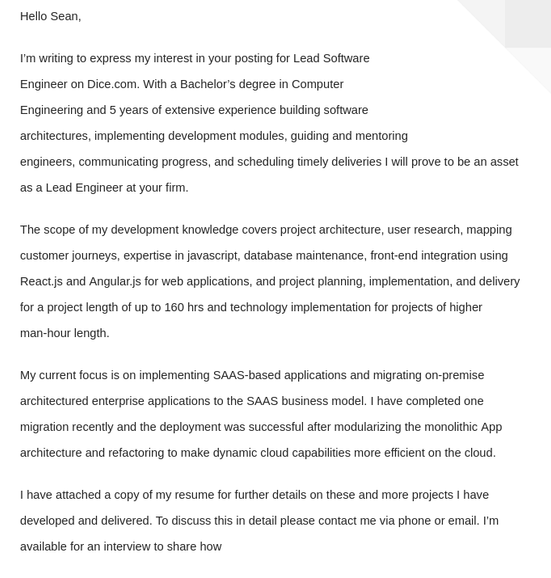
Hello Sean,
I’m writing to express my interest in your posting for Lead Software Engineer on Dice.com. With a Bachelor’s degree in Computer Engineering and 5 years of extensive experience building software architectures, implementing development modules, guiding and mentoring engineers, communicating progress, and scheduling timely deliveries I will prove to be an asset as a Lead Engineer at your firm.
The scope of my development knowledge covers project architecture, user research, mapping customer journeys, expertise in javascript, database maintenance, front-end integration using React.js and Angular.js for web applications, and project planning, implementation, and delivery for a project length of up to 160 hrs and technology implementation for projects of higher man-hour length.
My current focus is on implementing SAAS-based applications and migrating on-premise architectured enterprise applications to the SAAS business model. I have completed one migration recently and the deployment was successful after modularizing the monolithic App architecture and refactoring to make dynamic cloud capabilities more efficient on the cloud.
I have attached a copy of my resume for further details on these and more projects I have developed and delivered. To discuss this in detail please contact me via phone or email. I’m available for an interview to share how
I can contribute to your team.
Sincerely, George Brink