School Nurse Cover Letter (with 4+ Examples & Tips)
4 School Nurse cover letter examples for your job search inspiration. Copy, edit, and modify to land your dream role.
4 School Nurse cover letter examples for your job search inspiration. Copy, edit, and modify to land your dream role.
A school nurse cover letter is all about your nurse’s degree and your experience working with children.
When a school hires a school nurse, they are willing to invest in their children’s physical and psychological well-being.
That says you need to show that you are equally committed to nurturing the health of the young generation and building a healthy society.
This will be aligning your goals with theirs for the need to care for the children and show compassion and build a positive image of the school.
Your RN or LPN or nursing graduation will play an important role depending on what they are looking for - find it in their job description.
With this information, your cover letter is one step away from the interview call.
That final deciding factor will be your experience at a school or at a pediatric hospital.
If you do not have the experience, sharing your compassion towards their “care for children” motto will do the work for you.
Be concise and write your school nurse cover letter in 150-200 words. Finally, let’s look at the examples for both experienced and inexperienced school nurse cover letters.
Dear Ms.Tracy,
I came to know of the full-time School Nurse vacancy at Afsa Highschool through the Star Tribune newspaper and was inclined to apply for this position. I currently work at the Minnesota District School where I’m assigned to 5 district schools to assess and educate children on keeping a healthy diet, understanding their bodies, and identifying any health problems. My RN certification and 3-year experience with children would be beneficial to the position of School Nurse at your school.
I keep a strict schedule for each school I visit, after a careful evaluation of their needs. Apart from basic hygiene training, regular full-body checks, monitoring, and treating sick children, immunization checks, and vaccine administration or recommendations for all, I also took cases of individuals who required special care and attention on a regular basis. I was able to obtain approval at 3 schools to hold a weekly listening session where a student could meet me and ask health-related questions or seek advice in planning a healthy diet or routine for themselves. This proved to be extremely useful in gaining insight into what problems and health conditions they faced and where they needed help more often. I used this insight to carry out regular sessions more effectively covering areas to address their concerns.
With a full-time nurse position, I’ll be able to give more time and attention to students who need it most and will be able to take a holistic approach and be available for the long term to see progress and make suggestions to secure a healthy life for each student.
I hope to discuss further on this in a personal meeting this week. You may reach out to me on my phone to set up an interview.
Thank you for your time and consideration!
Best Regards, Jimmy Margaret
Dear Mr. Hudson,
This is to apply for the position of School Nurse as advertised in the Chicago Tribune yesterday. I completed my Bachelor’s in Nursing and earned my RN certificate last month. I like to work with children and I shadowed pediatric nurses in a children’s hospital while I pursued my BSN which gives me the hands-on experience to be able to work with the kids at school.
During my nursing training, I practiced giving emergency care, venipuncture, and collected blood samples from patients, and reported progress to the doctors of the concerned patients. I spent a lot of my free time educating my patients about their condition and listening to their troubles with their medical condition they had. This helped me understand the symptoms and the ailment better than reading a list of symptoms in the books, making me more empathetic towards the condition and recovery of my patients.
Previously, I also worked as a receptionist for a pediatric clinic and gained an understanding of clinical administration. I organized the doctor’s daily patient meetings and prioritized emergency cases took temperature measurements, and recorded weight, and medical history for the doctor’s reference.
My experiences make me an excellent fit to work with children and educate them simultaneously on keeping good health in the long run. I seek an opportunity for an interview with the school to discuss how I can contribute to the children’s welfare by working as a School Nurse there.
Please feel free to contact me via my phone number to get in touch for the next steps. Looking forward to speaking with you.
Thanks for the time you have taken to review my application.
Sincerely, Adam Jackson
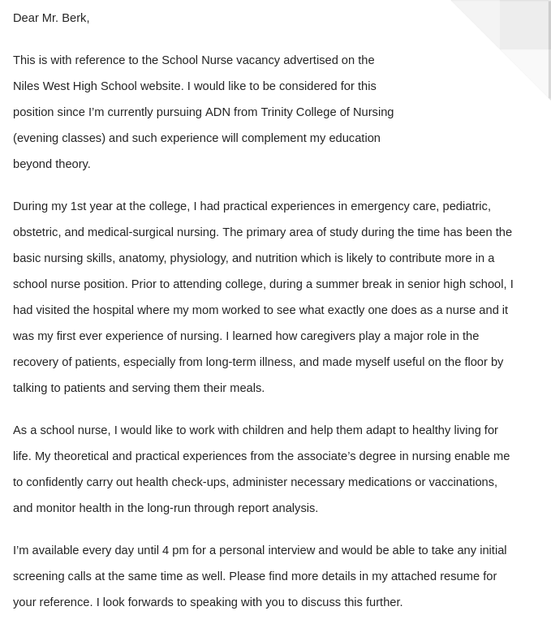
Dear Mr. Berk,
This is with reference to the School Nurse vacancy advertised on the Niles West High School website. I would like to be considered for this position since I’m currently pursuing ADN from Trinity College of Nursing (evening classes) and such experience will complement my education beyond theory.
During my 1st year at the college, I had practical experiences in emergency care, pediatric, obstetric, and medical-surgical nursing. The primary area of study during the time has been the basic nursing skills, anatomy, physiology, and nutrition which is likely to contribute more in a school nurse position. Prior to attending college, during a summer break in senior high school, I had visited the hospital where my mom worked to see what exactly one does as a nurse and it was my first ever experience of nursing. I learned how caregivers play a major role in the recovery of patients, especially from long-term illness, and made myself useful on the floor by talking to patients and serving them their meals.
As a school nurse, I would like to work with children and help them adapt to healthy living for life. My theoretical and practical experiences from the associate’s degree in nursing enable me to confidently carry out health check-ups, administer necessary medications or vaccinations, and monitor health in the long-run through report analysis.
I’m available every day until 4 pm for a personal interview and would be able to take any initial screening calls at the same time as well. Please find more details in my attached resume for your reference. I look forwards to speaking with you to discuss this further.
Ward Regards, Julia Hudson