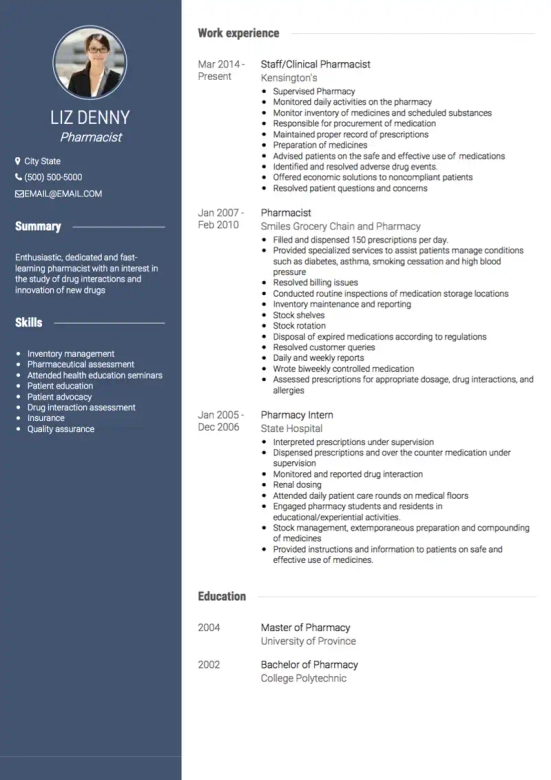
Learn how to effectively list pharmacy technician skills on your resume with real-world examples. Includes top pharmacy technician skills, sample resume phrases, and related skills.

Medication Administration - Proficient in administering medications accurately and safely to patients.
Prescription Preparation - Ability to prepare, label, and dispense prescriptions correctly.
Pharmacy Software Knowledge - Familiarity with pharmacy management systems like McKesson's SentriCare or Cerner Corporation's PowerChart.
Inventory Management - Skill in monitoring and maintaining appropriate stock levels of medications and supplies.
Patient Counseling - Capability to educate patients about their prescriptions, dosages, and side effects effectively.
Sterile Compounding - Knowledge and expertise in preparing sterile medications, including intravenous (IV) drugs.
Pharmacology - Understanding of drug actions, interactions, and contraindications.
Customer Service - Excellent communication skills to handle patient inquiries and concerns professionally.
Compliance with Regulations - Ability to adhere to federal, state, and local pharmacy regulations.
Data Entry - Skill in entering and maintaining accurate patient information and prescription details.
Pharmaceutical Calculations - Proficiency in performing mathematical calculations related to drug dosages and dilutions.
Quality Control - Ensuring the quality, safety, and effectiveness of medications by monitoring for errors and discrepancies.
Dispense Medication Devices - Knowledge of various medication delivery devices such as insulin pens, inhalers, and transdermal patches.
Patient Data Confidentiality - Maintaining patient privacy and protecting sensitive information according to HIPAA guidelines.
Emergency Procedures - Ability to handle emergency situations and follow established protocols.
Teamwork - Collaboration with pharmacists, nurses, and other healthcare professionals to provide optimal patient care.
Continuing Education - Willingness to stay updated on the latest pharmaceutical developments through professional development courses and certifications.
Time Management - Efficiently managing multiple tasks and priorities in a fast-paced pharmacy environment.
Problem Solving - Ability to analyze situations, identify problems, and propose effective solutions.
Adherence to Workflow Procedures - Understanding and following established workflows to maintain efficiency and accuracy in the pharmacy.
Quantify achievements whenever possible, using numbers or specific examples to demonstrate your impact.
Use action verbs to describe your tasks, such as "Developed," "Implemented," "Managed," and "Improved."
Organize skills under relevant headings (e.g., Technical Skills, Soft Skills) for clarity and readability.
Customize your resume for each job application by emphasizing the most relevant skills and experiences.
Use bullet points to make it easy for recruiters to quickly scan your skills and achievements.
Prepared and labeled over 50 prescriptions daily using Cerner Corporation's PowerChart software.
Ensured patient safety by double-checking all medication orders for accuracy and proper dosages.
Counseled patients on their prescriptions, providing clear instructions about usage, side effects, and potential interactions.
As a Pharmacy Technician at XYZ Hospital, I was responsible for managing prescription workflow, maintaining an accurate inventory of medications and supplies, and ensuring patient safety. I utilized my strong organizational skills to ensure that all prescriptions were prepared, labeled, and dispensed correctly using the McKesson's SentriCare system. In addition, I counseled patients on their prescriptions, explaining dosages, side effects, and potential interactions in clear and understandable terms. By implementing quality control measures, I was able to identify errors before they reached the patient, thus improving safety and efficiency within our pharmacy.
Technical Skills:
Pharmacy management systems: McKesson's SentriCare, Cerner Corporation's PowerChart
Mathematics: Performing calculations related to drug dosages and dilutions
Sterile compounding: Preparing sterile medications, including intravenous (IV) drugs
Soft Skills:
Communication: Effectively communicating with patients and healthcare professionals
Customer Service: Handling patient inquiries and concerns professionally
Teamwork: Collaborating with pharmacists, nurses, and other healthcare professionals to provide optimal patient care
Hospital Pharmacy Technician - Responsible for dispensing medications, maintaining inventory, and providing counseling to patients in a hospital setting.
Retail Pharmacy Technician - Works in a retail pharmacy, filling prescriptions, managing inventory, and providing customer service.
Long-Term Care Pharmacy Technician - Works in nursing homes or assisted living facilities, managing medication administration for residents.
Specialty Pharmacy Technician - Specialized roles focusing on specific areas such as oncology, infectious diseases, or rare conditions.
Mail-Order Pharmacy Technician - Responsible for processing and shipping mail-order prescription medications to patients.
Compounding Pharmacy Technician - Prepares customized medications according to a patient's specific needs.
Military Pharmacy Technician - Works in the military to provide medication support to service members and their families.
Academic Pharmacy Technician - Involved in teaching and supervising pharmacy technician students at educational institutions.
Medical Coding and Billing - Understanding of medical codes and billing procedures to assist with insurance claims and reimbursements.
Health Information Technology (HIT) - Knowledge of electronic health records systems, telemedicine platforms, and other HIT tools.
Healthcare Compliance - Familiarity with regulations related to healthcare, such as the Health Insurance Portability and Accountability Act (HIPAA).
Clinical Research Coordination - Experience in coordinating clinical trials, managing study data, and ensuring compliance with regulatory requirements.
Laboratory Techniques - Ability to perform basic laboratory tests and procedures, such as blood glucose monitoring or urinalysis.
Health Education and Promotion - Knowledge of health promotion strategies and the ability to educate patients on healthy lifestyles and disease prevention.
Quality Improvement - Experience in implementing quality improvement initiatives and using data to drive continuous improvement.
Project Management - Skills in planning, organizing, and executing projects to improve efficiency and productivity within a pharmacy setting.
Geriatrics - Understanding of the unique needs and challenges faced by older adults and the ability to provide appropriate care and support.
Mental Health First Aid - Knowledge of mental health issues and crisis response to help patients in need of emotional support.
Focus on your positive actions during work history gaps, such as volunteering at pharmacies or self-study related to the field. Be honest and concise about the gap itself; provide a brief explanation if necessary but don't dwell on it. Highlight any achievements or skills gained during this period to demonstrate professional growth.
Detail practical experience and real-world knowledge when presenting self-taught pharmacy technician skills. Describe the context in which you gained these abilities, such as through hands-on work or online courses. Use specific examples to demonstrate how your self-taught skills have been applied successfully in practice. Include any relevant certifications earned through self-study as well.
Consider which outdated pharmacy technician skills are still valuable and relevant for the position being applied for. If necessary, update your knowledge in these areas before listing them on your resume. For irrelevant skills, remove them from the resume entirely. Focus on current competencies that demonstrate professional growth.
Keep the pharmacy technician resume between one to two pages in length. This provides space for relevant work experience, skills, and accomplishments without overwhelming potential employers. Use bullet points and concise language if necessary to keep the document manageable.
List any in-progress pharmacy technician certifications on the resume, along with relevant details such as expected completion date or certification body. This demonstrates ongoing commitment to professional development and sets you apart from applicants who may not be actively pursuing additional qualifications.
Emphasize any relevant education, training, or skills that demonstrate your suitability for a pharmacy technician position. Include any volunteer work, internships, or coursework related to the field to show interest and commitment to the profession. Highlight transferable skills from other industries and explain how they can translate to success in a pharmacy technician role.
Focus on your unique strengths and accomplishments to set yourself apart from more experienced professionals. Highlight any specialized training or advanced certifications, excellent attention to detail, and commitment to patient care. Include specific examples of times when your skills led to positive outcomes in a pharmacy setting.
Update your pharmacy technician skills whenever you acquire new knowledge or training related to the field, including attending workshops, earning certifications, or completing additional coursework. Regularly reviewing and updating the resume ensures it remains accurate and up-to-date, making a strong impression on potential employers.
Including pharmacy technician-related side projects and volunteer work demonstrates enthusiasm for the profession and a willingness to go above and beyond in pursuit of professional growth. Highlight any relevant achievements or skills gained through these experiences, as well as their positive impact on organizations or individuals involved.
List your pharmacy technician certifications prominently on the resume, ideally in the summary or qualifications section at the top of the document. Include the name and issuing body of each certification, as well as relevant expiration dates. Organize them by type (e.g., national, state-specific, or specialized) for clarity and easy scannability.
Copyright ©2025 Workstory Inc.