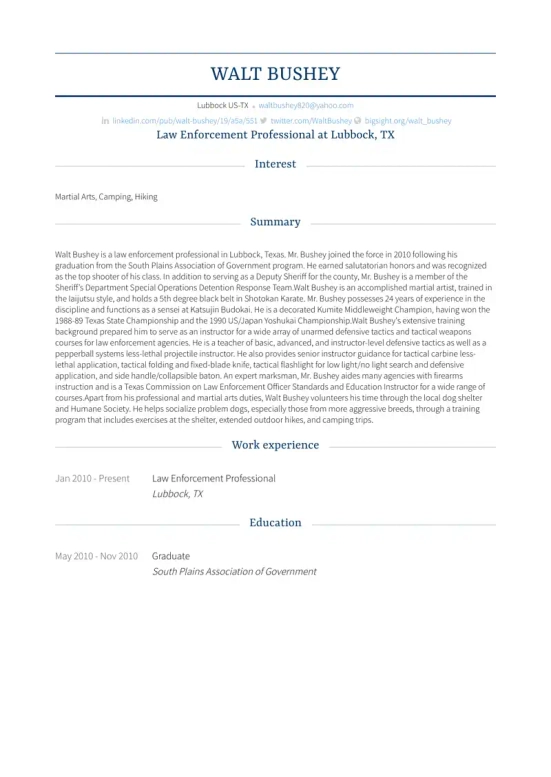
Top Law Enforcement Skills For Resume

Learn how to effectively list law enforcement skills on your resume with real-world examples. Includes top law enforcement skills, sample resume phrases, and related skills.

law enforcement resume skills

Top 20 Law Enforcement Skills for Resume

  1. Active Listening: Ability to understand and respond effectively to information and ideas presented in a conversation.

  2. Conflict Resolution: Skill in managing disagreements or disputes to achieve a satisfactory outcome for all parties involved.

  3. Critical Thinking: Ability to analyze situations and make informed decisions using logic and reasoning.

  4. Emotional Intelligence (EQ): Awareness of, and ability to manage one's own emotions, as well as the emotions of others.

  5. Investigative Skills: Ability to collect and analyze evidence to solve crimes or complex problems.

  6. Leadership: Ability to guide, influence, and inspire a team toward achieving a common goal.

  7. Patience: Ability to remain calm and composed in challenging situations.

  8. Physical Fitness: Maintaining a high level of physical fitness for the rigors of law enforcement duties.

  9. Report Writing: Ability to clearly and concisely document events, observations, and findings.

  10. Self-Defense Tactics: Skill in defensive techniques for personal safety and protection.

  11. SQL Server: Proficiency in managing and analyzing data using SQL, a standard database management system.

  12. Strategic Planning: Ability to develop comprehensive plans to achieve specific objectives within law enforcement.

  13. Surveillance Techniques: Skill in monitoring individuals or activities discreetly and effectively.

  14. Tactical Decision Making: Ability to make quick, informed decisions under pressure during high-risk situations.

  15. UX/UI Design: Understanding of user experience (UX) and user interface (UI) design principles to improve law enforcement tools and technology.

  16. Verbal Communication: Skill in expressing ideas clearly, concisely, and persuasively.

  17. Witness Interviewing: Ability to gather information effectively from witnesses during investigations.

  18. Criminal Law Knowledge: In-depth understanding of criminal law, procedures, and legal terminology.

  19. First Aid/CPR Certification: Ability to provide emergency medical care to injured individuals.

  20. Firearms Proficiency: Skill in handling, maintaining, and safely using firearms as required by the job.

How to List Law Enforcement Skills on Resume

  1. Prioritize Relevant Skills: Focus on the skills most directly related to the job you're applying for.

  2. Use Action Verbs: Start each bullet point with a strong action verb that clearly demonstrates what you accomplished using the skill.

  3. Quantify Achievements: When possible, provide specific numbers or percentages to demonstrate the impact of your skills.

  4. Use Keywords: Incorporate common keywords found in job descriptions to help your resume get past applicant tracking systems (ATS).

  5. Provide Specific Examples: Use concrete examples that illustrate how you've used your skills effectively in a law enforcement context.

Examples of How to List Law Enforcement Skills on Resume

Example 1

  • Investigated and solved complex criminal cases, resulting in a 95% conviction rate.

  • Led a team of officers in high-risk situations, ensuring their safety and successfully executing missions.

Example 2

Paragraph Format:

  • Demonstrated exceptional verbal communication skills by effectively negotiating with suspects, resulting in the peaceful resolution of conflicts and minimizing harm to all parties involved.

  • Utilized critical thinking and investigative skills to uncover hidden evidence that led to the apprehension of a dangerous criminal.

Example 3

Section-Based Format:

Investigative Skills

  • Conducted thorough investigations using various tactics, including witness interviews and physical evidence analysis.

  • Utilized SQL Server to analyze large datasets and identify patterns that aided in solving cases.

Leadership Skills

  • Led a team of officers during high-stress situations, ensuring their safety and coordinating efforts for successful mission execution.

  • Mentored junior officers, providing guidance and fostering a positive work environment.

Jobs that Demand Law Enforcement Skills

  1. Police Officer

  2. Detective

  3. Criminal Investigator

  4. Forensic Scientist

  5. Security Manager

  6. Border Patrol Agent

  7. Probation Officer

  8. Corrections Officer

  9. Federal Agent (FBI, DEA, etc.)

  10. Court Liaison Officer

  1. Crisis Management: Ability to handle and resolve critical situations effectively and efficiently.

  2. Adaptability: Flexibility in adjusting to new or unexpected challenges.

  3. Stress Management: Ability to manage stress effectively, particularly during high-pressure situations.

  4. Public Speaking: Skill in speaking clearly and persuasively to large groups of people.

  5. Ethics: Strong moral principles that guide decision-making and behavior within the law enforcement profession.

  6. Multi-tasking: Ability to handle multiple tasks simultaneously, prioritizing effectively for maximum efficiency.

  7. Spanish/Other Languages: Proficiency in a second language can be valuable in diverse communities or international law enforcement work.

  8. Legal Research: Ability to research and understand complex legal documents and decisions.

  9. Negotiation Skills: Ability to negotiate effectively with individuals, groups, or organizations.

  10. Active Learning: Continuously seeking out new knowledge and skills to improve one's performance as a law enforcement officer.

How to Address Gaps in Law Enforcement Experience on a Resume?

Explain brief reasons for any employment gaps in your law enforcement career, focusing on personal growth or circumstances that were beyond your control. Highlight relevant skills you developed during this time, such as continued education, training, or volunteer work related to law enforcement.

How to Showcase Self-taught Law Enforcement Skills Without Formal Education?

Present self-taught skills by providing specific examples of how they were applied in real-life situations or case studies relevant to the law enforcement field. Emphasize any relevant certifications, licenses, or achievements that validate your proficiency and dedication to the field.

How to Handle Outdated Law Enforcement Skills on a Resume?

Update your resume to reflect current trends and best practices in law enforcement. If you have outdated skills, focus on how they can be applied in a modern context or list them alongside newer skills you've acquired.

How Long Should a Law Enforcement Professional's Resume Be?

Aim for a one-to-two page resume that concisely highlights your most relevant law enforcement experience, achievements, and qualifications. Ensure essential sections like work history, education, certifications, and skills are included.

How to Address Law Enforcement Certifications that are in Progress?

List any completed certifications and clearly indicate those currently in progress. Provide the expected completion date or explain your ongoing efforts to achieve the certification.

What to Do If You Have Limited Law Enforcement Experience but Want to Enter the Field?

Emphasize any transferable skills relevant to law enforcement, such as communication, problem-solving, and critical thinking abilities. Highlight volunteer work, internships, or other experiences that demonstrate a commitment to the law enforcement profession.

How to Compete with More Experienced Law Enforcement Professionals?

Showcase your unique strengths, accomplishments, and passion for law enforcement in a clear and concise manner. Customize your resume to the specific job you're applying for by highlighting the most relevant skills and experiences.

How Frequently to Update Law Enforcement Skills on Your Resume?

Update your resume annually or semi-annually to ensure it remains current and accurate. Incorporate new certifications, training courses, and work experience as they are earned or acquired.

Whether to Include Law Enforcement Side Projects or Volunteer Work on a Resume?

Include side projects and volunteer work related to law enforcement, as they demonstrate your dedication to the field and can help set you apart from other candidates. Organize these experiences under an appropriate subheading, such as "Professional Development" or "Community Service." Emphasize skills developed and achievements accomplished during these experiences.

How to Present Law Enforcement Side Projects or Volunteer Work Effectively on a Resume?

Organize side projects or volunteer work under an appropriate subheading, such as "Professional Development" or "Community Service." Include the name of the organization, your role, and a brief description of the project and its objectives. Emphasize any skills you developed or achievements you accomplished during these experiences.

Copyright ©2025 Workstory Inc.