Financial Analyst Resume Objective Examples
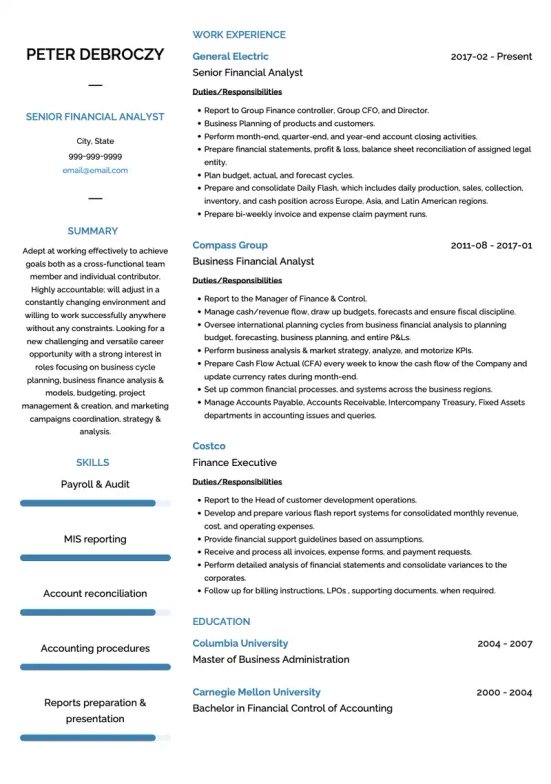
To write a Financial Analyst resume objective that stands out, consider these tips:
• Highlight specific Financial Analyst skills like Excel, VBA, SQL, Tableau, Bloomberg Terminal, Python, or R • Quantify your experience with metrics such as years of experience, number of financial models built, or percentage improvement in forecasting accuracy • Include industry-specific terminology recruiters look for, such as DCF, sensitivity analysis, variance analysis, P&L, EBITDA, ROI, and IFRS/GAAP compliance • Focus on the value you bring to the employer by highlighting measurable results like cost savings, revenue growth, or risk mitigation you have delivered • Keep it concise at 2‑3 lines while showcasing your most relevant qualifications
Below are some Financial Analyst resume objective examples that stand out:
Enthusiastic and high-performing Financial Analyst with extensive experience in finance strategy and project management. Consistent track record for meeting aggressive timelines and budget constraints, while achieving all functionality goals in complex initiatives requiring extensive cross organizational collaboration and the resourceful application of multiple talents.
Highly motivated and result oriented Commerce graduate with years of experience in handling accounting related functions and implementation of accounting. Seeking a Financial Analyst position at your organization.
Pursuing and seeking a role in the finance industry as Financial Analyst to expand my knowledge and fulfill my ambition of becoming an expert in the industry. I am a hardworking, trustworthy individual who has a passion for sales and financial information and enjoys a career in the world of finance.
Enthusiastic and Financial Analyst with extensive experience in financial analysis. Consistent track record for meeting aggressive timelines and budget constraints, while achieving all functionality goals in complex initiatives requiring extensive cross organizational collaboration and the resourceful application of multiple talents. Outgoing, proactive, can work with a heavy scope of information in a fast-paced environment and manage various projects at once.
Confident and Teamwork-oriented Financial Analyst, specializing in cash flow models. Bachelors in Commerce and acquired related Certifications from Corporate Finance Institute.
An aspiring Financial Analyst with expertise in qualitative expertise in Finance, Budgeting, Planning and Forecasting, Business Operations, Financial Modeling, Process Re-engineering, Team Handling & Performance Appraisals, and P&L Analysis. Thrives in a team environment and effectively communicates direction and commits people to action.
Experienced in Monthly business review, forecasting, budgeting, financial modeling & analytics. Financial Planning & Analysis | Process Improvement | Supply Chain Management.
An eager and fast learner individual with capabilities of working independently and learning quickly. Able to work well under pressure, follow instructions well and think on my feet. I find the world of finance very challenging and always strive to break my targets set each month. Pursuing and seeking a Financial Analyst role in the finance industry to expand my knowledge and fulfill my ambition of becoming an expert in the industry.
Accomplished financial analyst with 5+ years of experience in equity research and portfolio management, specializing in advanced financial modeling, variance analysis, and forecasting. Adept at leveraging Excel, VBA, and SQL to deliver actionable insights that drive investment decisions and optimize portfolio performance. Seeking to join a dynamic investment firm where I can apply my analytical expertise to enhance asset allocation strategies and increase return on investment.
Results-oriented analyst with 3 years of experience in data-driven financial planning, utilizing Python, Tableau, and machine learning techniques to uncover market trends and predict financial outcomes. Proven track record of reducing forecasting errors by 15% and streamlining reporting processes for senior leadership. Eager to contribute to a forward-thinking organization by integrating advanced analytics into strategic investment and risk management initiatives.
Strategic financial analyst with 7+ years of experience in corporate finance, budgeting, and stakeholder reporting, known for translating complex financial data into clear, actionable recommendations. Skilled in financial statement analysis, scenario planning, and risk assessment, with a strong ability to communicate findings to executive teams and influence decision-making. Looking to leverage my expertise in a growth-oriented company to support scalable financial strategies and drive sustainable profitability.