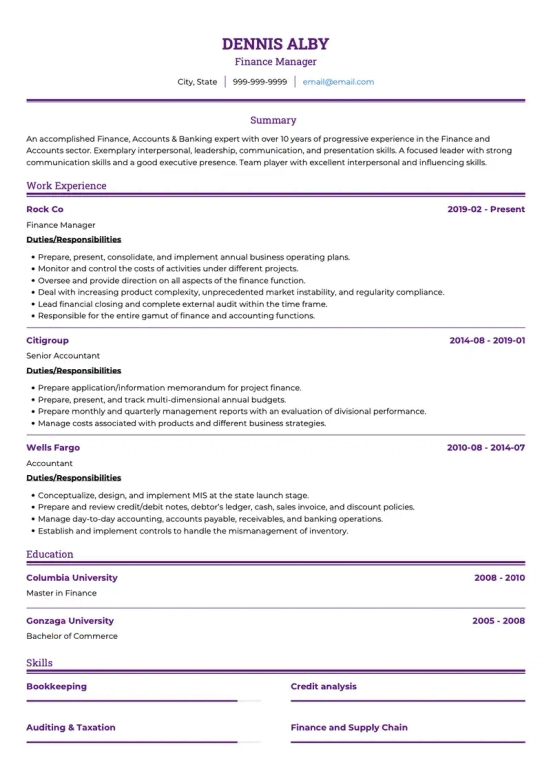
Learn how to effectively list finance manager skills on your resume with real-world examples. Includes top finance manager skills, sample resume phrases, and related skills.

Financial Analysis: Interpreting and evaluating financial data to make informed decisions.
Budgeting: Creating, managing, and monitoring budgets to ensure financial stability.
Accounting: Preparing, analyzing, and maintaining accurate financial records.
Forecasting: Predicting future financial trends and making projections based on data.
Risk Management: Identifying, assessing, and mitigating potential financial risks.
Investment Analysis: Evaluating investment opportunities to maximize returns.
Financial Modeling: Building mathematical models to forecast future performance.
Strategic Planning: Developing long-term plans for achieving organizational goals.
Project Management: Overseeing projects from conception to completion, ensuring they are completed within budget and on time.
Data Analysis: Analyzing complex data sets to make informed financial decisions.
SQL Server: Manipulating and extracting data from databases using this software.
Excel Proficiency: Advanced skills in Microsoft Excel for financial modeling, analysis, and reporting.
Financial Reporting: Preparing and presenting clear, concise, and accurate financial reports to stakeholders.
Tax Compliance: Ensuring that the organization is compliant with all relevant tax laws and regulations.
Auditing: Reviewing financial records to ensure accuracy and compliance with accounting standards.
Cash Management: Overseeing the management of cash flows to maximize liquidity and minimize risk.
Mergers & Acquisitions: Assessing potential deals, conducting due diligence, and integrating acquired entities.
Financial Regulations: Understanding and adhering to financial regulations in various industries.
Leadership: Guiding teams and inspiring them to achieve organizational goals.
Communication: Clearly conveying complex financial information to both technical and non-technical audiences.
Organization: Group skills logically, such as technical skills together and soft skills together.
Phrasing: Use action verbs and quantify accomplishments where possible (e.g., "Increased profitability by 15%").
Specificity: Be specific about the tools, software, or methodologies you've used (e.g., "Excel Proficiency: Created complex financial models using Excel's Solver tool").
Placement: Prioritize skills based on their relevance to the job you're applying for and place them at the top of your resume.
Tailoring: Customize your resume for each job application, highlighting the skills most relevant to that specific position.
Financial Analysis: Conducted comprehensive financial analysis to support strategic decision-making.
Budgeting: Developed and managed annual budgets for multiple departments, achieving a 10% reduction in expenses.
Investment Analysis: Evaluated investment opportunities, resulting in an 18% return on investments.
As a Finance Manager, I oversaw the financial operations of our company, implementing strategies to improve profitability and minimize risk. I conducted comprehensive financial analysis to support strategic decision-making, developed and managed annual budgets for multiple departments, and achieved a 10% reduction in expenses through careful cost management. In addition, I evaluated investment opportunities and made recommendations, resulting in an impressive 18% return on investments.
Skills:
Financial Analysis & Strategy
Developing financial models
Conducting comprehensive analysis
Supporting strategic decision-making
Budgeting & Cost Management
Creating and managing annual budgets
Achieving cost savings
Enhancing financial stability
Investment Analysis & Portfolio Management
Evaluating investment opportunities
Making recommendations
Monitoring and optimizing portfolio performance
Financial Controller
Corporate Finance Manager
Investment Analyst
Chief Financial Officer (CFO)
Financial Planner
Portfolio Manager
Risk Manager
Treasury Manager
Mergers & Acquisitions Analyst
Audit Manager
Business Intelligence: Gathering and analyzing data to drive business decisions.
Financial Forecasting: Predicting future financial performance based on historical data.
Data Visualization: Presenting complex data in a clear and understandable format.
Cash Flow Management: Optimizing cash flow for maximum liquidity.
Tax Planning: Minimizing tax liabilities through strategic planning.
Performance Metrics: Measuring the effectiveness of financial decisions using key performance indicators (KPIs).
Due Diligence: Conducting thorough research before making significant financial decisions.
Financial Regulation Compliance: Ensuring adherence to relevant financial regulations.
Stakeholder Communication: Clearly and effectively communicating financial information to stakeholders.
Strategic Partnerships: Building relationships with key partners to achieve mutual goals.
To minimize the impact of employment gaps, focus on transferable skills and experiences gained during that period, particularly those related to finance management. Highlight any relevant training, self-study, or certifications related to finance management and demonstrate how these new abilities can benefit your potential employer. Consider providing a brief explanation for the gap in a professional manner without getting too personal.
Demonstrate self-taught skills through concrete examples of projects or situations where you successfully applied these abilities, focusing on cost savings, budget management, and financial analysis. Mention any relevant certifications or continuing education courses completed to bolster your expertise.
Address outdated skills by showcasing how you have remained current in the field through ongoing learning and professional development. Include any recent training, workshops, or certifications acquired that focus on modern financial management practices. For older skills, briefly mention them with an emphasis on your continued proficiency and adaptability to new technologies or methodologies.
Aim for a one-page resume when applying for finance manager positions. If you have extensive experience that cannot fit on one page, consider condensing descriptions and focusing on the most relevant information while maintaining readability and organization.
List any in-progress certifications under a separate section called "Certifications (In Progress)" or similar. Include the certification title, name of the issuing organization, and expected completion date if known. This shows potential employers your commitment to ongoing professional development and up-to-date knowledge in the field.
Emphasize relevant skills and transferable experiences from other areas that demonstrate your aptitude for financial management, including any related coursework, projects, or volunteer work in finance. Tailor your cover letter to address how you can apply your unique background and skills to the specific job opening and highlight any aspirations, goals, or achievements that align with the role of a finance manager.
Focus on showcasing specialized skills, accomplishments, and unique value proposition that set you apart from other candidates. Use specific examples, metrics, and case studies in your resume to demonstrate your impact on previous roles. Research the company and tailor your application materials to highlight how your skills align with their needs and goals.
Update your resume every time you gain new skills, acquire a certification, or take part in professional development to ensure it remains accurate and up-to-date.
Absolutely! Side projects and volunteer work can showcase initiative, adaptability, and passion for finance management. Include these experiences in a separate section called "Additional Relevant Experience" or similar, highlighting the skills used, any significant accomplishments, and the impact of your involvement on the project or organization.
Quantify achievements by using numbers, percentages, or monetary values when possible. This can help potential employers understand the scale and scope of your contributions. For example, instead of stating "successfully implemented new financial systems," write "reduced accounting errors by 85% through implementation of an automated financial system."
Copyright ©2025 Workstory Inc.