Assistant Manager Resume Objective Examples
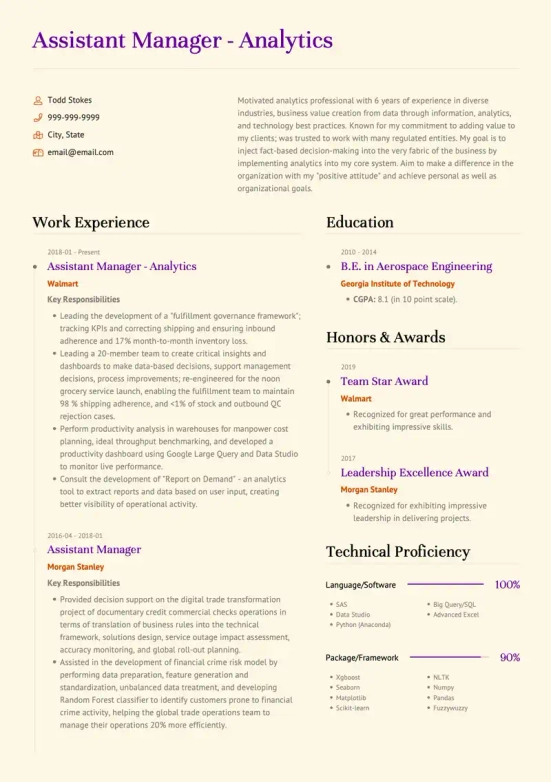
To write a Assistant Manager resume objective that stands out, consider these tips:
• Start with a concise statement that declares your goal to secure an Assistant Manager position • Highlight leadership skills such as team coordination, performance coaching, and conflict resolution • Mention proficiency with POS platforms (e.g., Shopify, Lightspeed) and inventory tools (e.g., TradeGecko, Vend) • Cite any retail certifications (e.g., Certified Retail Manager, Lean Six Sigma Green Belt) that demonstrate industry expertise • Quantify achievements with numbers, such as sales growth percentages, cost‑saving amounts, or staff‑retention improvements • Incorporate key industry terms like “margin optimization,” “inventory turnover,” “customer satisfaction index,” and “cross‑functional collaboration” • Keep the objective to 2–3 brief sentences, focusing on the value you will bring rather than personal career goals
Below are some Assistant Manager resume objective examples that stand out:
Assistant Manager Resume Objective Examples
Dedicated, highly motivated Assistant Manager offering significant experience in Sales, Customer Service, and Team Support. Proven interpersonal, communication and multitasking skills. Adaptable team player recognized for his willingness to learn and teach newly acquired skills.
People-focused Assistant Manager and team builder, who drives results through creativity, initiative, and strong leadership. Forward-thinking in addressing and resolving concerns, optimizing policies and engaging with customers to promote loyalty and drives the overall success of the business.
Responsible Assistant Manager with top-notch skills. Organized, passionate and a reliable hard worker.
Experienced Assistant Marketing Manager with a demonstrated history of working in diverse fields such as Content Management, Market Research, Data Analysis, Business Development and Client Relationship Management.
Seeking to obtain an Assistant Manager position, which will provide challenge, valuable supervisory experience, and opportunity for career advancement.
Currently seeking an Assistant Manager position. I am an enthusiastic individual with superior skills in working in both team-based and independent capacities. I am excited to begin new challenges with a successful team. I am bringing a strong work ethic and excellent organizational skills to any setting. I am a fast learner at new tasks that are thrown my way and will accomplish to the fullest extent.
Currently working as an Assistant Manager and looking to progress into a senior management position within the Oil & Gas Industry. Through utilizing my skills when working in leadership positions I have developed successful working relationships and leadership skills.
Leveraging over five years of progressive leadership experience in fast‑paced retail environments, I excel at coordinating cross‑functional teams to exceed sales targets and improve operational efficiency. My proven track record in inventory management and staff training has consistently reduced shrinkage by 12% while boosting customer satisfaction scores. I am eager to bring my data‑driven approach and strategic mindset to an Assistant Manager role where I can contribute to sustained growth and profitability.
With four years of hands‑on experience in hospitality operations, I specialize in streamlining processes, managing cost controls, and enhancing guest experiences. I have successfully implemented lean service protocols that decreased wait times by 20% and increased repeat patronage. Seeking an Assistant Manager position where I can leverage my analytical skills and passion for continuous improvement to elevate service standards and drive revenue.
I bring a blend of 6+ years in frontline management and a strong focus on talent development, having mentored over 30 staff members to achieve certification and performance excellence. My expertise in scheduling optimization and conflict resolution has consistently improved team morale and reduced turnover by 15%. I aim to join an organization as an Assistant Manager where I can harness my people‑first leadership style and technology proficiency to deliver superior customer service and operational excellence.